
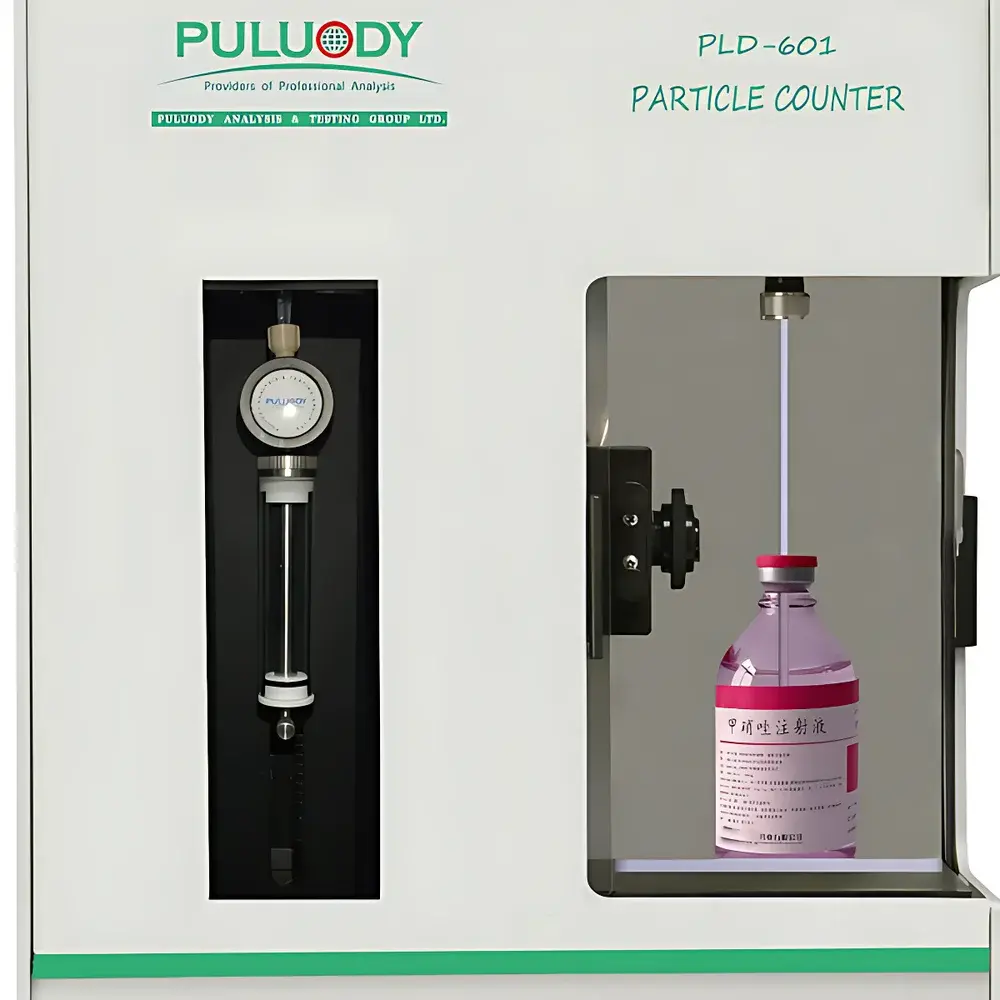
PULUODY PLD-601XY Sterile Blood Bag Insoluble Particle Counter
| Brand | PULUODY |
|---|---|
| Origin | Shaanxi, China |
| Model | PLD-601XY |
| Instrument Type | Optical Particle Counter (Light Obscuration Principle) |
| Detection Range | 1–450 µm (optional extended range: 0.03–3000 µm) |
| Channel Count | 1000 customizable size channels (down to 0.01 µm resolution) |
| Flow Control | Dual-precision metering piston pump + ultra-precise electromagnetic flow control system |
| Compliance | USP <788>, <789>, <797> |
Overview
The PULUODY PLD-601XY Sterile Blood Bag Insoluble Particle Counter is a high-precision optical particle counter engineered for regulatory-compliant particulate analysis of parenteral pharmaceuticals, medical devices, and critical liquid systems. It operates on the light obscuration (LO) principle—where particles suspended in a liquid stream pass through a focused laser beam, generating transient shadows proportional to their cross-sectional area. These pulse signals are digitized and classified into user-defined size bins with sub-micron resolution. Designed specifically for sterility-critical applications, the instrument meets stringent requirements for testing single-use sterile blood bags, IV containers, infusion sets, and associated packaging components per global pharmacopoeial standards including USP , ChP 0903, and EP 10.0. Its dual-laser narrow-beam sensor architecture minimizes coincidence error and improves counting accuracy at high particle concentrations (>1000 particles/mL), while maintaining robust performance across temperature-sensitive biological matrices from 0 °C to 80 °C.
Key Features
- Eighth-generation dual-laser narrow-beam optical sensor with 0.01 µm effective resolution and 1000 programmable detection channels
- Dual-flow precision control system: high-accuracy metering piston pump (±1% volumetric repeatability) coupled with closed-loop electromagnetic flow regulation (5–150 mL/min sample flow; 5–500 mL/min rinse flow)
- FDA 21 CFR Part 11-compliant V8.9 analytical software with full audit trail, electronic signatures, and five-tier role-based access control (administrator, supervisor, analyst, reviewer, auditor)
- Preloaded and customizable test methods aligned with USP , ChP 2020 Appendix 0903, EP 10.0, ISO 21501-4, and GB/T 11446.9–2013
- Touchscreen interface with bilingual (English/Chinese) operation and real-time graphical display of particle distribution histograms, cumulative counts, and pass/fail status against defined thresholds
- Traceable calibration support via National Defense Science & Technology Commission Level-1 Particle Metrology Station No. 116 or China National Institute of Metrology Northwest Center
Sample Compatibility & Compliance
The PLD-601XY accommodates a broad spectrum of liquid samples requiring particulate contamination assessment under Good Manufacturing Practice (GMP) and Good Laboratory Practice (GLP) frameworks. Validated use cases include sterile aqueous solutions (e.g., injectables, ophthalmic preparations, vaccines), lyophilized powder reconstitutes, water-for-injection (WFI), purified water (PW), ultra-pure water (UPW), semiconductor slurries (CMP), nanomaterial dispersions, and cleaning agents used in aseptic processing environments. It supports filter integrity verification—including terminal sterilizing-grade filters—and quantifies particle removal efficiency per ASTM F838 or ISO 13408-2. All hardware and firmware configurations comply with ISO/IEC 17025 documentation requirements for accredited laboratories and satisfy data integrity expectations outlined in MHRA, EMA, and PMDA guidance documents.
Software & Data Management
The integrated V8.9 software platform provides comprehensive data acquisition, statistical reporting, and long-term archival functionality. Raw pulse data, channel histograms, and metadata (operator ID, timestamp, environmental conditions, instrument configuration) are stored in encrypted binary format with optional SQL database export. Automated report generation includes compliance-ready PDF summaries with embedded electronic signatures, revision history, and deviation flags. Data backup and restoration are fully supported without loss of audit trail continuity. System validation packages—including IQ/OQ/PQ templates, risk assessments (FMEA), and URS alignment documentation—are available upon request to facilitate 21 CFR Part 11 and Annex 11 implementation.
Applications
- Pharmaceutical Quality Control: Quantitative insoluble particle testing of sterile blood bags, IV bags, syringes, stoppers, and tubing per YBB00272004-2015 and GB 8368
- Medical Device Evaluation: Filter challenge studies, extractables/leachables particulate screening, and biocompatibility-related debris analysis
- Water Systems Monitoring: Routine monitoring of WFI, PW, UPW, and clean steam condensate in pharmaceutical manufacturing facilities
- Semiconductor & Advanced Materials: Slurry stability assessment, wafer cleaning solution purity verification, and nanoparticle dispersion uniformity testing
- Industrial Hygiene & Maintenance: Wear debris analysis in hydraulic fluids, lubricants, and process coolants per ISO 4406 and NAS 1638
FAQ
Does the PLD-601XY meet USP requirements for injectable product testing?
Yes—the instrument’s optical design, flow dynamics, and software algorithms are validated against USP Annex guidelines for light obscuration methodology, including sensitivity verification using NIST-traceable polystyrene latex standards.
Can the system be calibrated by an external accredited laboratory?
Absolutely—PULUODY maintains formal collaboration agreements with national metrology institutes, including the China National Institute of Metrology (CNIM) and the National Defense Science & Technology Commission Particle Metrology Station No. 116, ensuring traceability to SI units.
Is raw pulse data export supported for secondary analysis?
Yes—full-resolution pulse height data (amplitude vs. time) can be exported in CSV or HDF5 format for advanced statistical modeling or machine learning applications.
What maintenance intervals are recommended for routine operation?
Daily system flush with filtered isopropanol followed by ultrapure water; quarterly optical path inspection and sensor alignment verification; annual full metrological recalibration recommended for GMP-regulated environments.
How does the dual-laser configuration improve measurement reliability compared to single-beam systems?
Dual orthogonal laser beams enable simultaneous signal acquisition, reducing false positives from air bubbles or refractive index anomalies while improving sizing linearity across the 1–450 µm dynamic range.



