
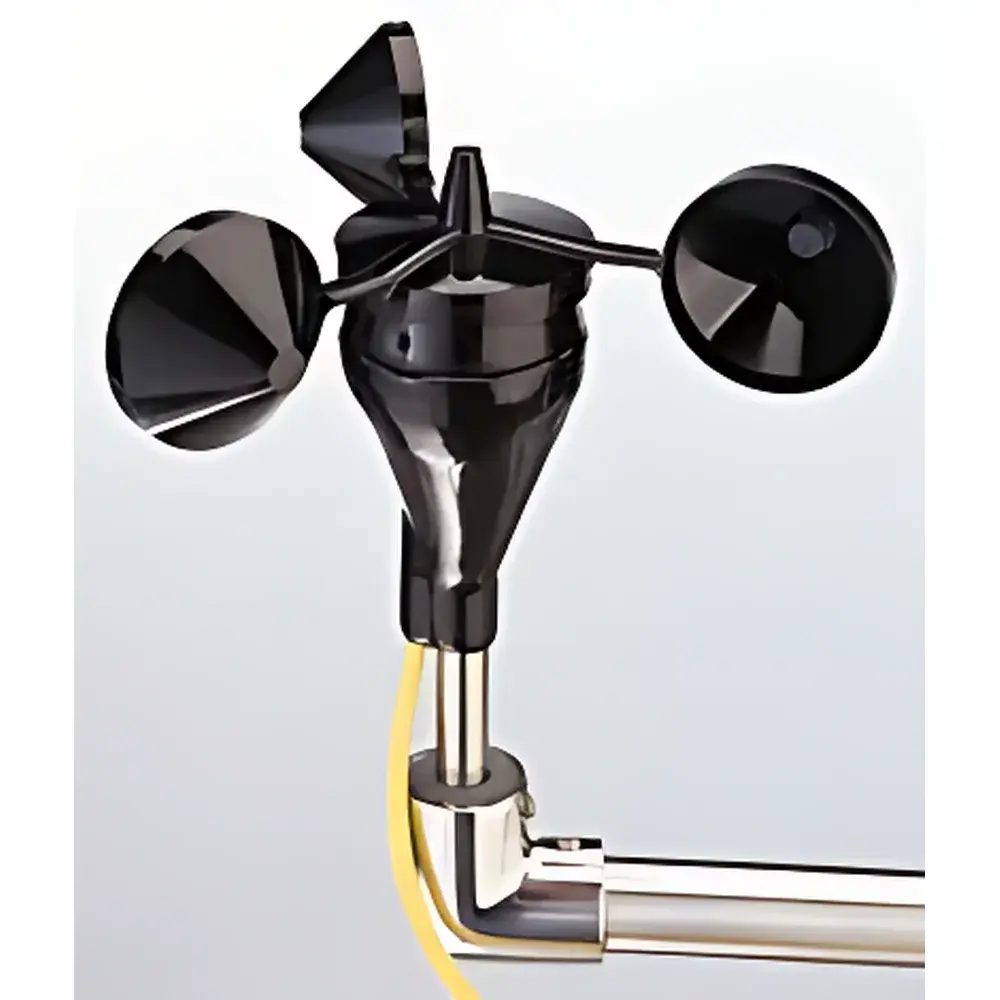
GW WE550 Cup Anemometer
| Brand | GW |
|---|---|
| Origin | USA |
| Manufacturer Type | Authorized Distributor |
| Origin Category | Imported |
| Model | WE550 |
| Price | Upon Request |
| Type | Three-Cup Anemometer |
| Threshold Wind Speed | <1.35 m/s |
| Output Signal | 4–20 mA (2-wire loop-powered) |
| Wind Speed Range | 0–50 m/s |
| Accuracy | ±0.09 m/s (within 4.9–24.6 m/s range) |
| Operating Voltage | 10–36 VDC |
| Warm-up Time | ≥3 s |
| Operating Temperature | −40 °C to +55 °C |
| Dimensions | Ø180 mm × 216 mm (H) |
| Weight | 0.5 kg |
| Standard Configuration | WE550 sensor unit, printed user manual |
| Key Construction Features | Marine-grade cable, fully potted electronics, 1-inch NPT mounting thread |
Overview
The GW WE550 Cup Anemometer is a precision-engineered, industrial-grade three-cup rotational anemometer designed for continuous, long-term wind speed measurement in demanding environmental and meteorological applications. Based on the classical cup-rotor principle—where wind-induced torque on hemispherical cups drives a low-inertia shaft coupled to a calibrated magnetic or hall-effect transducer—the WE550 delivers stable analog output proportional to instantaneous wind velocity. Its robust mechanical design adheres to IEC 61400-12-1 and WMO Guide to Meteorological Instruments and Methods of Observation (CIMO Guide) recommendations for cup anemometer performance under turbulent and low-wind conditions. The sensor operates without internal signal conditioning or digital processing; instead, it relies on a passive, linear 4–20 mA current loop output, ensuring intrinsic compatibility with SCADA systems, PLCs, data loggers, and building management systems (BMS) compliant with ISA-50.00.01 (formerly ANSI/ISA-50.00.01) analog signal standards.
Key Features
- Three-hemispherical aluminum alloy cups mounted on precision-balanced fiberglass arms for minimal starting inertia and consistent aerodynamic response
- Fully potted electronic assembly encapsulated in epoxy resin, providing IP67-rated protection against moisture, salt fog, dust, and thermal cycling
- Marine-grade, UV-stabilized, tinned-copper shielded cable (standard length: 10 m) with abrasion-resistant polyurethane jacket rated for −40 °C to +80 °C ambient exposure
- 1-inch NPT male threaded mounting interface compatible with standard mast adapters, rooftop brackets, and structural flanges per ASME B1.20.1
- Low threshold wind speed (<1.35 m/s) ensures reliable detection of light breezes critical for boundary-layer studies and HVAC intake monitoring
- Stable 4–20 mA output referenced to loop supply voltage, eliminating need for external power supplies or signal isolators in most field installations
Sample Compatibility & Compliance
The WE550 is intended for gaseous media only—primarily ambient air—and is not rated for use in corrosive, explosive, or particulate-laden environments exceeding ISO 14644-1 Class 8 cleanroom particulate limits. It complies with electromagnetic compatibility requirements per EN 61326-1 (industrial environment), meets RoHS 2011/65/EU directive for hazardous substances, and carries CE marking for conformity with EU Measuring Instruments Directive (MID) Annex MI-004 for anemometers used in legally regulated applications. While not certified to NIST-traceable calibration standards out-of-box, the device supports field recalibration using NIST-traceable reference anemometers per ASTM D5096–22 (Standard Practice for Calibration of Anemometers). Documentation includes a factory calibration certificate listing as-received sensitivity (mA/(m/s)) and linearity deviation across the 0–50 m/s range.
Software & Data Management
As a purely analog-output instrument, the WE550 requires no embedded firmware, driver installation, or proprietary software. Integration into digital infrastructure occurs at the acquisition layer: the 4–20 mA signal is digitized via a calibrated analog input module (e.g., Campbell Scientific CR1000X, Siemens Desigo PX, or National Instruments cDAQ-9174 with NI 9203). All time-series wind speed data inherit the timestamping, audit trail, and storage protocols of the host system. For users operating under FDA 21 CFR Part 11 or ISO/IEC 17025 quality frameworks, full traceability is maintained when paired with data loggers supporting electronic signatures, change logs, and secure user access control. No configuration file or firmware update is applicable—ensuring zero risk of version drift or cybersecurity vulnerability associated with networked sensors.
Applications
- Continuous wind monitoring at weather stations, airport wind shear detection zones, and renewable energy sites (pre-construction wind resource assessment and turbine yaw control feedback)
- Industrial stack emission monitoring where volumetric flow rate derivation requires accurate inlet wind speed input per EPA Method 2 (Determination of Stack Gas Velocity and Volumetric Flow Rate)
- Building envelope testing and natural ventilation performance validation in accordance with ASHRAE Standard 119 and ISO 16745-1
- Outdoor laboratory test beds for aerodynamic modeling, urban microclimate studies, and wildfire behavior simulation platforms
- Marine vessel mast instrumentation for navigational safety and dynamic stability analysis under IMO MSC.1/Circ.1580 guidance
FAQ
Is the WE550 suitable for outdoor installation in freezing climates?
Yes. Its operating temperature range extends from −40 °C to +55 °C, and the fully potted electronics prevent condensation ingress or thermal shock failure during rapid freeze-thaw cycles.
Does it require periodic recalibration?
Per ISO/IEC 17025 and manufacturer recommendation, annual verification against a traceable reference standard is advised for applications requiring metrological confidence.
Can the 4–20 mA output be converted to digital protocols like Modbus or SDI-12?
Yes—using commercially available analog-to-digital gateways (e.g., Advantech ECU-1051 or Onset HOBO U-DT-2) that maintain signal integrity and add protocol translation without altering native accuracy.
What mounting hardware is included?
The standard delivery includes only the sensor body with integrated 1-inch NPT male thread; mast clamps, leveling bases, and lightning protection are specified separately per site engineering requirements.
Is there a digital output option available for the WE550?
No. The WE550 is strictly an analog-only device. For digital variants (RS-485, SDI-12, or pulse output), consult GW’s WE550-D series, which shares identical mechanical specifications but incorporates onboard signal conversion.
Related Products







