
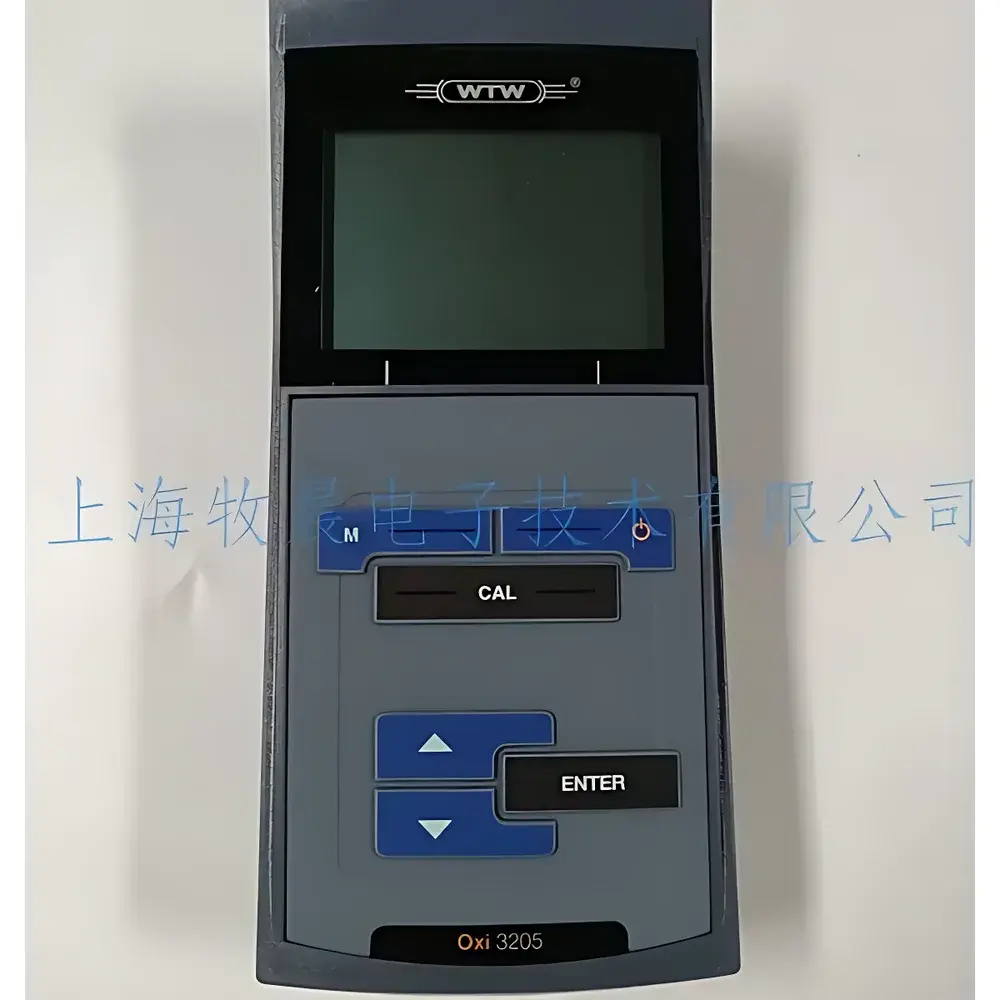
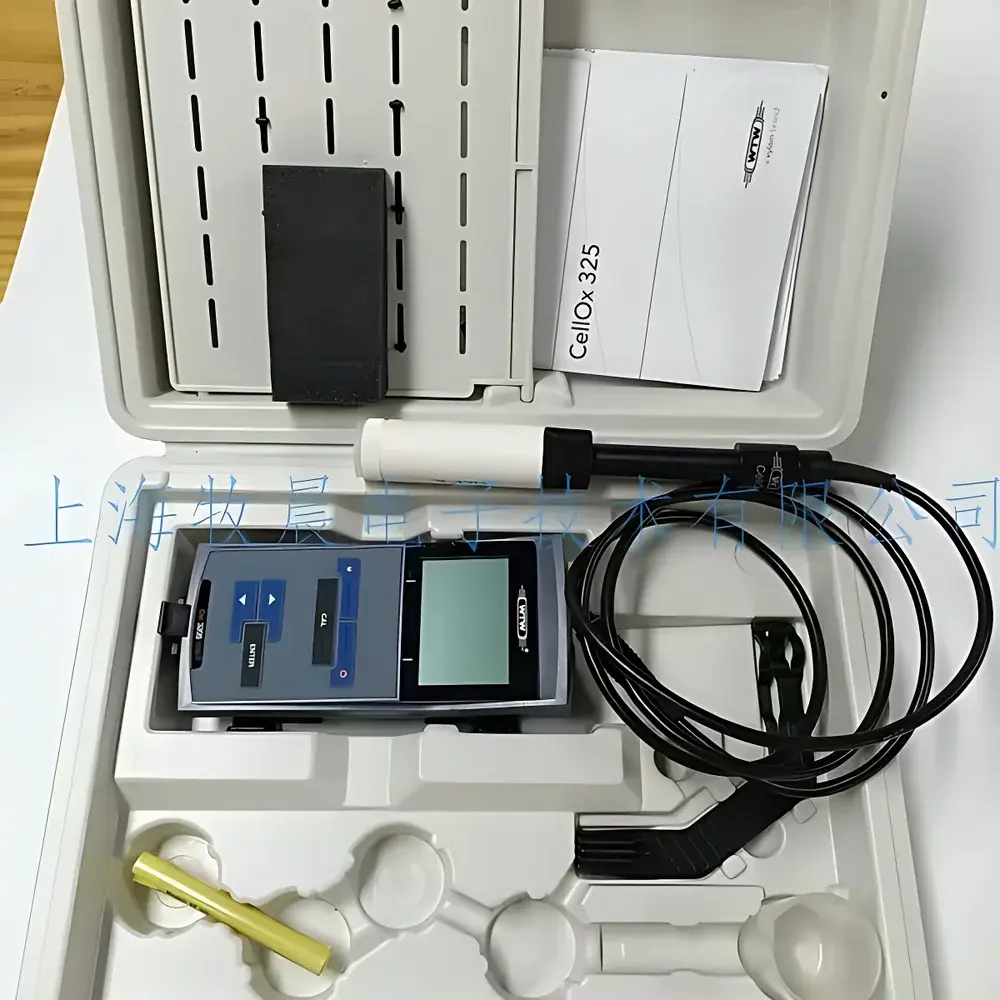
WTW Oxi 3205 Portable Dissolved Oxygen Meter
| Brand | WTW |
|---|---|
| Origin | Germany |
| Model | Oxi 3205 |
| Measurement Principle | Electrochemical (Clark-type polarographic sensor) |
| DO Range | 0.00–19.99 mg/L (±0.5% of reading), up to 90 mg/L |
| Saturation Range | 0.0–199.9% (±0.5%), up to 600% |
| Partial Pressure Range | 0–199.9 hPa / 0–1250 hPa (±0.5%) |
| Temperature Range | −5.0 to +105.0 °C (±0.1 °C) |
| IP Rating | IP66/IP67 |
| Power | 4×AA alkaline batteries (2500 h continuous operation) |
| Dimensions | 180 × 80 × 55 mm (H×W×D) |
| Weight | ~400 g |
Overview
The WTW Oxi 3205 is a rugged, field-deployable dissolved oxygen (DO) meter engineered for high-reliability environmental and process water quality monitoring. It operates on the Clark-type polarographic principle—utilizing a membrane-covered electrochemical cell with a cathode (typically gold or platinum) and anode (silver/silver chloride), immersed in electrolyte solution. Molecular oxygen diffuses through a gas-permeable membrane and is reduced at the cathode surface, generating a current linearly proportional to the partial pressure of dissolved oxygen. This analog signal is digitized, temperature-compensated (via integrated NTC thermistor), and converted into concentration (mg/L), saturation (%), or partial pressure (hPa) units. Designed for trace-level precision in variable ambient conditions, the Oxi 3205 delivers stable readings across freshwater, seawater, wastewater, and industrial process streams—without requiring frequent recalibration or electrode refurbishment.
Key Features
- Triple-parameter measurement: simultaneous display of dissolved oxygen (mg/L), saturation (%), and temperature (°C) with 0.01 mg/L resolution
- Compatible with WTW’s standardized CellOx 325 (membrane-based) and DurOx 325 (robust, long-life) polarographic probes—including 3-m cable variants for depth profiling
- High-contrast 7-segment LCD with backlight—optimized for outdoor readability under direct sunlight or low-light conditions
- IP66/IP67-rated housing (IEC 60529): fully dust-tight and submersible up to 1 m for 30 minutes; silicone keypad provides 100% waterproof tactile feedback
- Automatic temperature compensation (ATC) using integrated NTC sensor; automatic endpoint detection for rapid, reproducible measurements (repeatability < 0.05 mg/L)
- Built-in calibration timer and electrode health indicator—displays real-time status post-calibration using saturated air or zero-oxygen solutions
- Extended battery life: up to 2500 hours on four AA alkaline cells; optional rechargeable NiMH support; removable, sealed battery compartment
- User-configurable auto-off delay (10 min to 24 h); low-power sleep mode preserves measurement integrity during intermittent use
Sample Compatibility & Compliance
The Oxi 3205 supports routine analysis of diverse aqueous matrices including surface water (rivers, lakes, estuaries), groundwater, municipal and industrial wastewater effluents, aquaculture systems, pharmaceutical process water, food & beverage rinse solutions, swimming pools, and drinking water distribution networks. Its polarographic sensor design accommodates variable salinity (0–70.0 PSU) and barometric pressure (500–1100 mbar), applying automatic compensation algorithms per ISO 5814:2012 and ASTM D888-12 standards. While the instrument itself does not include onboard data logging, its analog output interface enables integration with external SCADA or LIMS platforms compliant with EPA Method 360.1 and EN 25814. The device meets CE marking requirements under the EU Electromagnetic Compatibility Directive 2014/30/EU and Low Voltage Directive 2014/35/EU.
Software & Data Management
The Oxi 3205 operates as a standalone, firmware-controlled measurement platform—requiring no PC connectivity for core functionality. Calibration history (date, method, offset, slope) is retained in non-volatile memory and accessible via menu navigation. Firmware updates are delivered via USB-to-serial adapter and WTW LabX® Light software (included on CD-ROM), supporting version control and configuration backup. Although internal storage is not provided, all calibration and operational parameters adhere to GLP traceability principles: timestamps, operator ID fields (user-definable), and sensor identification codes are embedded in service logs. For regulated environments (e.g., pharmaceutical water system validation), the device may be deployed within 21 CFR Part 11-compliant workflows when paired with validated third-party data acquisition modules that enforce electronic signatures and audit trails.
Applications
- Environmental field surveys: longitudinal DO profiling in rivers, tidal zones, and reservoirs to assess eutrophication risk and BOD loading
- Wastewater treatment plant monitoring: aeration basin control, secondary clarifier effluent verification, and nitrification/denitrification process optimization
- Aquaculture management: real-time DO surveillance in hatcheries, raceways, and recirculating aquaculture systems (RAS) to prevent hypoxia stress
- Pharmaceutical water systems: periodic verification of purified water (PW) and water for injection (WFI) storage loop DO levels per USP
- Food & beverage QA/QC: dissolved oxygen testing in carbonated beverages, brewing wort, and pasteurized dairy product lines to monitor oxidation potential
- Drinking water safety: compliance checks for residual oxygen in distribution networks and booster station outputs per WHO Guidelines for Drinking-water Quality
FAQ
What calibration methods does the Oxi 3205 support?
It supports two-point calibration: zero-oxygen (sodium sulfite solution) and saturated air (100% relative humidity at ambient pressure). Automatic air-saturation calculation adjusts for local barometric pressure and temperature.
Can the Oxi 3205 measure DO in seawater?
Yes—built-in salinity compensation (0–70.0 PSU) corrects for ionic strength effects on oxygen solubility, enabling accurate reporting per UNESCO 1983 solubility equations.
Is the instrument suitable for GMP-regulated laboratories?
While the base unit lacks audit-trail logging, it is routinely deployed in GMP environments when used with external validated data capture systems that meet Annex 11 and 21 CFR Part 11 requirements.
How often should the sensor membrane be replaced?
Typical replacement interval is every 2–3 months under continuous use; longer intervals apply in clean, low-fouling applications. Each SET kit includes spare membranes, electrolyte, and polishing tools for on-site maintenance.
Does the Oxi 3205 require annual factory recalibration?
No—its analog signal path and reference electrode stability allow user-performed verification against certified standards. Factory recalibration is recommended only after physical damage or performance drift exceeding ±0.5% of reading.







