
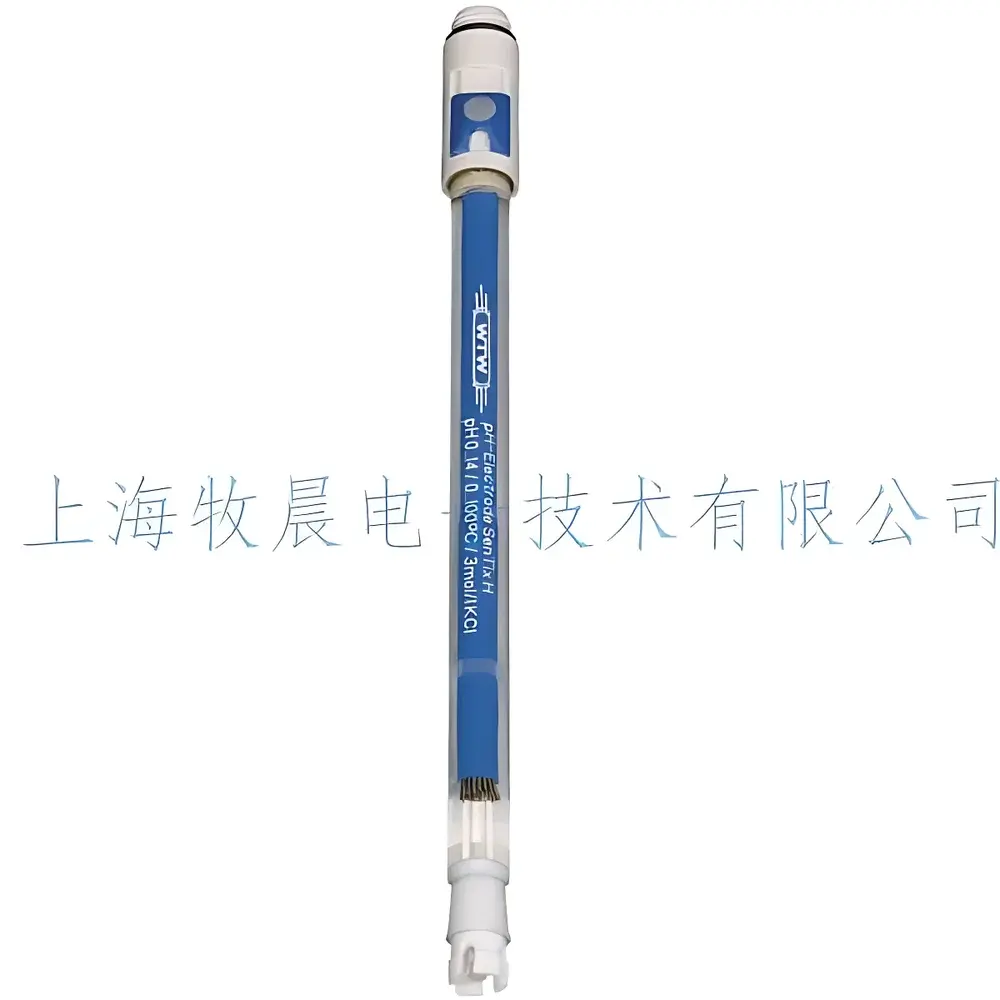
WTW SenTix HW Pure-Water pH Combination Electrode
| Brand | WTW |
|---|---|
| Origin | Germany |
| Model | SenTix HW |
| Instrument Type | Portable |
| Parameter Type | Single-Parameter |
| Reference Electrolyte | 3 mol/L KCl (Ag⁺-free) |
| Membrane Shape | Cylindrical |
| Shaft Material | High-Quality Glass |
| Shaft Length | 170 mm |
| Shaft Diameter | 12 mm |
| Connection | S7 Plug (Cable Not Included) |
| Temperature Sensor | None |
| Membrane Resistance | < 800 MΩ |
| pH Range | 0–14 |
| Operating Temperature | 0–60 °C |
| Diaphragm Type | Ground-Joint (Fritless, Low-Flow) |
| Electrolyte Reservoir | Large-Volume Refillable Chamber |
| Flow Adjustment | Adjustable Annular Junction |
Overview
The WTW SenTix HW is a high-precision, refillable combination pH electrode engineered specifically for reliable measurement in low-conductivity aqueous media—particularly ultrapure water, boiler feedwater, condensate, distilled water, and other ion-deficient solutions where conventional pH electrodes suffer from unstable potentials, slow response, and junction clogging. Unlike standard gel-filled or polymer-junction electrodes, the SenTix HW employs a robust cylindrical glass membrane with a ground-joint diaphragm and a large-volume, user-refillable electrolyte reservoir containing 3 mol/L KCl (silver-free), ensuring stable liquid junction potential and minimal diffusion potential drift. Its design adheres to electrochemical principles governing the Nernst equation under low-ionic-strength conditions, where junction potential stability and reproducible electrolyte outflow are critical to measurement integrity. The absence of an integrated temperature sensor reflects its dedicated use in applications where temperature is monitored separately or held constant—consistent with ISO 7027, ASTM D1293, and USP guidelines for pH measurement in purified water systems.
Key Features
- Refillable 3 mol/L KCl electrolyte system with adjustable annular junction—enables precise control of electrolyte outflow rate to optimize stability in ultra-low-conductivity samples (e.g., < 1 µS/cm).
- Cylindrical ground-joint diaphragm—eliminates frit-based clogging, resists fouling from colloids, proteins, sulfides, and suspended solids, and ensures consistent junction potential over extended use.
- High-quality borosilicate glass shaft (170 mm length, 12 mm diameter)—mechanically robust, chemically inert, and optimized for thermal and electrical stability in laboratory and industrial process environments.
- S7 plug interface—compatible with WTW handheld meters (e.g., Multi 3630 IDS, pH 3310) and benchtop analyzers supporting S7 analog input; cable-free modular design simplifies calibration and maintenance.
- No integrated Pt1000 or NTC sensor—intentionally omitted to reduce thermal mass and avoid measurement artifacts in temperature-controlled pure-water applications per DIN EN ISO 17025-compliant workflows.
- Ag⁺-free reference system—complies with pharmaceutical and food-grade requirements where silver leaching must be avoided (e.g., USP , EP 2.2.3, and FDA CGMP Annex 11 data integrity expectations).
Sample Compatibility & Compliance
The SenTix HW demonstrates exceptional performance across diverse low-conductivity and heterogeneous matrices: deionized and distilled water, boiler feedwater, condensate, rainwater, lake and surface water (low-TDS), seawater dilutions, saline solutions, soil extracts, fruit and vegetable juices, dairy products (milk, yogurt, quark), beverages (beer, soft drinks, wine), cosmetic formulations (shampoos, rinses, lotions), cleaning agents, coffee and tea extracts, honey, vinegar, and biological fluids (serum, urine, Tris buffers, enzyme solutions, gastric fluid). It meets functional requirements outlined in ISO 15235 (electrochemical sensors for water analysis), ASTM D1293 (pH of water), and EU Pharmacopoeia 2.2.3. Its Ag⁺-free construction supports compliance with ICH Q5C (protein stability) and avoids interference in protein-rich or sulfide-containing samples where silver precipitation would otherwise compromise reference stability.
Software & Data Management
When paired with WTW’s IDS-enabled instruments (e.g., Multi 3630 IDS), the SenTix HW supports full digital traceability: automatic electrode recognition, calibration history logging (including buffer IDs, dates, slopes, and asymmetry potentials), and GLP/GMP-compliant audit trails. Data export complies with FDA 21 CFR Part 11 requirements when used with validated WTW LabX software—enabling electronic signatures, user access controls, and immutable calibration records. No firmware update is required for electrode identification; the S7 interface transmits passive hardware metadata only, preserving measurement integrity without embedded processing.
Applications
- Pharmaceutical water systems: USP Purified Water (PW) and Water for Injection (WFI) monitoring per and Annex 1.
- Power generation: Real-time pH control of steam-cycle condensate and feedwater to prevent corrosion and silica carryover.
- Food & beverage QA/QC: pH verification of acidic beverages, dairy fermentations, and juice concentrates where low ionic strength and organic fouling challenge conventional electrodes.
- Environmental labs: Monitoring of oligotrophic surface waters, acid rain studies, and low-salinity estuarine samples.
- Research laboratories: Long-term stability testing of enzyme buffers, protein solutions, and cell culture media requiring drift-free baseline measurements.
- Electroplating & textile dyeing: pH control in sulfide-rich or surfactant-laden baths where junction clogging is common.
FAQ
Is the SenTix HW compatible with non-WTW meters?
Yes—provided the meter accepts S7 analog input (±400 mV, high-impedance) and supports manual calibration; however, digital features (auto-recognition, IDS logging) require WTW IDS-compatible instruments.
Why is the temperature sensor omitted?
To minimize thermal lag and eliminate thermoelectric noise in precisely temperature-controlled pure-water systems—consistent with ISO 17025 uncertainty budgets for pH in low-conductivity media.
How often should the electrolyte be refilled?
Refill frequency depends on usage intensity and sample matrix; under typical lab conditions (5–10 measurements/day), replenishment every 2–4 weeks maintains optimal junction stability and response time.
Can it be used in protein-rich or viscous samples?
Yes—the ground-joint diaphragm resists clogging better than ceramic or fiber junctions, and the adjustable flow prevents back-diffusion of sample into the electrolyte chamber.
Does it meet FDA or EU regulatory requirements for GMP environments?
Yes—its Ag⁺-free construction, documented calibration traceability, and compatibility with 21 CFR Part 11–validated software fulfill core instrumentation requirements for regulated pharmaceutical and biotech manufacturing.




