
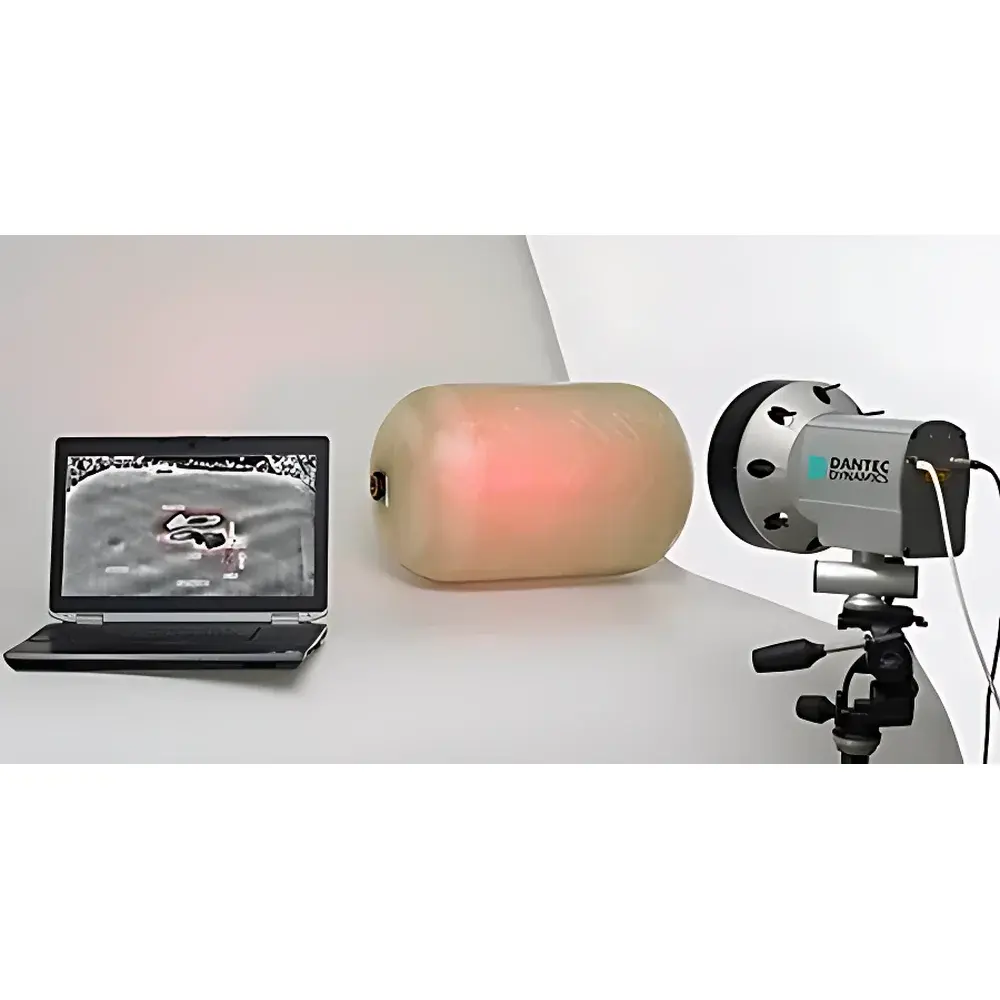
Dantec Dynamics Q-800 Shearography NDT System
| Brand | Dantec Dynamics |
|---|---|
| Origin | Germany |
| Model | Q-800 |
| Excitation Compatibility | Thermal, Vacuum, Vibration |
| Measurement Principle | Laser Speckle Shearing Interferometry |
| Field of View | Configurable from 10 × 10 cm to 2 m² |
| Acquisition Time | ≤30 s per 2 m² area |
| Compliance | NAS410 / EN4179 certified methodology |
| Target Materials | CFRP, aluminum alloys, honeycomb composites, bonded structures |
| Defect Sensitivity | Delaminations, disbonds, wrinkles, impact damage, core crush, foreign object inclusions, voids, moisture ingress, repair anomalies |
Overview
The Dantec Dynamics Q-800 Shearography NDT System is a high-speed, full-field optical inspection platform engineered for quantitative non-destructive evaluation of structural integrity in advanced materials. It operates on the principle of laser speckle shearing interferometry—a coherent optical technique that measures surface displacement gradients induced by controlled external stimulation. Unlike point-wise or scanning methods, shearography captures instantaneous deformation fields across large areas with sub-micron sensitivity to out-of-plane strain differentials. This enables rapid detection of subsurface discontinuities without physical contact, ionizing radiation, or coupling media. The system is purpose-built for aerospace, wind energy, automotive composites, and defense applications where certification-grade repeatability, traceable measurement uncertainty, and compliance with airworthiness directives are mandatory.
Key Features
- Modular excitation architecture supporting thermal (flash lamp or halogen), vacuum (chamber or portable suction), and mechanical vibration (electrodynamic shaker) stimuli—enabling defect contrast optimization across diverse material systems and layup configurations.
- Two sensor configurations: dual-laser (Q-800-2) and octal-laser (Q-800-8) heads, delivering scalable spatial resolution and field coverage—from localized QA verification to full-panel production-line screening.
- Real-time phase map generation with hardware-accelerated fringe analysis; raw interferograms processed onboard FPGA for latency <50 ms per frame.
- Ruggedized industrial design compliant with IP54 environmental rating; operational temperature range: 10–35 °C; relative humidity tolerance up to 80% non-condensing.
- Integrated calibration routines traceable to NIST-certified displacement standards; automatic focus and alignment compensation via motorized lens assembly and active beam stabilization.
Sample Compatibility & Compliance
The Q-800 demonstrates proven efficacy on carbon fiber reinforced polymer (CFRP) laminates, aluminum honeycomb sandwich panels, adhesive-bonded joints, thermoplastic composites, and hybrid metal-composite assemblies. Its insensitivity to surface finish, paint layers, or minor contamination makes it suitable for in-process inspection and post-repair verification. Methodology adheres to NAS410 Rev. 5 and EN4179 Section 8.3.2 for shearographic NDT personnel qualification and procedure validation. Data acquisition workflows support GLP/GMP-aligned documentation requirements, including audit trails, user authentication, and electronic signature capability per FDA 21 CFR Part 11 when deployed with validated software configuration.
Software & Data Management
FlawExplorer™ v5.2 software provides intuitive workflow navigation—from setup and stimulus synchronization to defect annotation, report generation, and database archiving. All measurements are stored in vendor-neutral HDF5 format with embedded metadata (stimulus parameters, camera settings, calibration coefficients, operator ID, timestamp). Export options include ASTM E2373-compliant XML reports, PDF summary documents with annotated fringe maps, and CSV files for statistical process control (SPC) integration. Batch processing mode enables automated comparison against reference baselines for trend analysis across serial production lots.
Applications
- Aerospace: Detection of disbonds in wing skins, delamination in empennage structures, impact damage assessment in radomes and fairings.
- Wind Energy: Inspection of blade root joints, trailing edge bonds, and spar cap adhesion in GFRP/CFRP blades.
- Automotive: Validation of adhesive curing in battery enclosure bonding, structural bonding of aluminum space frames, and CFRP crash box integrity.
- R&D Labs: Quantitative characterization of interlaminar fracture toughness, fatigue crack initiation mapping, and thermal stress distribution modeling.
- MRO Facilities: Rapid turnaround inspection of repaired composite components under EASA Part 145 or FAA AC 120-93 guidelines.
FAQ
What types of defects can the Q-800 reliably detect in CFRP?
It detects delaminations ≥0.5 mm depth, disbonds at adhesive interfaces, impact-induced matrix cracking, fiber breakage clusters, and moisture ingress zones—provided appropriate excitation modality and parameter tuning are applied.
Is the system qualified for use in certified aircraft maintenance environments?
Yes—when operated per approved procedures and personnel certified to NAS410 Level II or III shearography, the Q-800 meets EASA AMC 20-27 and FAA Order 8900.1 Chapter 16 requirements for NDI method validation.
Can FlawExplorer software integrate with existing MES or QMS platforms?
Yes—via RESTful API and OPC UA connectivity, enabling bidirectional data exchange with Siemens Opcenter, PTC Windchill QMS, and ETQ Reliance.
Does the system require darkroom conditions or ambient light shielding?
No—dual-wavelength laser illumination (532 nm + 635 nm) and polarization filtering ensure robust performance under typical factory lighting (≤1000 lux).
What is the typical measurement uncertainty for displacement gradient quantification?
Under controlled laboratory conditions with calibrated reference targets, combined standard uncertainty is ±0.015 µrad for in-plane shear strain, as verified per ISO/IEC 17025 accredited calibration protocols.



