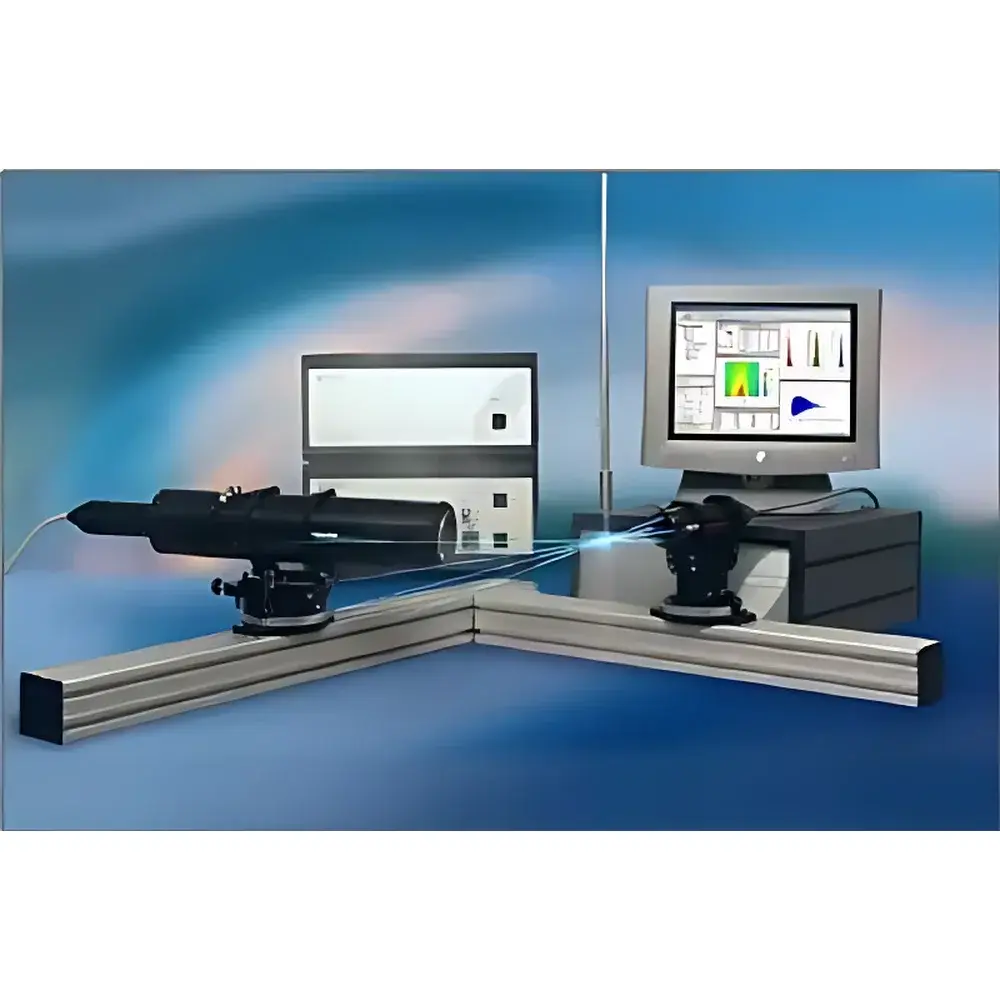
Dantec Dynamics FiberPDA Phase Doppler Anemometry System
| Brand | Dantec Dynamics |
|---|---|
| Origin | Denmark |
| Model | FiberPDA |
| Type | Phase Doppler Anemometer (PDA) |
| Measurement Principle | Phase Doppler Interferometry |
| Velocity Range | –300 to +1000 m/s |
| Particle Diameter Range | 0.5 µm to 10,000 µm |
| Velocity Uncertainty | ±0.1% of reading |
| Size Accuracy | <1% |
| Dynamic Range | 1:50 |
| Optical Configuration | Fiber-coupled dual-beam interferometric setup |
| Signal Processing | Real-time digital pulse processing with adaptive thresholding and burst-mode analysis |
Overview
The Dantec Dynamics FiberPDA Phase Doppler Anemometry System is a high-precision, non-intrusive optical instrument engineered for simultaneous, real-time measurement of particle/droplet size, velocity vector components (1D to 3D), and local number concentration in gaseous or liquid two-phase flows. Based on the well-established phase Doppler interferometry (PDI) principle—originally advanced by Prof. F. Durst—the system relies on the interference pattern generated when laser beams intersect within a probe volume, producing scattered light signals whose phase difference is directly proportional to particle diameter and whose frequency shift encodes axial velocity. Unlike laser Doppler velocimetry (LDV), which measures only velocity, the FiberPDA delivers concurrent sizing and multi-component velocity data without calibration against reference standards, making it particularly suitable for transient, polydisperse, and high-turbulence environments such as combustion chambers, fuel injector sprays, bubble columns, and boundary-layer investigations.
Key Features
- Fiber-optic beam delivery enables flexible probe positioning, robust alignment stability, and compatibility with confined or thermally hostile test sections—including engine cylinders, furnaces, and wind tunnels.
- Real-time digital signal processing architecture supports burst-mode acquisition and adaptive pulse discrimination, ensuring reliable detection even under high background noise conditions (e.g., luminous flames or mechanical vibration).
- Wide dynamic range (1:50) and broad particle sizing capability (0.5–10,000 µm) accommodate applications spanning micron-scale aerosols to millimeter-scale droplets and bubbles.
- Supports 1D, 2D, and 3D velocity vector reconstruction via configurable dual- or triple-beam optical setups, with optional polarization gating for directional ambiguity resolution.
- Integrated hardware triggering and synchronization interfaces (TTL, LVDS) allow precise temporal correlation with external events such as injection pulses, spark timing, or pressure transducer signals.
- Modular design permits seamless integration with complementary Dantec Dynamics systems—including Particle Image Velocimetry (PIV), Laser Sheet Imaging, and Constant Temperature Anemometry (CTA)—for hybrid flow diagnostics.
Sample Compatibility & Compliance
The FiberPDA is validated for use in both transparent and semi-opaque continuous phases, including air, nitrogen, water, ethanol, and low-viscosity oils. It operates effectively across Reynolds numbers from laminar ( 10⁵), and accommodates reverse, recirculating, and swirling flows. The system conforms to ISO 20487:2021 (optical methods for fluid flow measurement), ASTM D7504 (standard practice for PDA-based spray characterization), and supports GLP-compliant data traceability through audit-ready metadata logging. All firmware and software modules comply with FDA 21 CFR Part 11 requirements for electronic records and signatures when configured with user access control and electronic signature protocols.
Software & Data Management
Data acquisition and analysis are managed through Dantec Dynamics’ FlowManager™ v6.x software suite—a Windows-based platform supporting real-time visualization, statistical post-processing, and batch-mode analysis. Key capabilities include automated burst validation, Mie scattering correction tables, refractive index compensation, and customizable reporting templates aligned with ISO/IEC 17025 laboratory accreditation frameworks. Raw signal files (.pda) are stored in HDF5 format with embedded calibration parameters, timestamps, and environmental metadata (temperature, pressure, gas composition). Export options include CSV, MATLAB .mat, and Tecplot PLT formats; API access via Python SDK enables integration into custom automation pipelines and machine learning workflows for predictive spray modeling or combustion optimization.
Applications
- Quantification of droplet size distribution (DSD) and Sauter mean diameter (SMD) in fuel injector sprays under high-pressure conditions.
- Time-resolved velocity and size mapping in turbulent two-phase mixing layers, including counter-flow and swirl-stabilized combustors.
- In-situ characterization of bubble dynamics in electrochemical reactors, fermentation vessels, and nuclear coolant loops.
- Boundary layer profiling in low-speed and transonic wind tunnels, with particular utility in separation zone and transition region analysis.
- Validation of CFD multiphase models (Euler–Lagrange and Euler–Euler approaches) using statistically robust, spatially resolved experimental datasets.
- Development and certification testing of atomizers, nebulizers, and inhaler devices per USP & Ph. Eur. aerosol performance standards.
FAQ
What physical principle does the FiberPDA use to determine particle size?
It employs phase Doppler interferometry, where the phase difference between two scattered light signals—generated by a dual-beam interference fringe pattern—is linearly related to particle diameter.
Can the FiberPDA measure velocity in reverse or oscillatory flows?
Yes. Its bidirectional frequency demodulation capability allows unambiguous determination of velocity sign and magnitude across the full specified range (–300 to +1000 m/s).
Is refractive index input required for accurate sizing?
Yes. Accurate particle sizing requires specification of the particle’s real and imaginary refractive indices, which are used in Mie theory-based signal inversion algorithms.
How is system calibration verified?
Calibration is traceable to NIST-certified spherical standard particles (e.g., polystyrene latex spheres) and certified interferometric fringe spacing measurements; routine verification uses rotating disc or calibrated translation stages.
Does the system support long-term unattended operation?
Yes. With stable thermal management, redundant power supplies, and watchdog-triggered error logging, the FiberPDA is qualified for extended-duration experiments (≥72 h) in industrial R&D environments.