
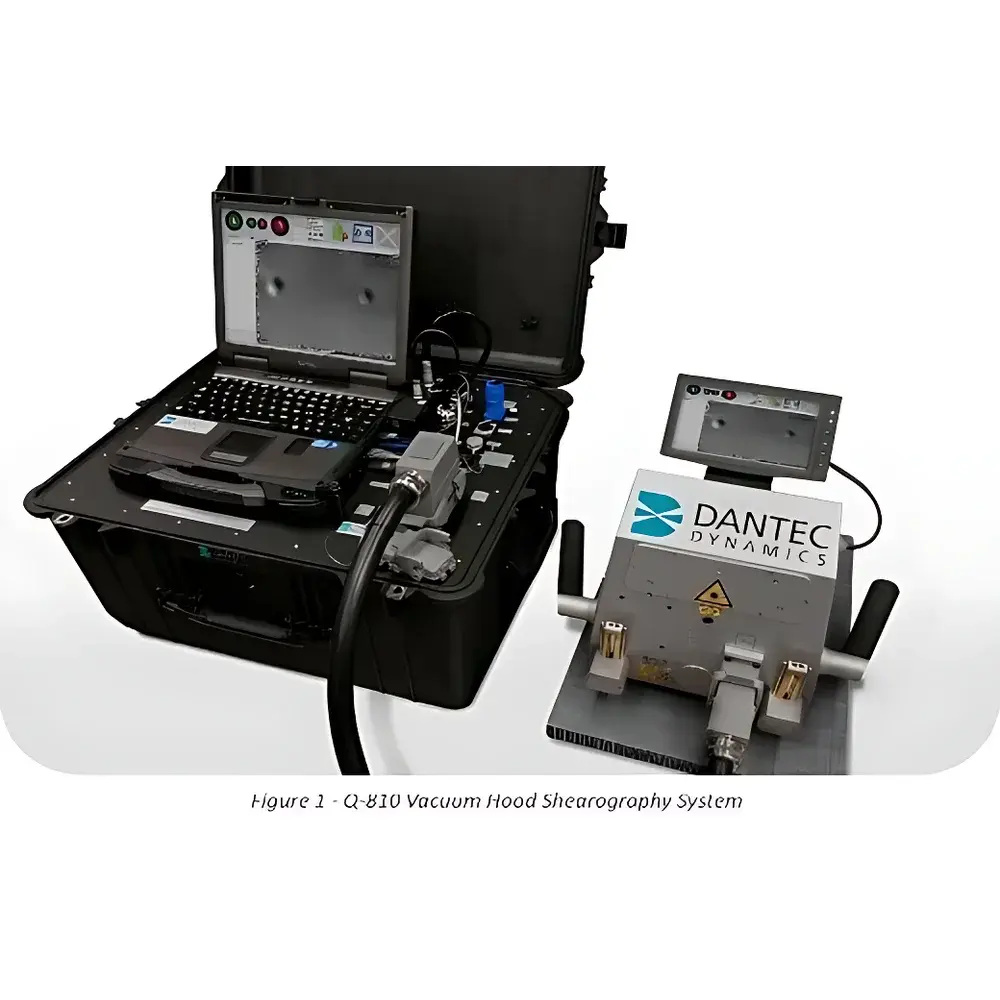
Dantec Dynamics Q-810 Shearography System
| Brand | Dantec Dynamics |
|---|---|
| Origin | Germany |
| Model | Q-810 |
| Type | Full-Field, Non-Contact Optical Shearography NDT System |
| Compliance | Designed for ASTM E2657, ISO 12718, and EN 13715-compliant shearographic inspection workflows |
| Application Scope | In-situ, large-area structural integrity assessment of composite and metallic components |
Overview
The Dantec Dynamics Q-810 Shearography System is a high-resolution, full-field optical interferometric instrument engineered for non-contact, quantitative detection of subsurface and interfacial defects in advanced materials. Operating on the principle of time-averaged shearography—where two laterally sheared speckle patterns are interferometrically compared before and after controlled mechanical or thermal loading—the system captures surface displacement gradients with nanometer-scale sensitivity. Unlike point-wise ultrasonic or eddy-current methods, shearography delivers instantaneous, spatially resolved strain maps across entire surfaces, making it uniquely suited for rapid, repeatable structural health monitoring of large, geometrically complex components under field conditions.
Key Features
- Real-time, full-field deformation gradient imaging with sub-micron displacement sensitivity (typical resolution: <100 nm in out-of-plane strain derivative)
- Adaptive optical sealing mechanism enabling stable operation on both planar and highly curved surfaces (radius of curvature down to 300 mm)
- Integrated dual-wavelength laser source (532 nm visible + optional 1064 nm NIR) for optimized contrast on reflective, translucent, or painted composites
- Ruggedized portable enclosure rated IP54, designed for hangar, shipyard, and wind turbine nacelle environments
- Automated load synchronization interface supporting pneumatic, thermal (Peltier/IR), or mechanical (vibrational) excitation sources
- Onboard real-time fringe analysis engine with hardware-accelerated phase unwrapping and noise suppression algorithms
Sample Compatibility & Compliance
The Q-810 is validated for use on carbon fiber reinforced polymer (CFRP), glass fiber laminates, aluminum honeycomb cores, foam-cored sandwich structures, and adhesive-bonded joints. It detects critical flaw types including delaminations (>0.5 mm lateral extent), disbonds at adhesive interfaces, kissing bonds (low-strength cohesive failure without macroscopic gap), impact-induced matrix cracking, crushed core regions, and manufacturing-induced wrinkles or dry spots. The system conforms to ASTM E2657 (Standard Practice for Shearography of Aerospace Structures), ISO 12718 (Non-destructive testing — Shearography — General principles), and supports traceable inspection documentation required under EASA Part-145 and FAA AC 120-93B. All image acquisition and processing workflows comply with GLP audit trails and support FDA 21 CFR Part 11–compliant electronic signatures when integrated with certified LIMS platforms.
Software & Data Management
Q-810 operates with Dantec’s ShearVision™ v5.2 software suite, featuring intuitive workflow-driven inspection sequencing, multi-modal defect classification (threshold-based, machine-learning-assisted anomaly clustering), and automated report generation in PDF/A-2 and XML formats. Raw interferograms, processed strain gradient maps, and metadata (excitation parameters, environmental logs, calibration timestamps) are stored in vendor-agnostic HDF5 containers. The software includes DIC-compatible export modules for cross-validation with digital image correlation systems and supports OPC UA integration for Industry 4.0 production line synchronization. Audit logs record every user action—including parameter modification, image rejection, and annotation—with immutable timestamps and role-based access control.
Applications
The Q-810 is deployed globally for in-service inspection of primary and secondary aircraft structures (fuselage skins, winglets, rudders, elevator surfaces), offshore wind turbine blades (up to 100 m length), marine composite hulls and bulkheads, launch vehicle fairings and payload adapters, and railcar composite underframes. Its 300 mm × 200 mm field-of-view capture rate of ≤10 seconds per frame enables survey speeds exceeding 1.2 m²/min when scanning aircraft fuselage panels. Additional research applications include bond-line integrity validation during autoclave cure cycles, residual stress mapping in thermally aged adhesives, and fatigue crack initiation monitoring in hybrid metal-composite joints.
FAQ
What types of defects can the Q-810 reliably detect in CFRP laminates?
It detects delaminations ≥0.5 mm in lateral dimension, interply disbonds, impact damage zones with subsurface matrix cracking, and manufacturing-induced wrinkles or resin-starved regions (dry spots). Detection depth is typically up to 8 mm in quasi-isotropic layups.
Is the system suitable for use inside an operational aircraft hangar?
Yes—the Q-810 meets MIL-STD-810G for shock/vibration resistance and operates reliably under ambient lighting conditions typical of industrial hangars; no darkroom or laser safety enclosures are required.
Does the system require coupling media or surface preparation?
No—it is fully non-contact and requires no couplants, coatings, or surface treatments beyond standard cleaning to remove loose debris or oil films.
Can Q-810 data be integrated into existing NDT asset management systems?
Yes—via RESTful API and standardized NDT data exchange schema (ASTM E2339-22), enabling direct ingestion into enterprise CMMS and predictive maintenance platforms.
What calibration standards are supported?
Traceable calibration uses NIST-traceable piezoelectric actuators and certified step-height artifacts (ISO 5725-2); annual verification follows Dantec’s accredited procedure Q-SHEAR-VER-03.
Related Products



