
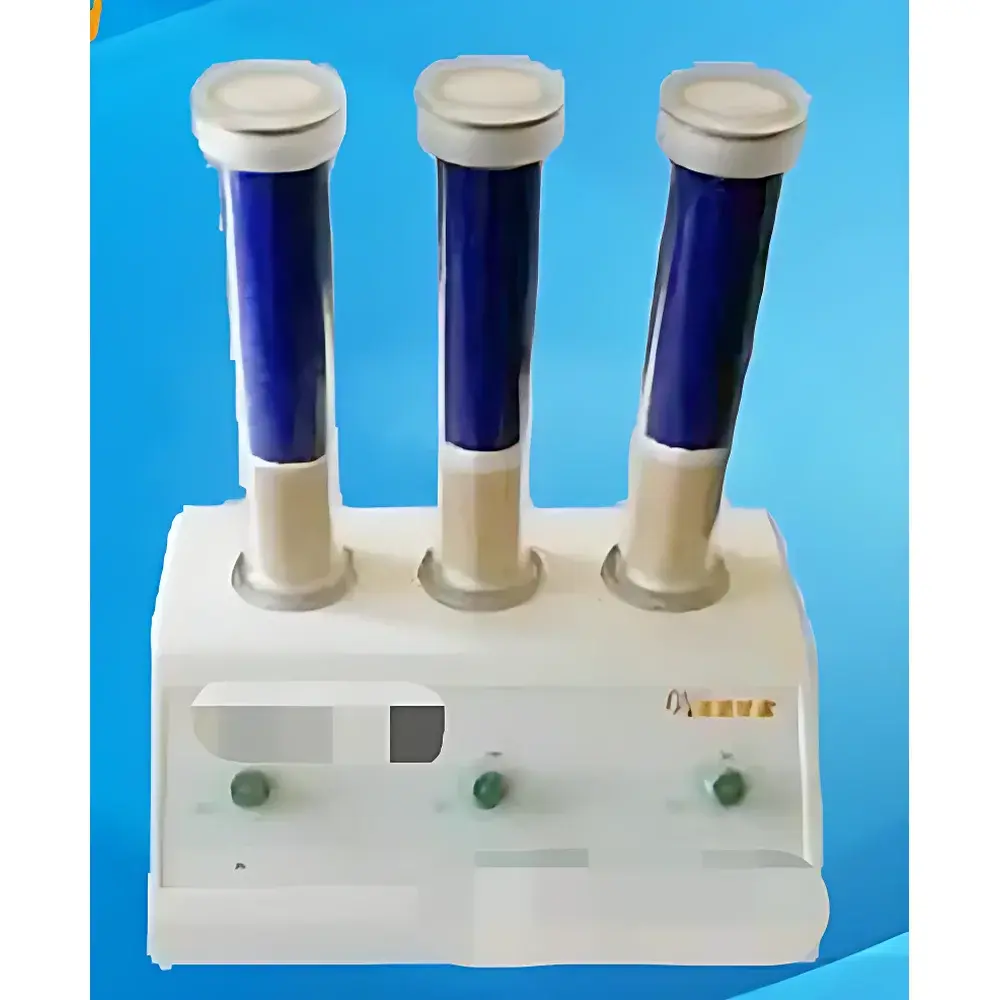
HL-2 Gas Purifier
| Brand | Hailong |
|---|---|
| Origin | Shanghai, China |
| Manufacturer Type | Authorized Distributor |
| Country of Origin | China |
| Model | HL-2 |
| Price Range | USD 140 – 700 |
Overview
The HL-2 Gas Purifier is a compact, modular, and field-deployable gas purification system engineered for laboratory and analytical instrumentation applications requiring high-purity carrier, purge, or fuel gases. It operates on a multi-stage, parallel-and-serial configurable adsorption principle—utilizing physical and chemical sorption mechanisms across three independent, interchangeable purification columns. Each column is designed to selectively remove specific contaminants from compressed or cylinder-supplied gases (e.g., N₂, He, H₂, Ar, synthetic air) without introducing particulates, outgassing, or pressure drop instability. The unit is not intended for bulk gas generation but rather as an inline polishing stage downstream of primary gas sources—ensuring compliance with stringent purity thresholds demanded by GC, GC-MS, ICP-MS, FTIR, and trace-level environmental monitoring systems.
Key Features
- Three independent, removable purification columns housed in standardized 1/4″ Swagelok-compatible stainless-steel bodies—enabling rapid media replacement and maintenance without system depressurization.
- Integrated dual-stage manual isolation valves (inlet and outlet) with leak-tight metal-seated construction, rated for up to 10 bar working pressure and compatible with ISO-KF and VCR fittings.
- Modular configuration support: columns may be operated in parallel for increased flow capacity or cascaded in series for progressive, multi-contaminant removal (e.g., moisture → hydrocarbons → CO₂).
- Visual media status indicators: optional color-changing desiccant (e.g., cobalt chloride–impregnated silica gel) and calibrated pressure-drop monitoring ports allow real-time assessment of column saturation and service life.
- Robust architecture: 304 stainless-steel body, EPDM-free wetted materials, and passivated internal surfaces minimize leaching and ensure long-term stability under continuous operation at ambient temperatures (5–40 °C).
Sample Compatibility & Compliance
The HL-2 supports inlet gases with dew points ≤ −40 °C and total hydrocarbon content < 1 ppm (v/v), provided upstream pressure regulation is applied. Compatible purification media include: 3Å or 4Å molecular sieves (H₂O removal, ≤ 0.1 ppm residual moisture); coconut-shell activated carbon (C₁–C₆ hydrocarbons, ≤ 10 ppb breakthrough); and soda lime or sodium hydroxide–impregnated asbestos-free mineral wool (CO₂ removal, ≤ 0.5 ppm residual). The unit conforms to ISO 8573-1:2010 Class 2:2:2 for compressed air quality when configured with appropriate media—and meets general requirements for GLP-compliant gas delivery in analytical laboratories per ISO/IEC 17025:2017 Annex A.2.
Software & Data Management
The HL-2 is a fully mechanical, valve-operated purifier with no embedded electronics, firmware, or digital interface. As such, it requires no software installation, driver configuration, or cybersecurity validation. Maintenance logs—including column installation dates, media lot numbers, and cumulative operating hours—should be recorded manually in accordance with laboratory SOPs and FDA 21 CFR Part 11–aligned documentation practices where used in regulated environments. Optional third-party pressure transducers (0–10 V analog output) may be installed upstream/downstream for integration into centralized facility monitoring systems (e.g., LabVantage, DeltaV).
Applications
- Carrier gas polishing for capillary GC and GC-MS systems requiring < 0.1 ppm O₂ and < 0.5 ppm H₂O to prevent column degradation and detector noise.
- Purge gas conditioning for headspace samplers and dynamic dilution calibrators used in VOC analysis per EPA Method TO-15 and ASTM D6420.
- Fuel and oxidant gas refinement for flame photometric detectors (FPD), nitrogen-phosphorus detectors (NPD), and hydrogen flame ionization detectors (FID).
- Instrument air supply conditioning for FTIR spectrometers, laser-based analyzers, and vacuum chamber backfilling where hydrocarbon contamination compromises optical path integrity.
- Pre-purification stage for zero-air generators and catalytic scrubbers in ambient air monitoring stations (e.g., EPA EQOA protocols).
FAQ
What types of gases can the HL-2 purify?
The HL-2 is validated for use with inert, non-corrosive, non-reactive gases including nitrogen, helium, argon, hydrogen, and synthetic air. It is not suitable for chlorine, ammonia, hydrogen sulfide, or other reactive or corrosive species.
How often must the purification media be replaced?
Replacement frequency depends on inlet gas quality, flow rate, and operating pressure. Under typical lab conditions (1–5 L/min, dew point −20 °C), molecular sieve columns last 3–6 months; activated carbon lasts 6–12 months; CO₂ traps last 2–4 months. Monitoring pressure drop (> 0.3 bar increase) or breakthrough testing is recommended.
Can the HL-2 be integrated into an existing gas distribution manifold?
Yes—its 1/4″ male NPT inlet/outlet ports and low-profile footprint (220 × 120 × 85 mm) allow direct mounting on wall brackets or integration via stainless-steel tubing and diaphragm valves in central gas systems.
Is the HL-2 compliant with ISO 8573-1 for instrument air?
When equipped with appropriate media combinations and operated within specified flow and pressure limits, the HL-2 achieves ISO 8573-1:2010 Class 2:2:2 (solid particles ≤ 0.1 µm, water ≤ 0.1 mg/m³, oil ≤ 0.1 mg/m³) for compressed air.
Does the unit require calibration or certification?
No—calibration is not applicable to passive adsorption purifiers. However, users should validate performance via periodic gas purity testing (e.g., using a moisture analyzer or GC-TCD) and document results per internal QA/QC procedures.



