
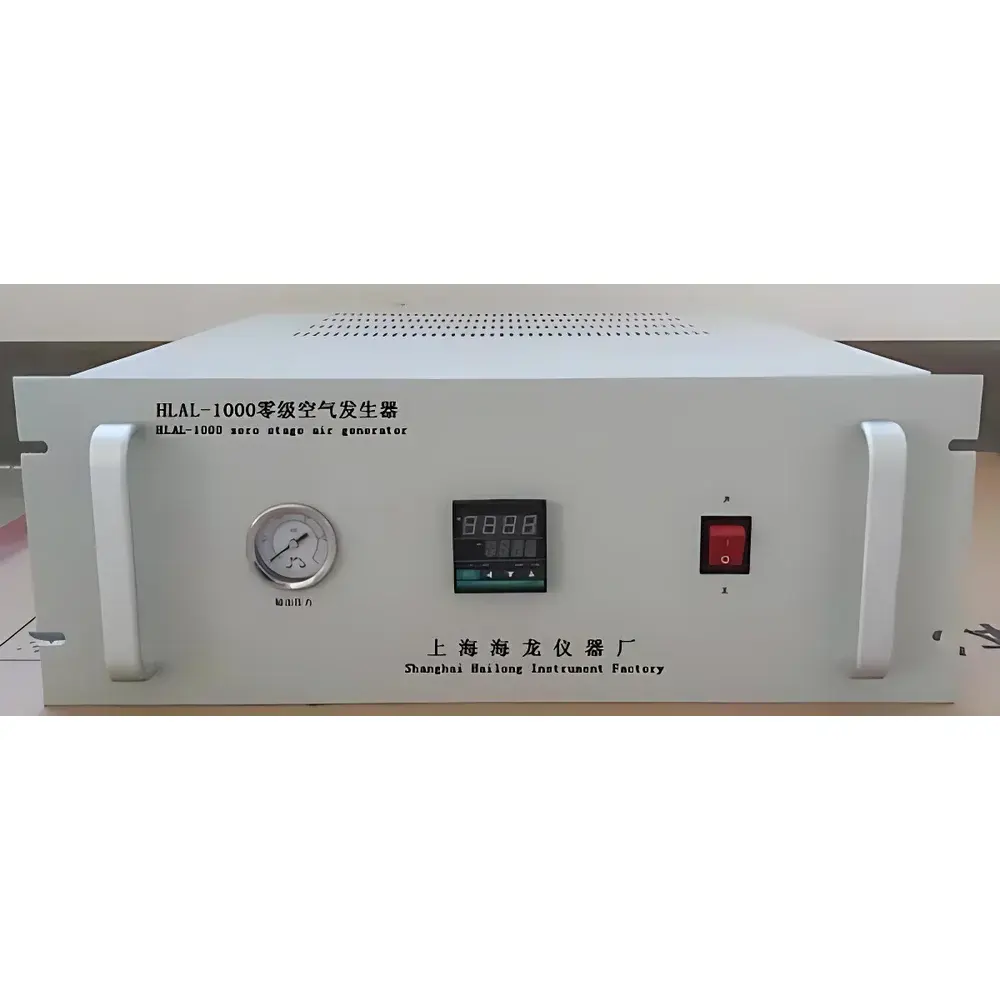
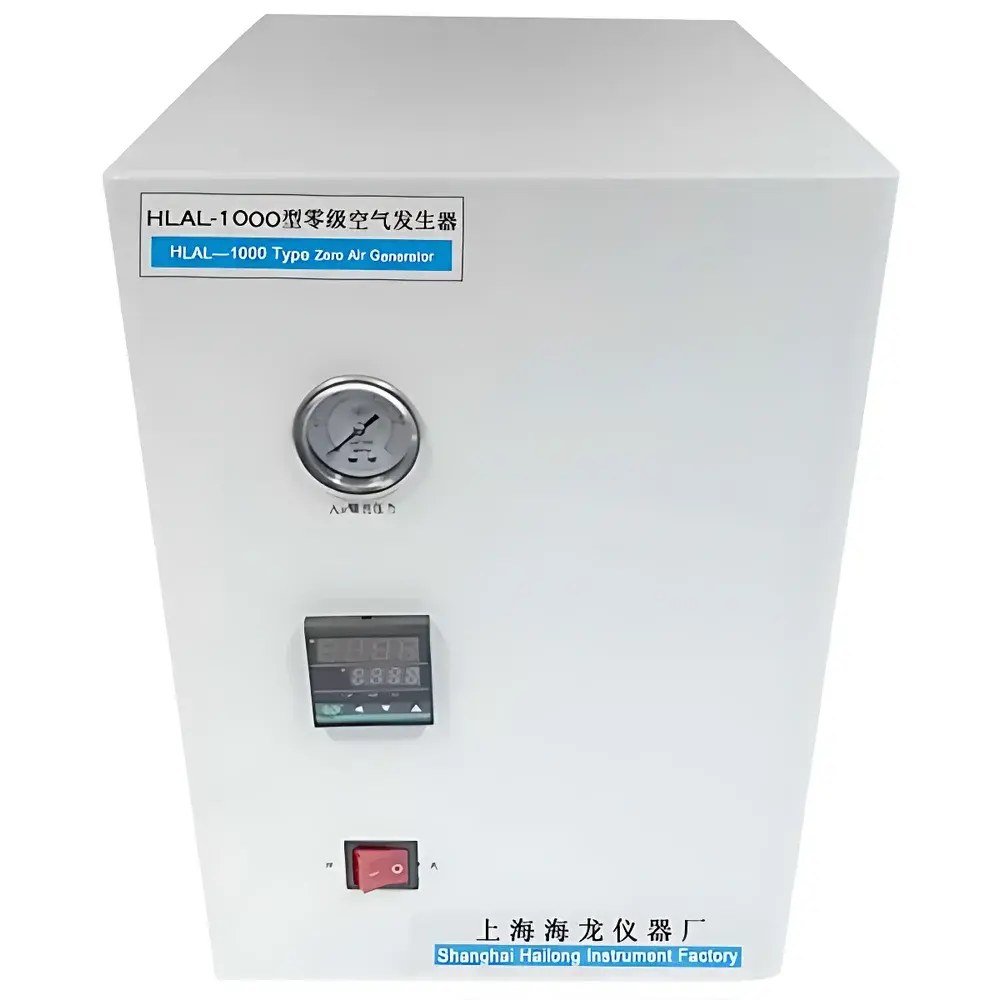
HLAL-1000/2000 Zero-Air Generator
| Brand | HLAL |
|---|---|
| Origin | Shanghai, China |
| Model | HLAL-1000, HLAL-2000 |
| Output Flow Rate | 1000 mL/min, 2000 mL/min |
| Maximum Input Air Pressure | 0–0.6 MPa |
| Hydrocarbon Content (e.g., methane) in Output Air | <0.1 ppm |
| Operating Ambient Temperature | 0–40 °C |
| Relative Humidity Limit | <85% RH |
| Power Supply | 220 V ±10%, 50–60 Hz |
| Power Consumption | 350 W |
| Catalytic Bed Operating Temperature | 350–450 °C (factory-set at 400 °C) |
| Dimensions (W×D×H) | 380 × 360 × 260 mm |
| Net Weight | ~16 kg |
Overview
The HLAL-1000/2000 Zero-Air Generator is a catalytically purified compressed-air source engineered for analytical laboratories requiring ultra-low hydrocarbon background air—specifically for gas chromatography (GC), GC–mass spectrometry (GC–MS), flame ionization detection (FID), and other trace-gas-sensitive instrumentation. Unlike oil-lubricated compressors or ambient-air-sourced systems, this generator employs high-efficiency platinum-group metal catalysts operating at precisely controlled elevated temperatures (350–450 °C, factory preset at 400 °C) to oxidize residual hydrocarbons—including methane, ethane, and volatile organic compounds—into CO₂ and H₂O. The resulting zero-air stream meets stringent specifications for hydrocarbon purity (<0.1 ppm as methane equivalent), enabling stable baseline performance and minimizing detector contamination or false-positive interference in low-concentration analyses.
Key Features
- Catalytic purification architecture with thermally stabilized reaction bed ensures consistent hydrocarbon removal across variable inlet air quality (up to 100 ppm hydrocarbons).
- Dual-output models (HLAL-1000: 1000 mL/min; HLAL-2000: 2000 mL/min) support single-instrument or multi-instrument deployment without pressure drop or flow instability.
- Integrated pressure regulation maintains stable output pressure up to 0.6 MPa, compatible with standard GC carrier-gas manifolds and pneumatic actuators.
- Robust thermal management system prevents overheating during continuous operation and supports safe ambient use within 0–40 °C and <85% RH.
- Low power draw (350 W) and compact footprint (380 × 360 × 260 mm) enable benchtop integration without dedicated HVAC or exhaust ducting.
- Front-panel status indicators provide real-time feedback on catalyst temperature, airflow, and system readiness—critical for GLP-compliant instrument logs.
Sample Compatibility & Compliance
The HLAL-1000/2000 delivers air meeting ASTM D6216-22 Class I specification for hydrocarbon-free air used in environmental air monitoring and regulatory compliance testing. Its output satisfies the air purity requirements defined in USP , ISO 8573-1:2010 Class 1 for hydrocarbons, and EPA Method TO-15/TO-17 auxiliary gas specifications. As a non-oil-based, closed-loop purification system, it eliminates risks associated with compressor lubricant carryover and ambient particulate ingress—making it suitable for ISO/IEC 17025-accredited laboratories performing trace VOC analysis, ambient air quality assessment, and method validation per FDA 21 CFR Part 11 data integrity guidelines.
Software & Data Management
While the HLAL-1000/2000 operates as a standalone hardware unit with no embedded microcontroller or digital interface, its operational parameters—including catalyst temperature setpoint, inlet pressure, and runtime hours—are fully documented in the user manual and service logbook. For laboratories implementing electronic lab notebooks (ELN) or LIMS integration, analog status outputs (optional relay contacts available upon request) can be wired to external PLCs or building management systems for automated uptime logging and preventive maintenance scheduling. All calibration and performance verification records align with GLP/GMP documentation standards, supporting audit readiness for regulatory inspections.
Applications
- Carrier and makeup gas supply for FID, NPD, and PID detectors in GC systems.
- Auxiliary air source for GC–MS ion sources and collision cell gases in triple-quadrupole instruments.
- Zero-air dilution standard generation in dynamic calibrator systems for EPA Method 25A and EN 14662.
- Reference air supply for ozone generators, photolysis reactors, and atmospheric simulation chambers.
- Lab-wide centralized zero-air distribution when paired with stainless-steel manifold networks and point-of-use filters.
FAQ
What inlet air quality is required for optimal performance?
The generator accepts compressed air containing ≤100 ppm total hydrocarbons (as methane); use of an upstream coalescing filter and desiccant dryer is recommended to remove particulates and moisture prior to entry.
Does the unit require periodic catalyst replacement?
Catalyst lifetime exceeds 10,000 operating hours under specified inlet conditions; replacement is only necessary if hydrocarbon breakthrough (>0.1 ppm) is confirmed via independent GC–FID verification.
Can the HLAL-1000/2000 be used in cleanroom environments?
Yes—its oil-free, particle-free output and absence of vented exhaust make it suitable for ISO Class 5–7 cleanrooms when installed with appropriate vibration isolation and HEPA-filtered intake lines.
Is the output air compliant with ISO 8573-1:2010 for solid particles and water?
The unit does not directly control particulate or dew point; users must integrate certified inline filters (0.01 µm) and refrigerated/membrane dryers downstream to achieve full ISO 8573-1 Class 1 certification.
What safety certifications does the device hold?
The HLAL-1000/2000 complies with IEC 61010-1:2010 for laboratory electrical equipment and carries CE marking per EMC Directive 2014/30/EU and Low Voltage Directive 2014/35/EU.



