
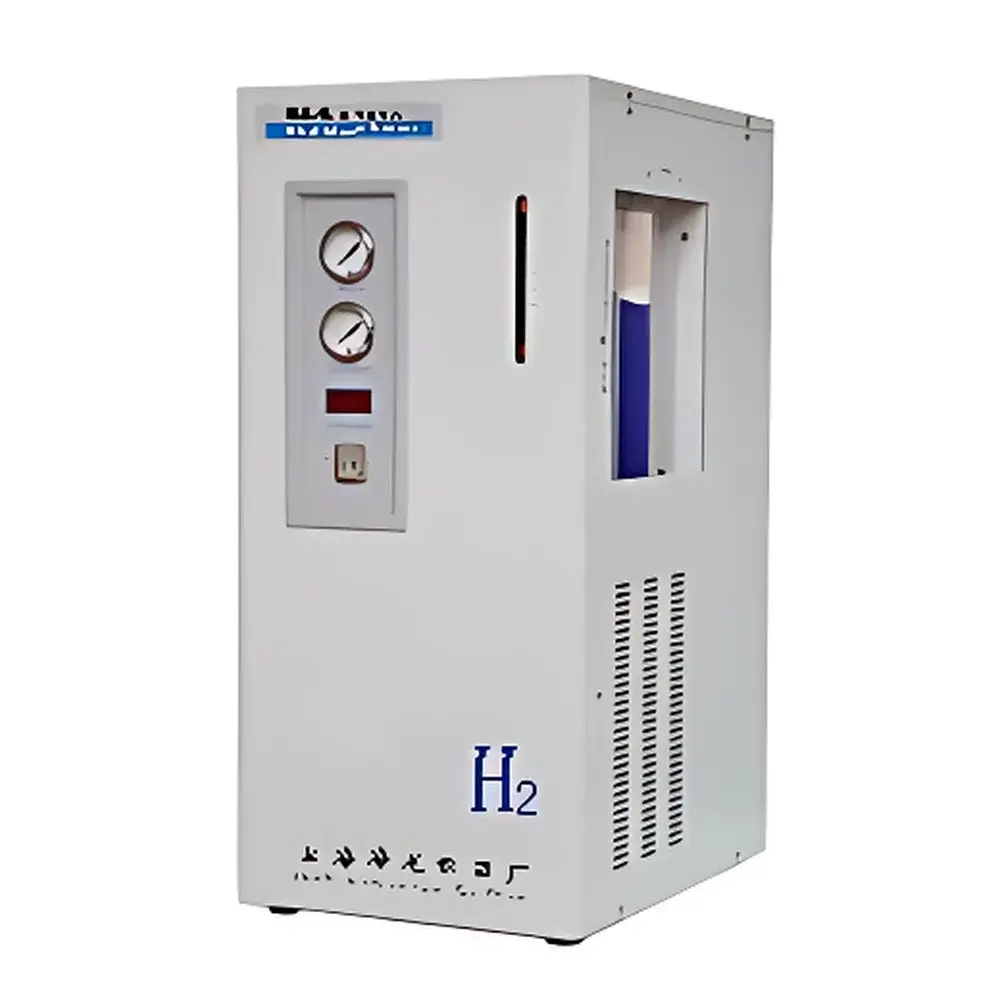
Hydrogen Generator HLH-1L
| Origin | Shanghai, China |
|---|---|
| Manufacturer Type | Authorized Distributor |
| Origin Category | Domestic (PRC) |
| Model | HLH-1L |
| Pricing | Available Upon Request |
| Hydrogen Purity | >99.999% |
| Flow Rate | 0–1 L/min |
| Output Pressure | 0–0.4 MPa (Factory Set at 0.3 MPa) |
| Max Power Consumption | 400 W |
| Operating Environment | 10–40 °C, Relative Humidity ≤85%, Non-corrosive, Low-dust Ambient |
Overview
The HLH-1L Hydrogen Generator is a membrane-based alkaline electrolysis system engineered for continuous, on-demand hydrogen supply in analytical laboratories. It employs a zero-gap,桶-type (cylindrical) electrolytic cell with imported noble-metal-coated electrodes and a high-stability KOH electrolyte matrix—enabling efficient water-splitting under controlled thermal conditions. Unlike pressurized gas cylinders, this generator eliminates storage hazards and regulatory constraints associated with compressed H₂, while delivering ultra-high-purity hydrogen suitable for sensitive detection systems including flame ionization detectors (FID), pulsed discharge helium ionization detectors (PDHID), and hydride generation atomic absorption spectrometry (HG-AAS). The unit operates on deionized or distilled water only after initial alkali charge—reducing maintenance frequency and operational overhead across multi-instrument lab environments.
Key Features
- Single-initiation alkaline electrolyte system: Pre-charged KOH solution requires only periodic top-up with distilled water—no routine electrolyte replacement.
- Stainless steel fluidic path: All wetted components—including electrolyzer housing, gas/liquid separators, and pressure-regulated output lines—are electropolished 316L stainless steel, ultrasonically cleaned to eliminate particulate residue and ensure long-term corrosion resistance.
- Dual-stage gas purification: Integrated molecular sieve (4Å) and oxygen scavenger cartridges remove residual moisture, O₂, and trace organics—maintaining consistent >99.999% H₂ purity over extended operation.
- Anti-backflow protection: A patented mechanical check-valve and hydrophobic membrane barrier prevent liquid carryover into downstream instrumentation—even during abrupt pressure fluctuations or shutdown events.
- Thermally stabilized electrolysis: Active temperature regulation within the cylindrical electrolytic cell maintains optimal reaction kinetics, minimizing electrode polarization and extending service life beyond 3 years (electrolyzer warranty period).
- Intelligent flow tracking: Closed-loop pressure and flow feedback enables automatic adjustment of electrolysis current to match real-time demand—ensuring stable delivery across 0–1 L/min without manual intervention.
Sample Compatibility & Compliance
The HLH-1L is compatible with all standard 1/8″ and 1/4″ stainless steel or PTFE gas lines used in GC, GC-MS, and elemental analyzers. Its output meets ASTM D7165–22 specifications for carrier and fuel gases in chromatographic applications. The unit conforms to IEC 61010-1:2010 safety standards for laboratory electrical equipment and incorporates overpressure cutoff (0.45 MPa threshold), ground-fault circuit interruption (GFCI), and thermal runaway protection. While not certified to ISO/IEC 17025 calibration requirements, its performance stability supports GLP-compliant workflows when paired with documented preventive maintenance logs and periodic purity verification via online gas chromatography or trace O₂/moisture analyzers.
Software & Data Management
This standalone generator operates without embedded firmware or digital interfaces; control is executed via front-panel toggle switch and analog pressure gauge. However, it integrates seamlessly with laboratory information management systems (LIMS) and building automation platforms through optional 4–20 mA analog output (pressure or flow signal) and dry-contact alarm relay (for low-water or overtemperature events). Audit trails for maintenance intervals, water refills, and cartridge replacements are maintained manually per internal SOPs—fully compatible with FDA 21 CFR Part 11–aligned documentation practices when supported by electronic lab notebooks (ELN) or validated paper-based records.
Applications
- Fuel gas source for GC-FID and GC-PDHID systems requiring ultra-high-purity H₂ with minimal baseline drift.
- Carrier gas alternative in specialized GC configurations where helium scarcity or cost drives substitution strategies—subject to method revalidation per USP and EP 2.2.46.
- Reductant gas in hydride generation atomic absorption (HG-AAS) for As, Se, Sb, Bi, and Te speciation analysis.
- Lab-scale hydrogen feed for catalytic reaction screening, electrochemical cell purging, and inert atmosphere maintenance in gloveboxes (when coupled with secondary pressure regulation).
- Replacement for cylinder-based supply in regulated pharmaceutical QC labs seeking reduced audit burden related to gas cylinder inventory, inspection, and handling compliance.
FAQ
What is the expected lifetime of the electrolytic cell?
The cylindrical electrolyzer is warranted for three years under normal operating conditions (≤1 L/min, ambient temperature 15–35 °C, distilled water input). Field data indicate median service life exceeding 42 months with biannual cartridge replacement and quarterly water quality verification.
Can this generator supply multiple GC instruments simultaneously?
Yes—provided total demand remains within 0–1 L/min and distribution manifolds include individual back-pressure regulators and particulate filters per instrument inlet.
Is external cooling required?
No. The unit features passive heat dissipation and internal thermal regulation; ambient airflow ≥0.5 m/s is sufficient for sustained operation at rated power.
How often must the purification cartridges be replaced?
Under typical lab usage (8 hrs/day, 5 days/week), molecular sieve and oxygen scavenger cartridges require replacement every 6–12 months—frequency increases with higher humidity or elevated ambient temperatures.
Does the generator comply with explosion-proof area classifications?
It is rated for general laboratory use (non-hazardous location per NEC Class I, Division 2); installation in classified zones requires third-party hazardous-area certification and enclosure integration.



