
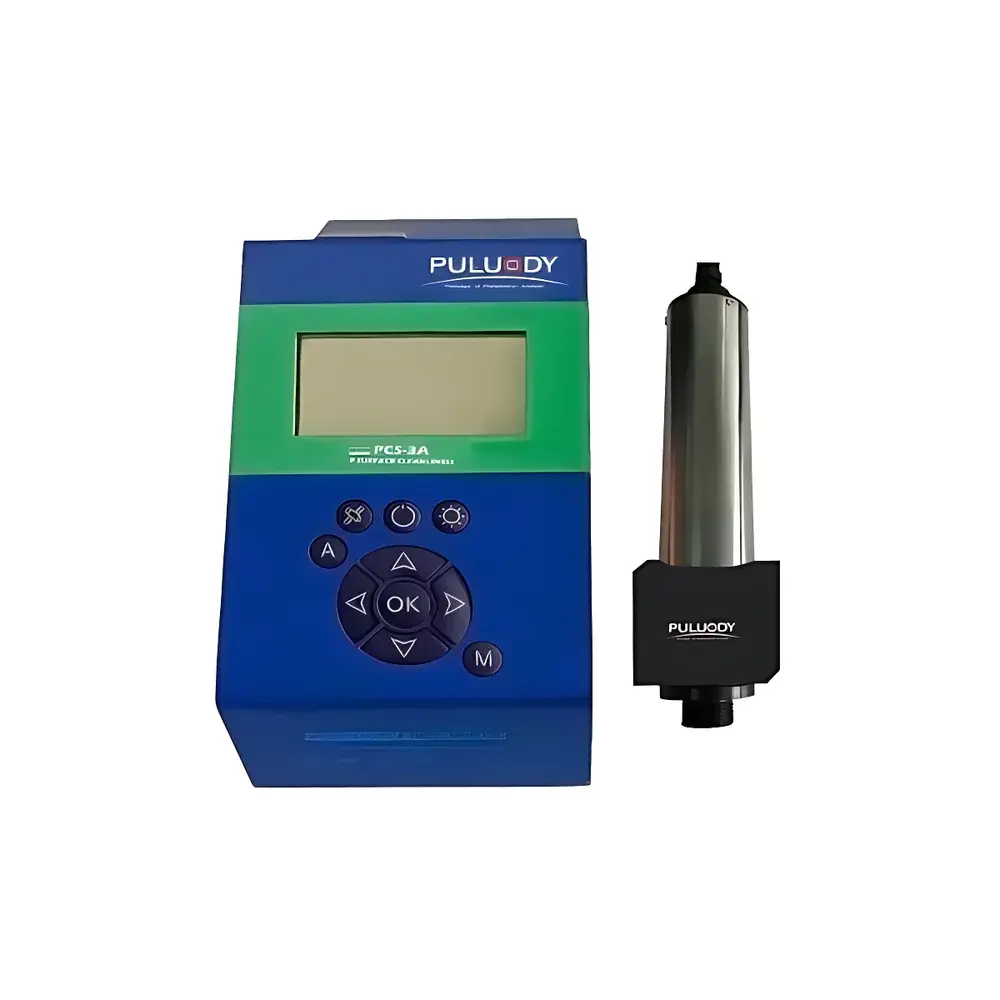
PULUODY PSC-3A Surface Cleanliness Analyzer
| Brand | PULUODY |
|---|---|
| Model | PSC-3A |
| Origin | Shaanxi, China |
| Detection Principle | Fluorescence Energy Spectroscopy (FES) |
| Measurement Range | 0.01 FU (RFU) to full-scale fluorescence response |
| Detection Limit | 1 µg/mL (for representative hydrocarbon standards) |
| Response Time | 0.1–30 s per measurement |
| Sampling Rate | Up to 1000 data points/second |
| Output Units | Standardized Fluorescence Units (FU), % relative to calibration reference, or user-defined scale |
| Sample Compatibility | Flat or moderately curved solid surfaces (metals, composites, ceramics, plastics) contaminated with petroleum-based oils, synthetic lubricants, greases, hydraulic fluids, and other fluorescent organic residues |
| Compliance | Designed for alignment with ISO 8502-9 (Surface cleanliness by fluorescence), ASTM D7474 (Standard Test Method for Determination of Oil and Grease in Wastewater by Infrared Spectrophotometry — adapted for surface residue quantification via fluorescence correlation), and GLP/GMP-relevant data integrity practices |
Overview
The PULUODY PSC-3A Surface Cleanliness Analyzer is a benchtop-to-field portable instrument engineered for rapid, non-destructive quantification of residual hydrocarbon contaminants—including mineral oils, synthetic lubricants, greases, hydraulic fluids, and related fluorescent organics—on solid industrial surfaces. It operates on the principle of Fluorescence Energy Spectroscopy (FES), a selective optical detection method wherein a stabilized UV–visible laser source excites native or derivatized fluorophores present in surface-bound contaminants. Emitted fluorescence photons are collected and spectrally resolved using a high-efficiency photodiode array coupled with a multi-channel pulse-height analyzer (MPHA). The resulting energy-dispersive fluorescence spectrum is processed in real time by an embedded ARM-based controller running proprietary spectral deconvolution algorithms. Unlike broad-band intensity meters, the PSC-3A discriminates overlapping emissions through characteristic peak centroid analysis and intensity integration across defined energy windows, enabling discrimination between interfering background fluorescence (e.g., from certain coatings or substrates) and target hydrocarbon signatures (C5–Cn aliphatics, aromatics, PAHs, and heterocyclic compounds). This spectral resolution underpins its high selectivity and low detection limit of 1 µg/mL (equivalent to ~0.01 FU or 0.01% relative signal under calibrated conditions), making it suitable for validation-critical applications in aerospace component cleaning, precision machining, and semiconductor packaging environments.
Key Features
- Fluorescence Energy Spectroscopy (FES) detection architecture with integrated laser excitation source and energy-resolving detector
- Real-time spectral acquisition and on-device MPHA-based pulse processing (up to 1000 spectra/sec)
- Calibration traceable to NIST-traceable hydrocarbon reference standards; supports user-defined calibration curves
- Ruggedized aluminum alloy chassis with IP54-rated enclosure; operational in ambient temperatures from 5 °C to 45 °C and relative humidity up to 85% non-condensing
- Touchscreen interface with intuitive workflow navigation; <5-minute operator familiarization required
- No consumables or reagents; maintenance limited to periodic optical path inspection and laser power verification
Sample Compatibility & Compliance
The PSC-3A is validated for use on metallic (aluminum, steel, titanium), ceramic, polymer, and composite substrates commonly found in aerospace, automotive, and power generation components. It accommodates flat, slightly curved, or textured surfaces with minimal topographic interference due to optimized optical geometry and auto-focus assist. Measurement repeatability (RSD) is ≤3.2% across 20 replicate measurements on stainless steel coupons spiked with 50 µg/cm² of MIL-PRF-23699 synthetic turbine oil. Instrument design aligns with requirements for controlled-environment manufacturing per ISO 14644-1 Class 8 cleanrooms and supports audit-ready documentation per FDA 21 CFR Part 11 when paired with optional secure network logging. While not a direct replacement for gravimetric or solvent-extraction methods, it satisfies ISO 8502-9 Annex A as a rapid screening tool for process control and pass/fail release testing.
Software & Data Management
The embedded firmware includes configurable data export (CSV, PDF report templates), timestamped measurement logs with operator ID tagging, and built-in statistical summaries (mean, SD, min/max, CPK). Optional PULUODY CleanTrace™ PC software enables centralized fleet management, SPC charting (X-bar/R, CUSUM), and integration with MES/ERP systems via OPC UA or RESTful API. All raw spectral datasets are retained with metadata (ambient temperature, humidity, calibration ID, probe contact status), satisfying GLP/GMP data integrity expectations for electronic records.
Applications
- Aerospace: Pre-coating verification of turbine blades, landing gear components, and fasteners after aqueous or solvent cleaning
- Automotive: Final inspection of engine blocks, transmission housings, and brake calipers prior to assembly
- Semiconductor: Monitoring of wafer carrier trays and robotic end-effectors for hydrocarbon carryover
- Energy: Validation of heat exchanger tube sheets and nuclear fuel handling tools
- Medical device manufacturing: Residue checks on surgical instrument surfaces post-cleaning validation
FAQ
Does the PSC-3A require solvent extraction or sample preparation?
No. It performs direct, non-contact or light-contact surface interrogation without solvents, swabs, or consumables.
Can it distinguish between different types of oils (e.g., mineral vs. synthetic)?
Yes—via spectral signature analysis. Its FES engine resolves characteristic emission bands, enabling semi-quantitative differentiation when calibrated against reference oils.
Is the instrument compliant with ISO 8502-9?
It implements the fluorescence-based methodology described in ISO 8502-9 Annex A and is intended for use as a rapid screening tool within that framework.
What is the typical lifetime of the excitation laser source?
Rated for ≥20,000 hours of operation under standard duty cycles, with automatic power stabilization and thermal compensation.
How is calibration verified in daily use?
A factory-supplied reference standard slide (certified hydrocarbon deposit) is used for daily system suitability checks; full recalibration is recommended every 6 months or after 1,000 measurements.



