
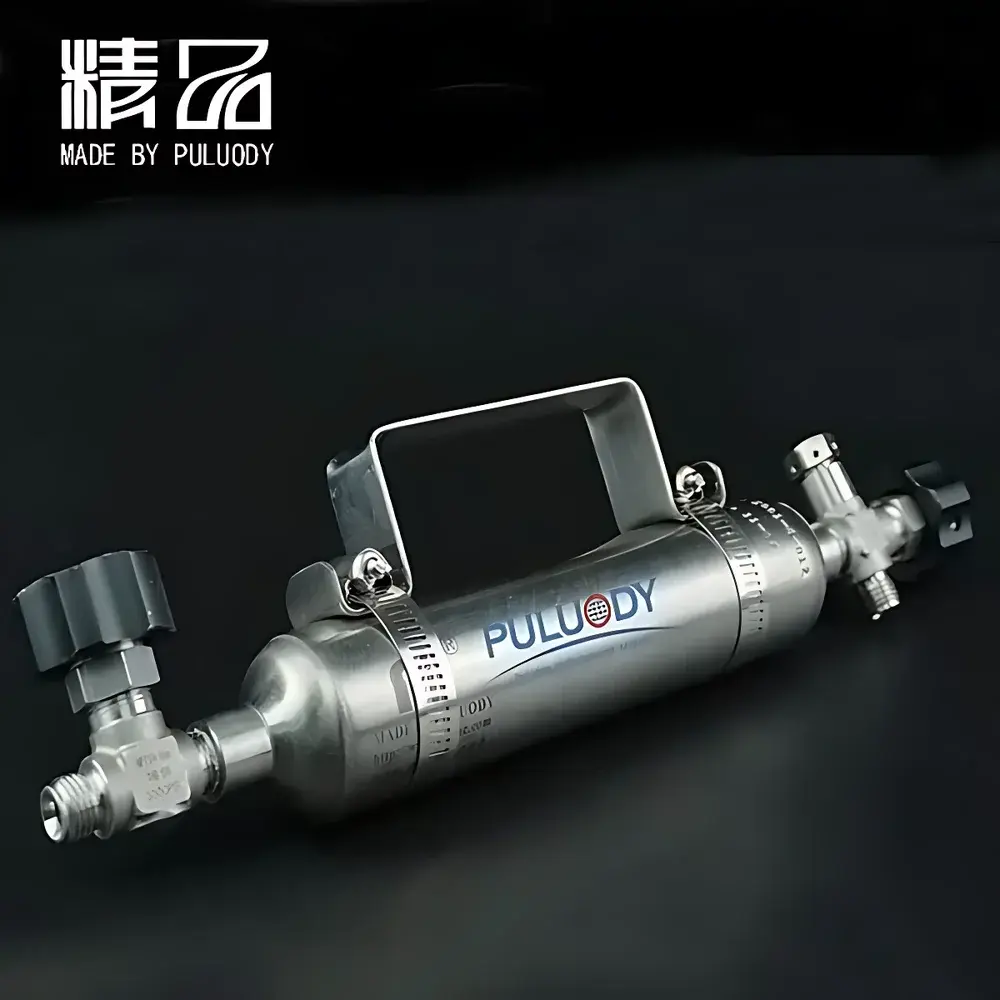
PULL pull-4-300 Seamless Liquefied Petroleum Gas (LPG) Sampling Cylinder
| Brand | PULL |
|---|---|
| Origin | Shaanxi, China |
| Manufacturer Type | Authorized Distributor |
| Country of Origin | China |
| Model | pull-4-300 |
| Price | USD 295 (FOB) |
| Working Pressure | 4 MPa |
| Burst Pressure | ≥38 MPa |
| Operating Temperature Range | −60 °C to +80 °C |
| Material | ASTM A240 UNS S31603 (316L stainless steel) |
| Internal Coating Option | PTFE-lined |
| Valve Configuration | Dual-end, with standard and explosion-proof needle valves |
| Pressure Gauge | Integrated Bourdon-tube gauge (0–10 MPa, Class 1.6) |
| Volume | 300 mL |
| Compliance | SH/T 0233–1992, SY/T ZJ1045, ASTM D1265, IP 173, ISO 4256, EN 13757-3 |
Overview
The PULL pull-4-300 Seamless Liquefied Petroleum Gas (LPG) Sampling Cylinder is a precision-engineered, high-integrity pressure vessel designed for the safe, representative, and contamination-free collection, transport, and temporary storage of volatile hydrocarbon gases and liquefied gases under elevated pressure. Constructed entirely from seamless, cold-drawn ASTM A240 UNS S31603 (316L) stainless steel, the cylinder eliminates weld seams—critical for structural integrity, fatigue resistance, and corrosion mitigation in aggressive environments involving H2S, CO2, chlorides, or trace sulfur compounds. Its design adheres strictly to the mechanical and procedural requirements of SH/T 0233–1992 (“Standard Test Method for Sampling Liquefied Petroleum Gases”) and SY/T ZJ1045, while maintaining full technical alignment with international sampling standards including ASTM D1265 (“Standard Practice for Sampling Liquefied Petroleum (LP) Gases”), IP 173, ISO 4256, and EN 13757-3. The cylinder operates within a certified working pressure range of 4 MPa at temperatures spanning −60 °C to +80 °C, with a minimum burst pressure rating of 38 MPa (per ASME BPVC Section VIII, Div. 1), ensuring robust safety margins for routine laboratory and field use.
Key Features
- Seamless 316L Construction: Eliminates potential leak paths and stress concentrations associated with welded joints; provides superior resistance to pitting, crevice corrosion, and chloride-induced stress corrosion cracking (SCC).
- Dual-Valve Configuration: Equipped with two independently operable needle valves—one standard stainless steel valve and one certified explosion-proof (Ex d IIB T4) valve—enabling controlled venting, pressurization, and sample transfer under hazardous area conditions (ATEX/IECEx Zone 1 compatible).
- Integrated Pressure Monitoring: Factory-mounted, calibrated Bourdon-tube pressure gauge (0–10 MPa, accuracy class 1.6 per EN 837-1) allows real-time verification of internal pressure prior to and after sampling, supporting traceability and procedural compliance.
- PTFE-Lined Interior (Optional): Electropolished interior surface with uniform 25–35 µm PTFE coating minimizes analyte adsorption—particularly critical for trace-level sulfur compounds (e.g., mercaptans, sulfides), oxygenates, and metallo-organic species—while enhancing cleanability and chemical inertness.
- Pressure Relief & Safety Integration: Includes a certified rupture disc assembly (set point: 38 MPa ±5%) mounted directly on the valve manifold, providing passive overpressure protection without compromising sample integrity or requiring recalibration.
- Ergonomic Support Compatibility: Designed to interface seamlessly with standardized 304 stainless steel laboratory support stands (sold separately), enabling vertical stabilization during filling, analysis, or chromatographic injection—reducing operator fatigue and improving workflow reproducibility.
Sample Compatibility & Compliance
The pull-4-300 is validated for use with saturated and unsaturated C2–C4 hydrocarbons—including ethylene, propylene, butadiene, propane, butane, isobutane, and their blends—as well as natural gas condensates and refinery off-gas streams meeting ISO 8573-1 purity classes 2:2:2. It is not intended for hydrogen, chlorine, ammonia, or highly oxidizing media unless specifically validated per client protocol. All units undergo 100% hydrostatic testing at 1.5× working pressure (6 MPa) and helium leak testing (<1×10⁻⁹ mbar·L/s) prior to shipment. Documentation includes material test reports (MTRs) per EN 10204 3.1, pressure equipment directive (PED 2014/68/EU) declaration of conformity, and calibration certificates for integrated gauges. The cylinder supports GLP-compliant workflows when used with audit-trail-enabled data loggers and meets the physical sample container requirements outlined in USP , ASTM E2912, and ISO/IEC 17025:2017 Clause 7.5.2.
Software & Data Management
While the pull-4-300 is a passive sampling device and does not incorporate embedded electronics or firmware, it is fully compatible with digital laboratory infrastructure. Each unit is assigned a unique serialized QR code laser-engraved on the shoulder, linking to a secure cloud-based asset registry containing MTRs, test reports, calibration history, and maintenance logs. When integrated into LIMS or ELN platforms (e.g., LabWare, Thermo Fisher SampleManager), the QR code enables automatic sample metadata capture—including lot number, fill date, pressure reading at time of sealing, and analyst ID—supporting 21 CFR Part 11-compliant electronic records. Optional RFID tags (ISO 15693 compliant) are available for automated inventory tracking in high-throughput analytical labs.
Applications
- Gas chromatographic analysis (ASTM D2505, D6667) of LPG composition and impurity profiling
- Calibration gas preparation for process analyzers and online GC systems
- Trace moisture and H2S quantification via coulometric titration or electrochemical sensors
- Stability testing of formulated fuel blends under accelerated aging conditions
- Refinery feedstock characterization per API RP 4500 and GPA 2145
- Environmental emissions monitoring per EPA Method TO-15 and EN 13649-1
FAQ
Is the pull-4-300 cylinder suitable for sampling hydrogen sulfide (H2S)-containing streams?
Yes—provided H2S concentration remains below 500 ppmv and exposure duration is limited to ≤72 hours per fill cycle. For extended exposure or higher concentrations, PTFE lining is mandatory.
Can this cylinder be used for quantitative headspace analysis?
Yes—the seamless construction and low-permeability 316L wall ensure minimal analyte loss or diffusion over 14 days at 25 °C, meeting ASTM D7213 requirements for static headspace vials.
What is the recommended cleaning procedure between samples?
Rinse three times with ultra-high-purity nitrogen, followed by vacuum evacuation to ≤10 Pa for ≥30 minutes. For PTFE-lined units, add a final rinse with LC-MS-grade methanol.
Does PULL provide validation documentation for GMP-regulated environments?
Yes—upon request, we supply IQ/OQ protocols aligned with ASTM E2500, along with raw test data, uncertainty budgets, and a Certificate of Conformance traceable to NIST standards.
Are replacement rupture discs available as spare parts?
Yes—certified rupture discs (part no. RD-PULL-38MPA) are supplied with individual calibration certificates and shelf-life labeling (24 months from manufacture date).
Related Products





