
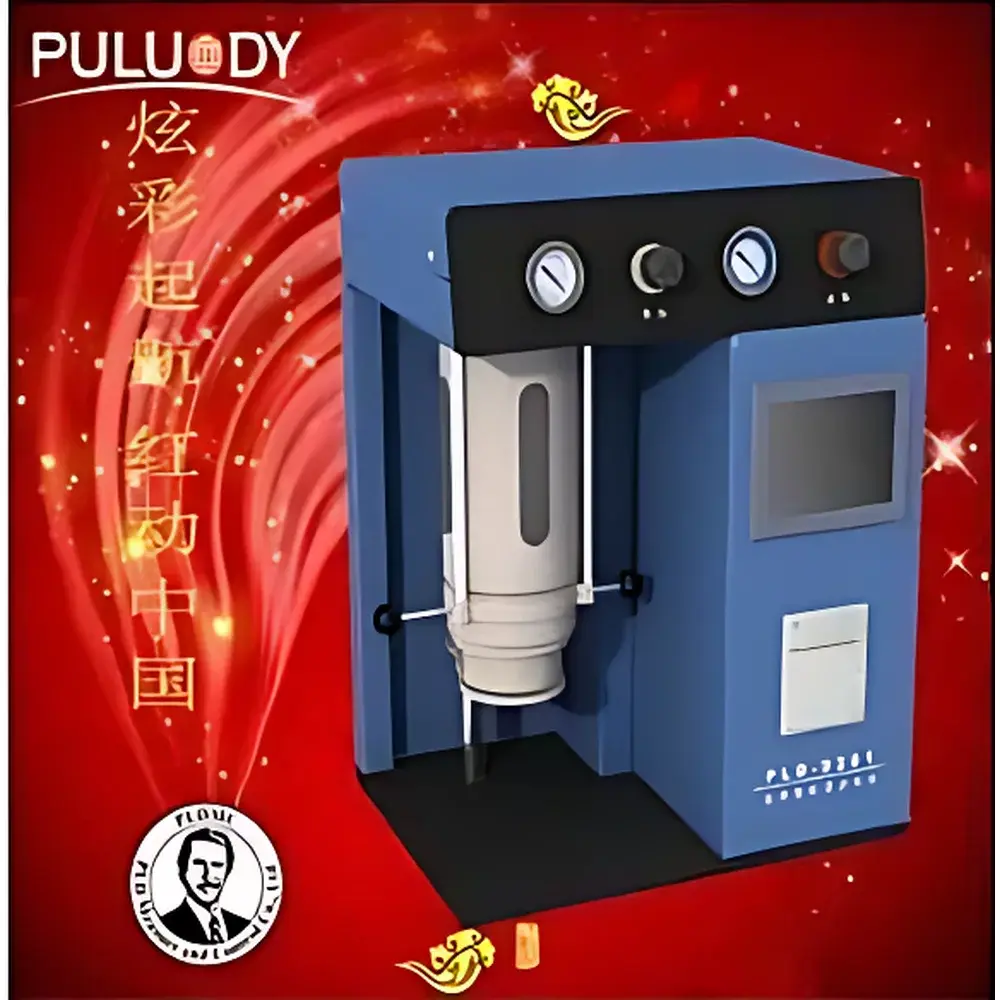
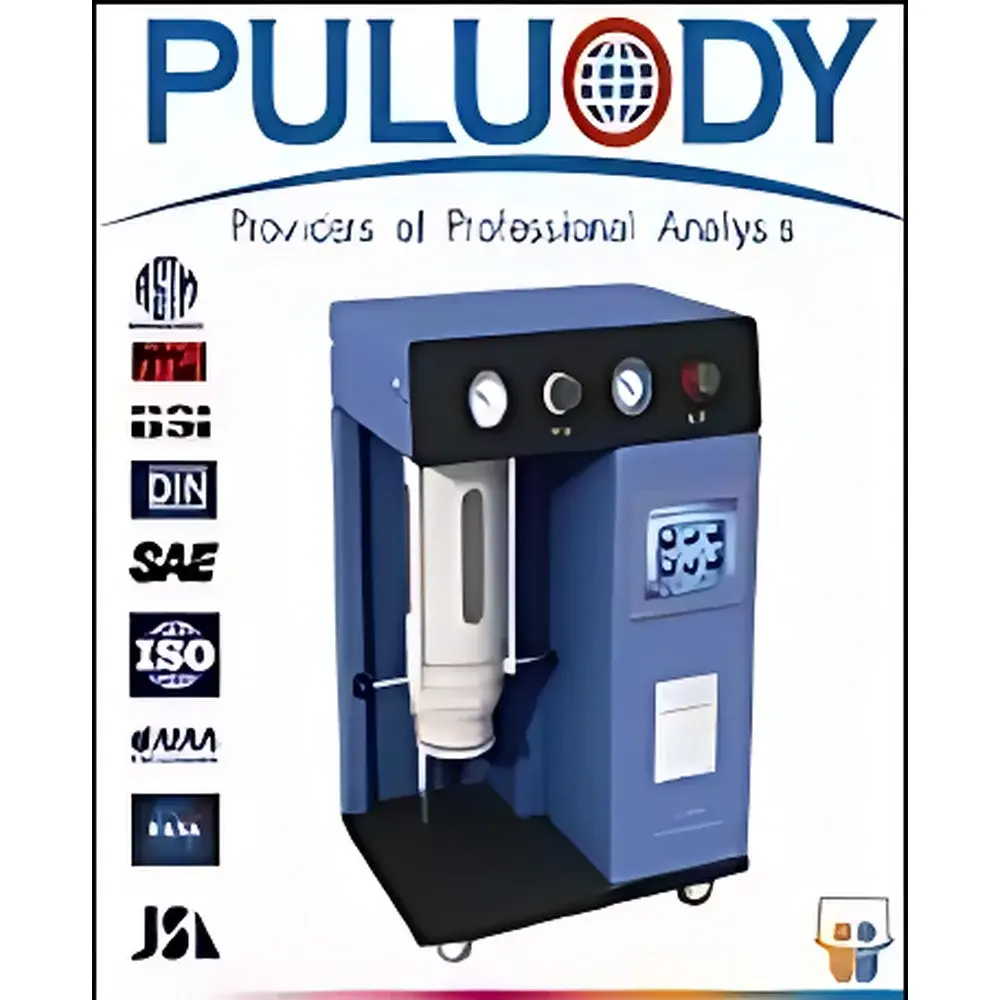

PULUODY PLD-0201 Optical Particle Counter
| Brand | PULUODY |
|---|---|
| Origin | Shaanxi, China |
| Manufacturer Type | OEM Manufacturer |
| Country of Origin | China |
| Model | PLD-0201 |
| Instrument Type | Optical Particle Counter (Light Obscuration Principle) |
| Measurement Range | 1–450 µm |
| Sensitivity | 1 µm (per ISO 4402) or 4 µm(c) (per ISO 11171 / GB/T 18854) |
| Detection Channels | 8 user-configurable channels |
| Coincidence Limit | 10,000 particles/mL (≤5% coincidence error) |
| Sample Flow Rate | 5–60 mL/min |
| Sample Volume Accuracy | ±1% |
| Test Duration | Adjustable, default 12.5 s |
| Viscosity Limit | ≤350 mm²/s |
| Operating Temperature | Ambient to 65 °C |
| Ambient Temperature Range | 0–50 °C |
| Power Supply | 220 V, 50 Hz, <80 W |
| Calibration Standard | GB/T 18854–2002 (equivalent to ISO 11171:1999) |
| Compliance Standards | ISO 4406:1999, NAS 1638, GJB 380, GJB 420 |
| Data Interface | RS232 |
| Control System | Integrated Industrial PC or External PC |
| Software | P6.4 Particle Analysis Suite (Standalone & PC Edition) |
Overview
The PULUODY PLD-0201 Optical Particle Counter is an industrial-grade, light obscuration (LO) based instrument engineered for quantitative analysis of insoluble particulate contamination in liquid media. It operates on the principle of single-particle optical sensing: as particles suspended in a flowing liquid stream pass through a focused laser beam, they cause transient reductions in transmitted light intensity—proportional to their projected area—which are converted into calibrated particle size and count data. This method conforms to internationally recognized metrological frameworks including ISO 11171 (calibration), ISO 4402 (historical sensitivity reference), and ISO 4406 (contamination coding). Designed for routine quality control and condition monitoring, the PLD-0201 delivers traceable, repeatable measurements essential for hydraulic fluid cleanliness verification, lubricant integrity assessment, and pharmaceutical excipient suspension analysis.
Key Features
- High-fidelity sixth-generation narrow-beam laser sensor with thermal stabilization and drift compensation for long-term signal stability.
- Eight fully programmable detection channels enabling customizable binning from 1 µm to 450 µm—supporting both standardized reporting (e.g., ISO 4406 code generation) and application-specific distribution profiling.
- Integrated dual-mode sampling system featuring precision piston pump delivery with flow-rate regulation (5–60 mL/min) and volumetric accuracy better than ±1%, ensuring reproducible sample introduction across viscosity ranges up to 350 mm²/s.
- Onboard industrial PC with 7-inch capacitive touch LCD interface—enabling full instrument control, real-time histogram visualization, and direct result printing without external hardware.
- Comprehensive standard library preloaded with ISO 4406:1999, NAS 1638, GJB 380B, and GJB 420A; supports user-defined threshold tables and custom grading logic via firmware configuration.
- Automated post-analysis rinse cycle using integrated solvent reservoir and pressure-controlled purge lines—minimizing carryover and reducing manual cleaning requirements.
- RS232 serial interface compliant with industry-standard SCPI command syntax, facilitating integration into LIMS environments and automated test benches.
Sample Compatibility & Compliance
The PLD-0201 is validated for use with mineral oils, synthetic lubricants, transformer insulating fluids, turbine oils, aviation fuels (including Jet A-1), water-glycol hydraulic fluids, organic solvents, and polymer solutions. It requires no pre-filtration or dilution for samples within specified viscosity and particulate load limits. All measurement protocols align with ASTM D6786 (for aerospace hydraulic fluids), ISO 4406:2017 (revised contamination coding), and USP Annex for non-aqueous parenteral suspensions when adapted per laboratory SOPs. The instrument’s calibration traceability is maintained through periodic verification against NIST-traceable reference materials certified by the National Defense Science and Technology Commission First-Class Particle Metrology Station (No. 116), fulfilling GLP audit requirements for defense and energy-sector applications.
Software & Data Management
The P6.4 Particle Analysis Software suite provides dual deployment modes: embedded operation via the onboard controller and full-featured desktop execution on Windows-based PCs. It supports raw pulse data export in CSV and XML formats, time-stamped audit logs with operator ID fields, and configurable report templates compliant with 21 CFR Part 11 for electronic signature and record retention. Histograms, cumulative distribution curves, and multi-sample comparison overlays are generated natively. Data security includes password-protected method files, encrypted calibration archives, and immutable event logging—including calibration events, maintenance alerts, and parameter changes—to satisfy ISO/IEC 17025 documentation mandates.
Applications
- Hydraulic system health monitoring in aircraft ground support equipment and flight-critical actuation circuits.
- Condition-based oil analysis for power generation turbines and wind turbine gearboxes.
- Batch release testing of transformer oil in substation maintenance programs per IEC 60296 and IEEE C57.106.
- In-process verification of filtration efficiency in petrochemical refining and additive manufacturing fluid supply lines.
- Contamination screening of polymer melts and solvent-based coatings prior to extrusion or spray application.
- Research-grade particle shedding studies in tribological testing rigs and bearing fatigue experiments.
FAQ
What calibration standards does the PLD-0201 support?
It complies with GB/T 18854–2002 (equivalent to ISO 11171:1999) for sensor calibration and supports verification using ISO MTD (Medium Test Dust) and ACFTD (Air Cleaner Fine Test Dust) reference suspensions.
Can the instrument measure particles below 1 µm?
No—the lower detection limit is defined at 1 µm per ISO 4402 or 4 µm(c) per ISO 11171; sub-micron analysis requires alternative techniques such as nanoparticle tracking analysis (NTA) or dynamic light scattering (DLS).
Is the system compatible with Good Manufacturing Practice (GMP) environments?
Yes—when deployed with P6.4 software configured for 21 CFR Part 11 compliance, including electronic signatures, audit trails, and role-based access control.
Does the PLD-0201 require sample degassing prior to analysis?
Not typically; however, for high-viscosity or volatile samples prone to microbubble formation, optional vacuum-assisted degassing modules can be integrated upstream.
How is sensor fouling mitigated during extended operation?
The system employs automatic backflush cycles between analyses and optional ultrasonic transducer activation in the flow cell housing to dislodge adherent residues.



