
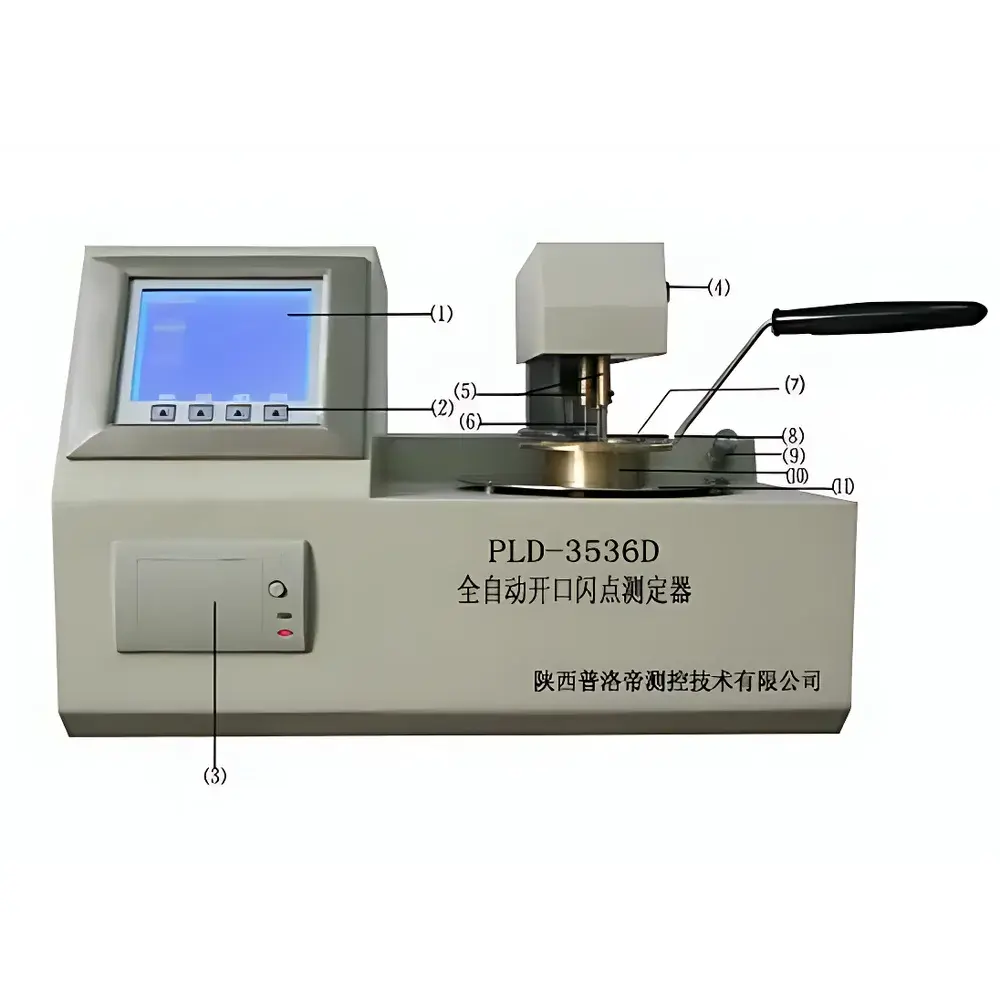
PULUODY PLD-3536D Automatic Cleveland Open-Cup Flash Point Tester
| Brand | PULUODY |
|---|---|
| Origin | Shaanxi, China |
| Manufacturer Type | Manufacturer |
| Country of Origin | China |
| Model | PLD-3536D |
| Detection Method | Cleveland Open-Cup (COC) |
| Standards Compliance | GB/T 3536–2008, ASTM D92, ISO 2592 |
| Temperature Range | Ambient to 400 °C |
| Ignition Modes | Dual-mode (electronic spark + gas flame, selectable individually or simultaneously) |
| Control System | Dual-core CPU microcontroller |
| Display | 4.0-inch TFT LCD with touch-sensitive keypad |
| Cooling Method | Forced-air cooling |
| Atmospheric Pressure Compensation | Integrated digital barometric sensor with automatic calibration |
| Data Output | Thermal printer (built-in) |
| Software | PV Flash Point (Open) Test v8.0 |
| Flash Point Detector | PULL proprietary open-cup flash sensor |
| Power Supply | AC 220 V ±20 V, 50 Hz ±5 Hz |
| Rated Power | 500 W |
| Dimensions (W×D×H) | 310 × 395 × 303 mm |
| Safety Features | Auto-extinguishing, real-time fault diagnosis, thermal runaway protection, end-of-test forced cooldown |
Overview
The PULUODY PLD-3536D Automatic Cleveland Open-Cup Flash Point Tester is a precision-engineered instrument designed for the standardized determination of flash point and fire point of petroleum products using the Cleveland Open-Cup (COC) method. It operates in strict accordance with internationally recognized test protocols—namely GB/T 3536–2008, ASTM D92, and ISO 2592—ensuring metrological traceability and regulatory acceptability across global laboratories. Unlike closed-cup methods (e.g., ASTM D56 or D93), the COC procedure subjects the sample to controlled heating in an unsealed crucible, allowing volatile vapors to accumulate above the surface until ignition occurs under a calibrated test flame. This method is specifically recommended for viscous or high-boiling materials—including lubricating oils, residual fuels, bitumens, and heavy distillates—with flash points exceeding 79 °C. The PLD-3536D eliminates manual intervention through full automation of cup positioning, temperature ramping, flame application, event detection, and result validation—reducing operator variability and enhancing inter-laboratory reproducibility.
Key Features
- True dual-mode ignition system: independent electronic spark and liquefied petroleum gas (LPG) flame sources, configurable via software for method flexibility or redundancy.
- Programmable temperature ramping with adaptive control logic, ensuring compliance with specified heating rates per ASTM D92 (e.g., 5–6 °C/min up to 200 °C; 2–3 °C/min thereafter).
- Integrated atmospheric pressure sensor with real-time compensation—critical for accurate flash point reporting, as vapor pressure is inherently barometrically dependent.
- Self-diagnostic firmware architecture that continuously monitors heater integrity, thermocouple response, flame detection circuitry, and mechanical actuator status.
- Auto-extinguishing mechanism activated upon flash point confirmation or thermal anomaly detection, preventing uncontrolled combustion and supporting laboratory safety protocols (OSHA 1910.106, NFPA 30).
- Forced-air active cooling system reduces post-test cooldown time by >40% compared to passive dissipation, enabling higher throughput without thermal memory effects.
- 4.0-inch high-contrast TFT display with intuitive touch interface provides live graphical representation of temperature curve, detection events, and step-by-step procedural guidance.
Sample Compatibility & Compliance
The PLD-3536D is validated for use with non-volatile petroleum derivatives where closed-cup testing is inappropriate due to viscosity, volatility suppression, or thermal stability constraints. Typical applications include industrial lubricants, cylinder oils, marine fuels (IFO 380/IFO 180), asphalt binders, and transformer oils. It excludes gasoline, jet fuel, and light naphthas—materials requiring ASTM D56 or D93 methodology. Regulatory alignment extends beyond method standards: the instrument’s audit trail functionality, user-access controls, and electronic signature support in PV Flash Point v8.0 enable compliance with FDA 21 CFR Part 11 requirements for electronic records and signatures. Full GLP/GMP documentation packages—including IQ/OQ/PQ templates, calibration logs, and uncertainty budgets—are available upon request. All hardware components meet IEC 61010-1 safety certification for electrical equipment used in laboratory environments.
Software & Data Management
PV Flash Point (Open) Test v8.0 serves as the embedded operating and data management platform. It supports multi-user authentication with role-based permissions (operator, supervisor, administrator), ensuring separation of duties. Each test generates a timestamped, tamper-evident report containing raw temperature vs. time data, detected flash/fire point values, atmospheric pressure at time of test, operator ID, instrument serial number, and calibration verification status. Reports export in PDF/A-1b (ISO 19005-1) and CSV formats for LIMS integration. The software maintains a local database with search-by-date, sample ID, or parameter filters, and supports automated backup to network drives or USB storage. Audit log entries record all configuration changes, user logins, and critical events—fully compliant with ALCOA+ principles (Attributable, Legible, Contemporaneous, Original, Accurate, Complete, Consistent, Enduring, Available).
Applications
- Quality assurance of base oils and finished lubricants per OEM specifications (e.g., API, ACEA, JASO).
- Regulatory submission testing for customs clearance and environmental compliance (e.g., REACH Annex XVII, EPA 40 CFR Part 79).
- Research and development of high-temperature synthetic fluids and bio-based lubricants.
- In-process monitoring in refinery blending units and additive package formulation labs.
- Third-party certification testing accredited to ISO/IEC 17025:2017 by national metrology institutes.
- Technical service support for field-deployed equipment requiring on-site flash point verification under ASTM D92 equivalence.
FAQ
What sample volume is required for ASTM D92 testing on the PLD-3536D?
A nominal 70 mL sample volume is recommended to ensure sufficient depth and thermal mass for stable vapor layer formation during ramping.
Does the instrument support method customization beyond ASTM D92?
Yes—users may define custom heating profiles, ignition timing windows, and pass/fail criteria within software limits, provided such modifications are documented and scientifically justified per internal SOPs.
How frequently must the atmospheric pressure sensor be calibrated?
The integrated barometer is factory-calibrated and requires no routine recalibration; however, annual verification against a NIST-traceable reference device is advised for ISO/IEC 17025 accreditation.
Can test data be exported directly to a LIMS without manual intervention?
Yes—CSV export supports automated ingestion via scheduled FTP/SFTP transfers or direct ODBC connectivity when configured with compatible middleware.
Is the PLD-3536D suitable for testing biodiesel blends (e.g., B20, B100)?
It is appropriate for B100 and high-concentration blends per ASTM D92, though users should verify compatibility with oxidation-prone feedstocks via preliminary stability assessment prior to routine deployment.





