
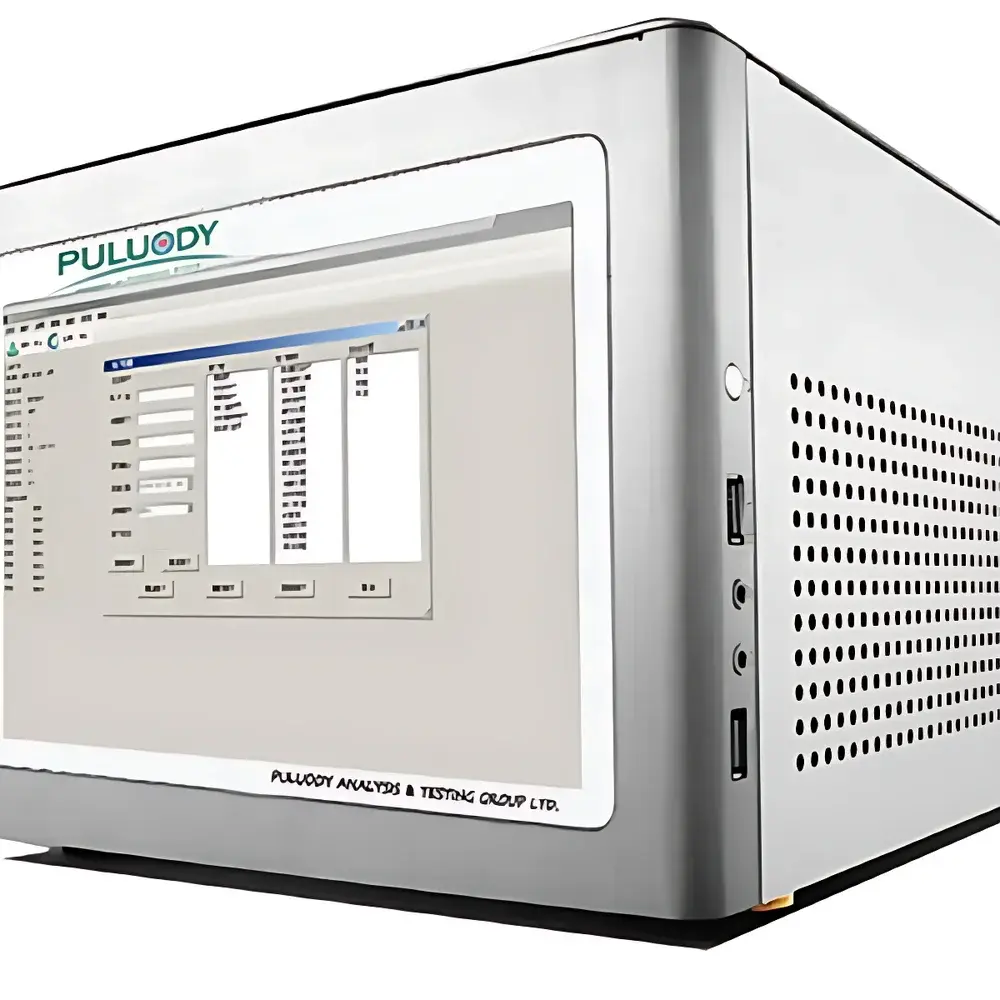
PULUODY PMT-2C 18 MΩ Electronic-Grade Ultrapure Water Liquid Particle Counter
| Brand | PULUODY |
|---|---|
| Origin | Shaanxi, China |
| Model | PMT-2C |
| Instrument Type | Optical Particle Counter |
| Detection Principle | Dual-Laser Narrow-Beam Light Scattering |
| Detection Range | 0.1–0.5 µm (standard), customizable 1–100 µm or 4–70 µm(c), down to 0.1 µm(c) |
| Sampling Accuracy | <±1% |
| Measurement Accuracy | <±3% (typical) |
| Coincidence Limit | 1000 particles/mL (2.5% coincidence error) |
| Output | 4–20 mA analog interface with configurable alarm trigger |
| Calibration Standards | JJG 1061, ISO 21501, NIST-traceable latex spheres |
| Software | V8.3 Integrated Analysis & Calibration Software (PC + touchscreen UI) |
| Power Input | 100–265 VAC, 50–60 Hz |
| Compliance | Designed for ISO 14644-1 cleanroom monitoring, SEMI F57, ASTM D6978, USP <788> & <789>, and GLP/GMP-aligned data integrity workflows |
Overview
The PULUODY PMT-2C 18 MΩ Electronic-Grade Ultrapure Water Liquid Particle Counter is an optical particle counter engineered specifically for real-time, high-sensitivity contamination monitoring in ultrapure water (UPW) systems used across semiconductor fabrication, flat-panel display manufacturing, photovoltaic cell production, and advanced pharmaceutical water-for-injection (WFI) distribution networks. Operating on the principle of dual-laser narrow-beam light scattering—representing the eighth-generation sensor architecture developed by PULUODY’s UK R&D center—the instrument achieves sub-micron resolution critical for detecting process-critical defects in 18.2 MΩ·cm resistivity water. Its design addresses the fundamental challenge of quantifying low-concentration, nanoscale particulate contamination (<0.5 µm) where conventional single-wavelength counters suffer from signal noise, refractive index dependency, and optical coincidence errors. The PMT-2C integrates a precision metering piston pump and ultra-stable electromagnetic flow control to ensure volumetric repeatability within ±1%, enabling traceable, statistically robust particle counts per milliliter—essential for compliance with SEMI F63, ISO 14644-2, and IEC 60404-8-11.
Key Features
- Dual-laser narrow-beam optical detection system optimized for refractive index-insensitive sizing of transparent and semi-transparent particles in high-resistivity liquids (≥18 MΩ·cm)
- Configurable detection thresholds: standard 0.1–0.5 µm; extended ranges include user-defined 1–100 µm or 4–70 µm(c); optional 0.1 µm(c) mode for nucleation-level monitoring
- Integrated metrology-grade fluidics: positive-displacement piston pump with closed-loop electromagnetic flow regulation, minimizing pulsation and shear-induced artifact generation
- Touchscreen HMI (color LCD) + optional wireless keyboard/mouse support for offline analysis and method configuration
- 4–20 mA analog output with programmable alarm thresholds for integration into SCADA, DCS, or MES platforms
- Calibration traceability to national standards: JJG 1061 (China), ISO 21501-2 (light scattering particle size analyzers), and NIST-certified polystyrene latex standards
- Modular architecture supporting both online bypass-loop installation and portable offline sampling via calibrated syringe adapters
Sample Compatibility & Compliance
The PMT-2C is validated for use with electronic-grade ultrapure water (18.2 MΩ·cm at 25 °C), deionized rinse solutions, photoresist solvents, CMP slurries, and polymer-based processing fluids. It meets material compatibility requirements for wet benches and UPW recirculation loops per SEMI C11 (Materials Handling) and SEMI F57 (Particle Counting in Ultrapure Water). Data acquisition and reporting comply with ALCOA+ principles (Attributable, Legible, Contemporaneous, Original, Accurate, Complete, Consistent, Enduring, Available) and support audit-ready electronic records under FDA 21 CFR Part 11 when deployed with V8.3 software’s role-based access control, electronic signatures, and full audit trail functionality. All measurement reports include particle count/mL, ISO Class (per ISO 14644-1), and NAS 1638 or SAE AS4059F contamination codes.
Software & Data Management
The V8.3 Integrated Analysis & Calibration Suite separates calibration validation routines from routine testing workflows—eliminating cross-contamination of reference data and ensuring regulatory defensibility. The software supports multi-channel trending, statistical process control (SPC) charting (X-bar/R, CUSUM), automated report generation (PDF/CSV/XML), and direct export to LIMS or ELN systems. Calibration modules include multi-point verification using certified reference materials, drift correction algorithms, and sensor health diagnostics. All raw scatter pulse data is preserved with timestamp, environmental metadata (temperature, pressure), and operator ID—enabling retrospective reanalysis without re-sampling. Firmware updates are digitally signed and version-locked to maintain 21 CFR Part 11 compliance.
Applications
- Semiconductor front-end process: UPW loop monitoring pre- and post-TOC removal, point-of-use filtration validation, and megasonic bath cleanliness verification
- Flat-panel display manufacturing: DI water purity assurance for TFT array cleaning and color filter coating processes
- Photovoltaic wafer processing: slurry residue detection in texturing and etching rinse stages
- Pharmaceutical WFI systems: continuous monitoring per USP and EU Annex 1 requirements for sterile product manufacturing
- Nanofiltration and ultrafiltration membrane integrity testing via challenge particle breakthrough analysis
- Research applications: nanoparticle synthesis stability tracking, colloidal dispersion characterization, and microfluidic device clogging studies
FAQ
What calibration standards are supported by the PMT-2C?
The instrument supports calibration per JJG 1061 (Chinese national metrology regulation), ISO 21501-2 (international standard for light-scattering particle counters), and traceable NIST polystyrene latex spheres (e.g., Duke Scientific 3000 series). Custom calibration curves can be generated for non-spherical or high-refractive-index particles.
Can the PMT-2C be integrated into an existing factory automation system?
Yes—it provides isolated 4–20 mA analog output with configurable alarm thresholds, Modbus TCP/IP (optional), and OPC UA compatibility via V8.3 software gateway modules, enabling seamless connection to DeltaV, Siemens PCS7, or Rockwell FactoryTalk environments.
Is offline portable operation possible without permanent installation?
Absolutely. The unit supports battery-powered mobile operation (with external Li-ion pack), handheld syringe sampling, and rapid field deployment using ISO-standard 1/4″ Swagelok fittings and low-dead-volume tubing kits.
How does the dual-laser design improve measurement reliability over single-laser counters?
Dual orthogonal laser illumination reduces Mie scattering ambiguity, enables better discrimination of coincident events, and improves sizing accuracy for particles near the diffraction limit—particularly critical for sub-0.2 µm detection in low-conductivity fluids where electrostatic charging effects distort single-beam signals.
Does the system meet FDA 21 CFR Part 11 requirements for electronic records?
When operated with V8.3 software in “Regulatory Mode”, the system enforces electronic signatures, audit trails, role-based permissions, and data immutability—fully satisfying Part 11 criteria for computerized systems used in GxP-regulated environments.



