
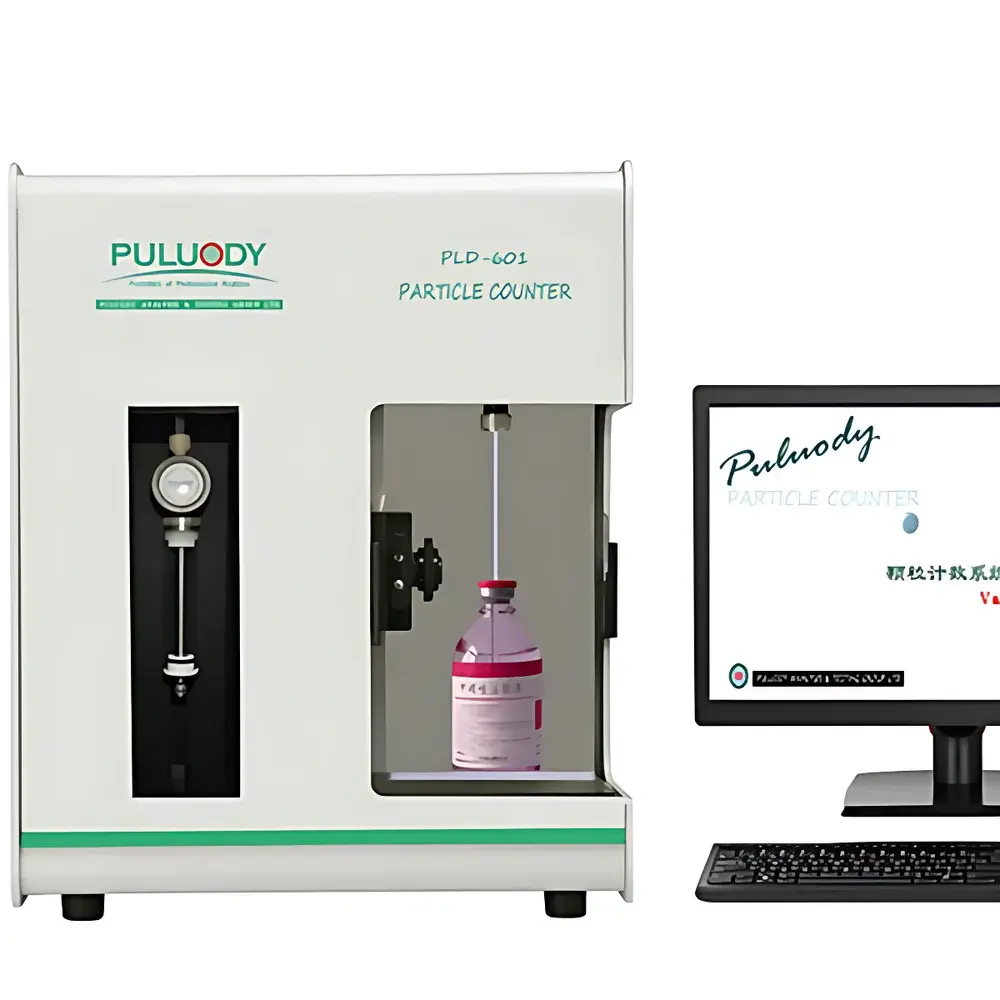
PULUODY PLD-601-N Single-Use Straight-Groove Urethral Catheter Particulate Analyzer
| Brand | PULUODY |
|---|---|
| Origin | Shaanxi, China |
| Manufacturer Type | Authorized Distributor |
| Product Category | Domestic |
| Model | PLD-601-N |
| Instrument Type | Optical Particle Counter |
| Detection Principle | Light Obscuration (LO) / Dual-Laser Narrow-Beam Sensor |
| Channel Resolution | 1000 Channels |
| Minimum Detectable Size | 0.01 µm |
| Calibration Standards | ISO 21501-4, JJG 1061, USP <788>, ChP 2020 <0903>, EP 10.0, ISO 11171 |
| Flow Control | Precision Metering Plunger Pump + Ultra-Precise Electromagnetic Flow Regulation |
| Software Compliance | FDA 21 CFR Part 11, Audit Trail, Electronic Signature, 5-Tier User Permissions |
| Operating Temperature Range | 0–80 °C (fluid), 0–50 °C (ambient) |
| Sample Flow Rate | 5–150 mL/min |
| Rinse Flow Rate | 5–500 mL/min |
| Accuracy | ±5% typical |
| Sampling Precision | <±1% |
| Coincidence Limit | 1000 particles/mL (5% coincidence error) |
| Resolution | >95% (per ChP 2015/2020), <10% (per USP/ISO 21501) |
| Customizable Size Ranges | 1–100 µm, 4–70 µm(c), 0.1 µm(c), or user-defined thresholds |
Overview
The PULUODY PLD-601-N Single-Use Straight-Groove Urethral Catheter Particulate Analyzer is a high-precision optical particle counter engineered for regulatory-grade microcontamination analysis in sterile pharmaceutical manufacturing, biologics processing, and medical device quality assurance. It operates on the light obscuration (LO) principle—where particles suspended in liquid flow through a precisely defined sensing zone illuminated by dual-laser narrow-beam detection optics—and generate transient signal pulses proportional to their cross-sectional area. This eighth-generation sensor architecture delivers exceptional signal-to-noise ratio, enabling reliable quantification of sub-micron particulates down to 0.01 µm with metrological traceability to ISO 21501-4 and national calibration standards (JJG 1061). Designed specifically for evaluating micro-particle shedding from single-use urological devices—including straight-groove urethral catheters—the instrument supports both routine batch release testing and root-cause investigation of extractables and leachables per ISO 10993-12 and USP . Its fluidic path accommodates low-volume, high-value samples without carryover, and its modular design integrates seamlessly into cleanroom environments compliant with ISO 14644-1 Class 5–7.
Key Features
- Dual-laser narrow-beam optical sensor with 1000-channel resolution across 0.01–450 µm, supporting fully customizable binning (e.g., 4, 16, 64, or 128 user-defined size ranges)
- Independent dual-flow control system: precision metering plunger pump for accurate volumetric sampling (±1% repeatability) and ultra-stable electromagnetic flow regulation for rinse and purge cycles
- FDA 21 CFR Part 11-compliant V8.9 analytical software with full audit trail, electronic signatures, role-based 5-tier permissions, and encrypted data backup/recovery
- Thermally stabilized fluid path (0–80 °C operating range) and ambient operation (0–50 °C), validated for use with aqueous, organic, and viscous formulations including vaccines, ophthalmic solutions, and CMP slurries
- Preloaded compliance libraries for ChP 2020 , USP /, EP 10.0, BP 2019, JP 17, WHO IntPh IV, YBB00272004-2015, GB/T 11446.9–2013, and ISO 4406/NAS 1638
- Integrated validation support: certified calibration using NIST-traceable polystyrene latex (PSL) standards or ISO 21501-4 reference materials; compatible with verification by NMIs including China National Institute of Metrology (NIM) and Defense Science & Technology Commission’s Level-1 Particle Metrology Station No. 116
Sample Compatibility & Compliance
The PLD-601-N is validated for direct analysis of pharmacopeial-compliant sample types, including sterile injectables (solution, lyophilized powder, concentrated solution), intravenous excipients, ophthalmic preparations, vaccine suspensions, purified water (PW), water for injection (WFI), and ultrapure water (UPW). It meets extraction protocol requirements for medical device particulate testing per GB 8368 (infusion sets) and ISO 8536-4 (catheters), particularly for assessing micro-particle generation during simulated clinical use of single-use straight-groove urethral catheters. All hardware and software components conform to GLP/GMP-aligned documentation practices, including IQ/OQ/PQ templates, calibration records, and change control logs. The system supports 21 CFR Part 11 Annex 11 and EU GMP Annex 11 expectations for electronic records integrity, with immutable timestamped audit trails covering user actions, method modifications, result exports, and system configuration changes.
Software & Data Management
The embedded V8.9 PC-integrated analysis platform provides real-time particle counting, size distribution histogramming, and pass/fail evaluation against configurable pharmacopeial limits. Data files are stored in encrypted binary format with SHA-256 checksums and support export to CSV, PDF, XML, and LIMS-compatible ASTM E1382-22 structures. The software includes automated report generation with embedded metadata (operator ID, instrument serial number, calibration certificate ID, environmental conditions), electronic signature workflows for QA review, and version-controlled method storage. All user interactions—including login/logout, parameter edits, result approvals, and data deletions—are logged with full forensic detail for regulatory inspection readiness. Backup archives may be scheduled locally or to network drives, with optional cloud synchronization via TLS 1.3–secured endpoints.
Applications
- Pharmaceutical QC: Quantitative assessment of insoluble particles in parenterals, ophthalmics, and biologics per ChP, USP, EP, and JP monographs
- Medical device validation: Micro-particle shedding analysis from urethral catheters, IV sets, syringes, and stopcocks under dynamic flow conditions
- Water purity monitoring: Solid contaminant profiling in PW, WFI, UPW, and semiconductor process water per ISO 14644-1, SEMI F57, and ASTM D5127
- Materials science: Slurry stability testing in CMP formulations, nanomaterial dispersion uniformity, and wear debris analysis in lubricants and hydraulic fluids
- Industrial hygiene: Cleanliness verification of packaging components, filtration media, and assembly tools in ISO Class 5–8 cleanrooms
- Regulatory submission support: Generation of ALCOA+ compliant datasets for ANDA, BLA, and MAA dossiers requiring particulate characterization evidence
FAQ
Does the PLD-601-N comply with FDA 21 CFR Part 11 requirements for electronic records and signatures?
Yes. The system implements full Part 11 controls including audit trail activation, electronic signature enforcement, role-based access, and data immutability safeguards.
Can the instrument measure particles below 1 µm, and is calibration traceable to international standards?
Yes. With 0.01 µm minimum detection and dual-laser optics, it achieves sub-micron resolution. Calibration is traceable to ISO 21501-4, JJG 1061, and NIST-certified PSL standards.
Is the fluidic path compatible with aggressive solvents such as acetone or IPA?
The wetted path uses chemically resistant PEEK, sapphire, and fused silica components; compatibility must be verified per solvent exposure duration and concentration per material safety data sheets.
How is system suitability verified before routine testing?
Automated system suitability tests include background noise assessment, flow rate verification, pulse height calibration, and reference standard recovery checks—all documented in the electronic log.
Does the analyzer support custom reporting formats required by internal QA or regulatory agencies?
Yes. Report templates are fully editable; users may define headers, footers, pass/fail logic, statistical summaries, and metadata fields to meet internal SOPs or agency-specific submission requirements.



