
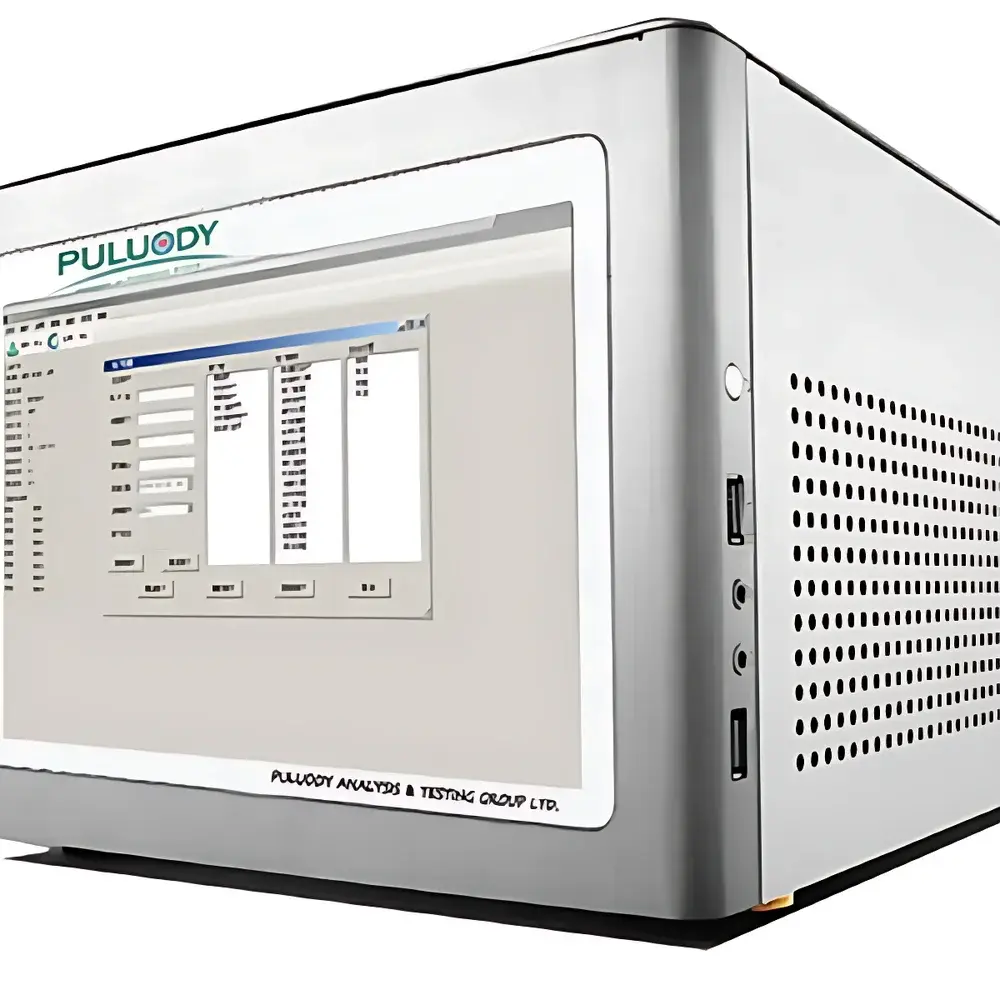
PULUODY PMT-2G Optical Liquid Particle Counter
| Brand | PULUODY |
|---|---|
| Origin | Shaanxi, China |
| Manufacturer Type | Authorized Distributor |
| Country of Origin | China |
| Model | PMT-2G |
| Instrument Type | Optical Particle Counter |
| Detection Principle | Dual-Laser Narrow-Beam Light Scattering |
| Calibration Standards | JJG 1061, ISO 21501-2, Polystyrene Latex (PSL) Reference Spheres |
| Detection Range | 0.1–0.5 µm, 0.1–1.0 µm |
| Customizable Ranges | 1–100 µm or 4–70 µm (c), down to 0.1 µm (c) |
| Sampling Method | Precision Metering Piston Pump |
| Flow Control | Dual-Stage Electromagnetic + Piston Pump Regulation |
| Sample Volume Accuracy | < ±1% |
| Counting Accuracy | ±5% typical |
| Coincidence Limit | ≤5% error at 10,000 particles/mL |
| Output Interface | 4–20 mA analog output with programmable alarm threshold |
| Data Reporting | Particles per mL and ISO 4406 / NAS 1638 contamination code |
| Power Input | 100–265 VAC, 50–60 Hz |
| Operating Interface | Color TFT LCD touchscreen + optional wireless keyboard/mouse |
| Software | PULUODY V8.3 Integrated Analysis & Calibration Suite (PC & embedded versions) |
| Compliance | Designed for GLP/GMP environments |
Overview
The PULUODY PMT-2G Optical Liquid Particle Counter is an advanced inline and offline particle monitoring instrument engineered for high-sensitivity detection and quantification of suspended solid contaminants in ultrapure and process-critical liquids. Utilizing eighth-generation dual-laser narrow-beam light scattering technology, the PMT-2G achieves sub-micron resolution with enhanced signal-to-noise ratio and minimal optical interference from liquid matrix effects. Its measurement principle relies on single-particle optical sensing (SPOS), where individual particles passing through two spatially separated laser beams generate coincident scattering pulses—enabling robust discrimination against false counts from bubbles, refractive index fluctuations, or background noise. This architecture is especially suited for applications demanding trace-level particulate control, including semiconductor wafer cleaning fluids, photomask rinsing solutions, flat-panel display etchants, and nanopore-filtered ultrapure water (UPW) streams compliant with SEMI F63 and ASTM D5127 standards.
Key Features
- Dual-laser narrow-beam sensor with independent wavelength alignment and beam collimation—optimized for simultaneous detection across multiple size thresholds without spectral crosstalk.
- Hybrid flow control system integrating a precision metering piston pump and ultra-stable electromagnetic flow regulator, ensuring repeatable sample delivery at rates from 1 to 100 mL/min with volumetric accuracy better than ±1%.
- Modular optical path design supporting both oil- and water-based matrices—validated for use with organic solvents, polymer solutions, aqueous electrolytes, and low-conductivity UPW.
- Embedded V8.3 firmware with segregated calibration and analysis modules, eliminating software-induced drift during long-term deployment or multi-shift operation.
- Real-time analog output (4–20 mA) with configurable alarm thresholds for integration into SCADA, DCS, or MES platforms—enabling automated process interlock and preventive maintenance triggers.
- Touchscreen HMI with intuitive workflow navigation and optional wireless peripheral support for glove-compatible operation in cleanroom environments (ISO Class 5 or better).
Sample Compatibility & Compliance
The PMT-2G is validated for direct analysis of low-viscosity, optically transparent liquids with refractive index contrast ≥0.02 relative to the carrier medium. Compatible sample types include deionized water, hydrogen peroxide solutions, ammonium hydroxide mixtures, photoresist developers, CMP slurries (post-filtration), and pharmaceutical-grade solvents. It meets the physical and metrological requirements of ISO 21501-2:2019 for light extinction and light scattering particle counters, and supports traceable calibration using NIST-traceable polystyrene latex (PSL) reference standards or certified reference materials compliant with JJG 1061–2010. When deployed in regulated manufacturing settings—including semiconductor front-end fabs and biopharmaceutical purification suites—the system can be configured with electronic signatures, audit trails, and role-based access control to satisfy FDA 21 CFR Part 11, EU Annex 11, and ICH Q9/Q10 quality system expectations.
Software & Data Management
PULUODY V8.3 software provides full lifecycle data handling—from real-time histogram generation and cumulative distribution plotting to batch reporting, trend analysis, and contamination code assignment per ISO 4406:2017 and NAS 1638. The platform separates calibration management (requiring administrator privileges) from routine testing functions (operator-level access), enforcing procedural integrity during qualification and routine use. Raw pulse data are stored in vendor-neutral binary format with metadata tagging (timestamp, operator ID, method name, environmental conditions). Export options include CSV, PDF, and XML formats compatible with LIMS integration. Optional cloud synchronization enables remote diagnostics and fleet-wide performance benchmarking across geographically distributed facilities.
Applications
- In-line monitoring of ultrapure water loops in semiconductor fabrication plants—detecting >0.1 µm particles upstream and downstream of 2 nm-rated membrane filters.
- Offline verification of cleaning efficacy for silicon wafers, glass substrates, and microelectromechanical systems (MEMS) components using standardized rinse protocols.
- Quality control of nano-dispersions in battery electrode slurries, conductive inks, and quantum dot formulations where agglomerate formation impacts functional performance.
- Validation of final filtration steps in sterile drug product manufacturing—supporting USP and Ph. Eur. 2.9.19 particulate matter testing requirements when used as a complementary tool.
- Research-grade characterization of colloidal stability in polymer emulsions, liposomal suspensions, and nanocellulose dispersions under controlled shear and temperature conditions.
FAQ
What particle size ranges does the PMT-2G support out-of-the-box?
The standard configuration covers 0.1–0.5 µm and 0.1–1.0 µm detection channels. Custom optical modules are available for extended ranges including 1–100 µm or 4–70 µm(c), with detection limit down to 0.1 µm(c) upon request.
Can the PMT-2G be integrated into an existing PLC-controlled production line?
Yes—it features isolated 4–20 mA analog output with programmable alarm setpoints and digital status flags, enabling seamless interfacing with Allen-Bradley, Siemens, and Mitsubishi PLCs via standard current-loop protocols.
Is the instrument suitable for measuring particles in organic solvents such as acetone or IPA?
Yes, provided the solvent is optically clear and non-corrosive to wetted materials (316L SS, fused silica, PEEK). Compatibility validation data are available for common semiconductor-grade solvents per SEMI C1–C10 specifications.
Does the system comply with regulatory requirements for data integrity in GMP environments?
When deployed with optional Part 11-compliant configuration (user authentication, electronic signatures, immutable audit trail), it supports inspection readiness for FDA, EMA, and PMDA audits.
How is calibration verified and maintained over time?
Calibration is performed using PSL reference spheres traceable to NIST SRM 1963 or ISO 21501-2 protocols. Field verification checks can be executed daily using built-in zero-check and reference pulse diagnostics; full recalibration is recommended every six months or after 1,000 operating hours.



