
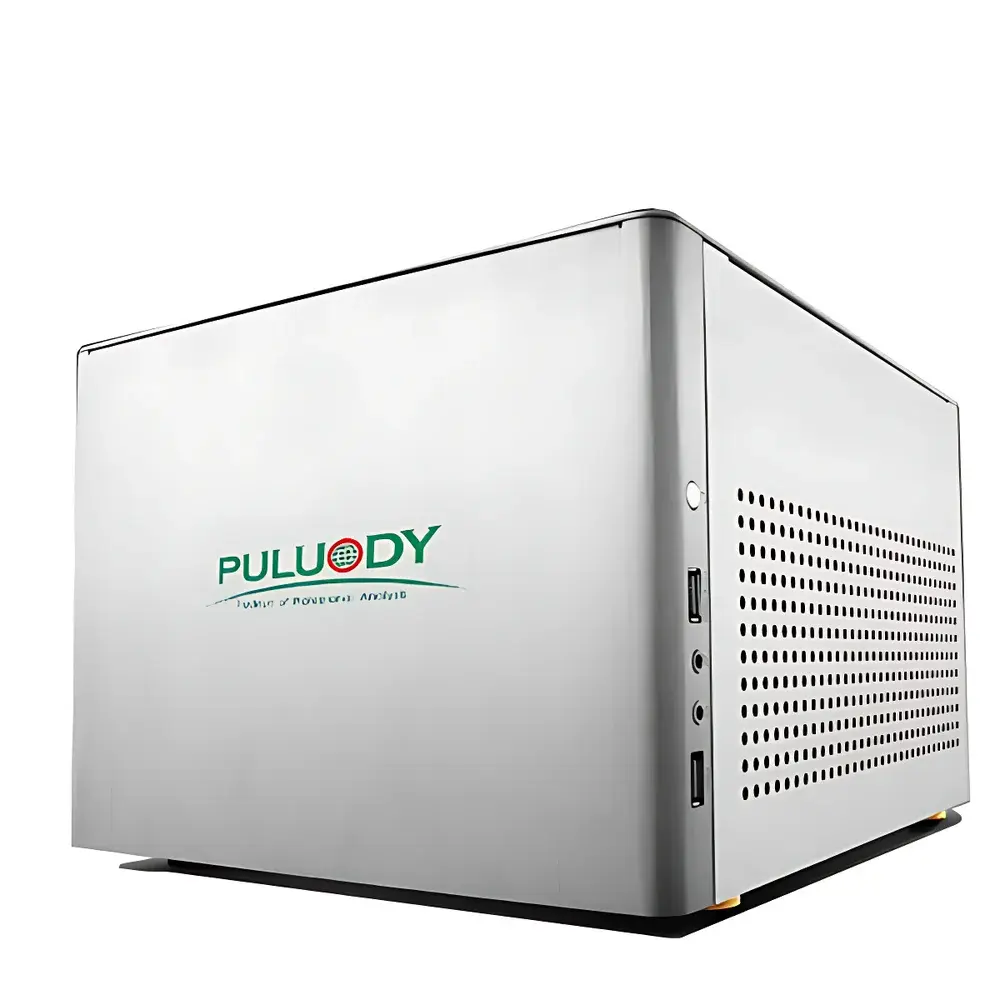
PULUODY PMT-2-41 Online Universal Liquid Particle Counter
| Brand | PULUODY |
|---|---|
| Origin | Shaanxi, China |
| Manufacturer Type | Authorized Distributor |
| Regional Classification | Domestic (China) |
| Model | PMT-2-41 |
| Instrument Type | Optical Particle Counter |
| Detection Principle | Dual-Laser Narrow-Beam Light Scattering |
| Calibration Standards | JJG 1061, ISO 21501-2, Polystyrene Latex (PSL) Spheres |
| Measurement Range | 0.1–1.0 µm, 0.2–2.0 µm, 0.5–5.0 µm (customizable from 1–100 µm or 4–70 µm(c) |
| Sampling Accuracy | < ±1% |
| Counting Accuracy | ±5% typical |
| Coincidence Limit | 10,000 particles/mL (5% coincidence error) |
| Flow Control | Precision Piston Pump + Electromagnetic Flow Regulation |
| Output Interface | 4–20 mA analog output with customizable alarm trigger |
| Data Acquisition | iPad-integrated real-time acquisition |
| Software | V8.3 Integrated Analysis & Calibration Software (PC & Standalone Mode) |
| Display & Control | Color LCD touchscreen + optional wireless keyboard/mouse |
| Power Input | 100–265 VAC, 50–60 Hz |
| Reporting | Particles per mL + ISO 4406 / NAS 1638 / SAE AS4059 contamination grade classification |
Overview
The PULUODY PMT-2-41 Online Universal Liquid Particle Counter is an industrial-grade optical particle counter engineered for continuous, real-time monitoring of solid particulate contamination in ultra-clean and process-critical liquid streams. Based on the eighth-generation dual-laser narrow-beam light scattering detection principle, the instrument delivers high-sensitivity, high-reproducibility particle enumeration across sub-micron to micron size ranges. Its core sensor architecture employs two spatially separated laser sources with tightly collimated beams—minimizing Mie scattering interference and enabling robust discrimination of low-refractive-index particles (e.g., silica, polymers, organics) in aqueous and non-aqueous media. Designed for integration into semiconductor wet benches, ultrapure water (UPW) distribution loops, flat-panel display cleaning lines, and pharmaceutical water-for-injection (WFI) systems, the PMT-2-41 operates under ISO 21501-2-compliant optical design principles and supports traceable calibration via NIST-traceable PSL standards or certified reference materials per JJG 1061.
Key Features
- Dual-laser narrow-beam optical detection system with optimized signal-to-noise ratio for reliable 0.1 µm(c) sensitivity in clean liquids
- Integrated precision piston pump and electromagnetic flow regulator ensuring volumetric sampling accuracy better than ±1% and long-term flow stability
- Modular channel configuration supporting up to three simultaneous size thresholds (e.g., 0.2/0.5/5.0 µm) with independent gain and threshold tuning
- Real-time analog output (4–20 mA) with programmable alarm thresholds for PLC or DCS integration in GMP and SEMI-compliant facilities
- Touchscreen HMI with intuitive workflow navigation; optional wireless keyboard/mouse support for advanced parameter configuration and diagnostics
- IPad-based data acquisition module enabling secure, timestamped, and geotagged logging without PC dependency
- Hardware-level coincidence correction algorithm validated at particle concentrations up to 10,000 particles/mL (≤5% error)
Sample Compatibility & Compliance
The PMT-2-41 is validated for use with deionized water, UPW, solvent-based cleaning agents (e.g., SC1, SC2), photoresist developers, polymer solutions, and low-viscosity organic solvents (e.g., IPA, acetone). It complies with ISO 21501-2:2019 for light-scattering particle counters and meets functional requirements outlined in SEMI F63 (for UPW monitoring), ASTM D7622 (for hydraulic fluid cleanliness), and USP Annex (for visible and subvisible particle testing in parenterals when used in offline mode with appropriate sample preparation). All firmware and software modules are structured to support audit trails, electronic signatures, and data integrity per FDA 21 CFR Part 11 when deployed in regulated environments.
Software & Data Management
The V8.3 Integrated Analysis & Calibration Software provides dual-mode operation: a standalone calibration module (separate from test execution) ensures metrological separation between instrument verification and routine analysis—eliminating software-induced bias during validation. The platform supports automated report generation in PDF and CSV formats, with configurable templates aligned to ISO 4406, NAS 1638, and SAE AS4059 contamination codes. Raw scatter pulse data is stored with full metadata (flow rate, temperature, pressure, operator ID, calibration certificate ID), enabling retrospective reanalysis and trend modeling. Audit logs record all user actions, parameter changes, and calibration events with immutable timestamps.
Applications
- Real-time particulate monitoring in semiconductor fab UPW loops and chemical delivery systems
- In-line cleanliness verification of TFT-LCD and OLED panel cleaning baths
- Contamination control in silicon wafer slurry recirculation and rinse tanks
- Validation of nanofiltration and ultrafiltration membrane integrity in biopharma water systems
- Offline particle characterization of medical device rinsates and injectable excipient solutions
- Process qualification of microfluidic device fabrication fluids and photolithography resists
FAQ
Is the PMT-2-41 suitable for measuring particles in organic solvents?
Yes—it supports stable operation in low-viscosity solvents including isopropyl alcohol, acetone, and ethyl lactate, provided wetted materials (quartz flow cell, PTFE tubing) remain chemically compatible.
Can the instrument be calibrated to ISO 21501-2 using customer-supplied PSL standards?
Yes—the V8.3 software includes a certified calibration wizard that accepts user-loaded PSL diameter distributions and refractive index parameters for traceable recalibration.
Does the system support 21 CFR Part 11 compliance out-of-the-box?
The hardware and firmware support required controls (audit trail, role-based access, electronic signature), but full Part 11 compliance requires site-specific validation documentation and IT infrastructure alignment.
What is the minimum detectable particle size under standard operating conditions?
The instrument achieves 0.1 µm(c) detection limit in ultrapure water with optimal alignment and zero-background conditioning; performance varies with liquid refractive index and turbidity.
Can multiple PMT-2-41 units be networked for centralized monitoring?
Yes—via Ethernet TCP/IP or Modbus TCP, enabling synchronized data streaming to SCADA or MES platforms with time-aligned event tagging.
Related Products



