
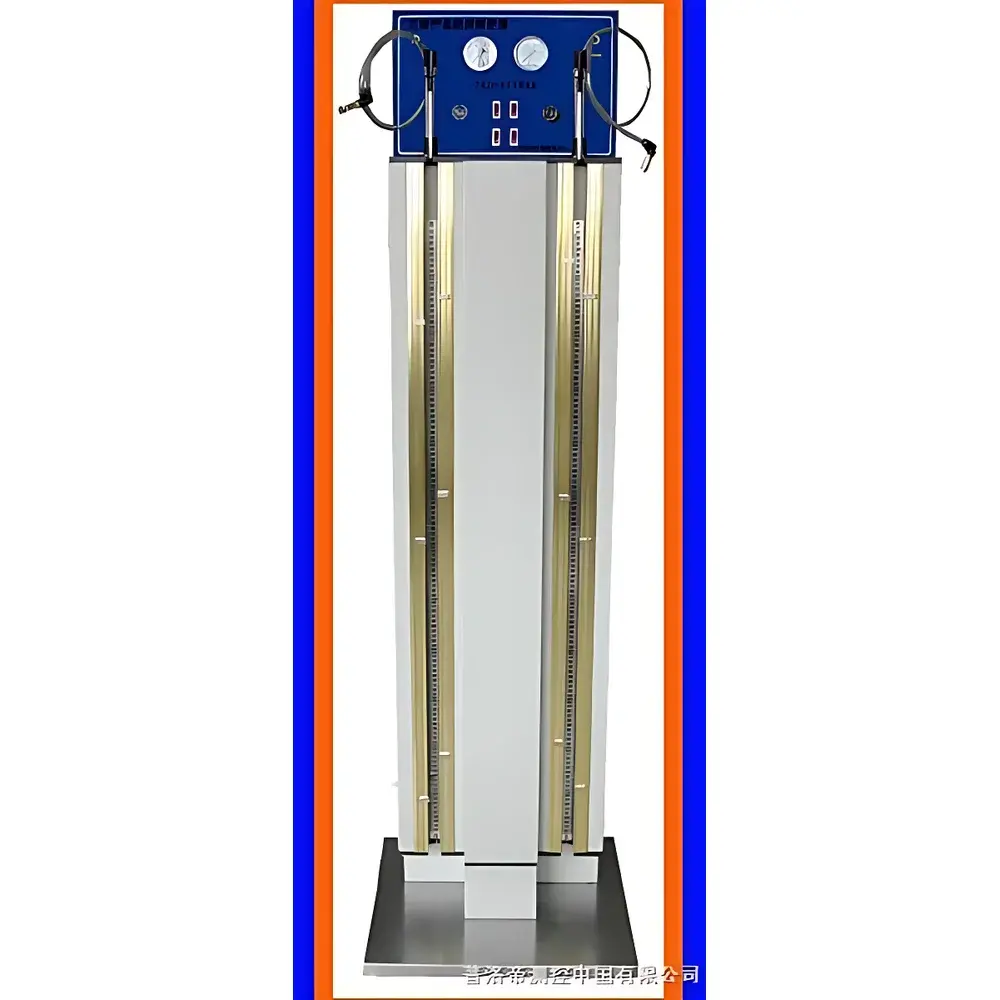
PULUODY PLD-11132A Liquid Petroleum Hydrocarbon Analyzer
| Brand | PULUODY |
|---|---|
| Origin | Shaanxi, China |
| Manufacturer Type | OEM Manufacturer |
| Country of Origin | China |
| Model | PLD-11132A |
| Pricing | Upon Request |
| Capillary Adsorption Column | Compliant with GB/T 11132 |
| Fluorescent Indicator | Imported silica gel or solution pre-impregnated with fluorescent dye |
| Silica Gel Mesh Size | 100–200 mesh |
| Oscillator Frequency | 100 Hz ± 2 Hz, Amplitude > 1.5 mm |
| UV Light Source Wavelength | 365 nm ± 5 nm |
| Structural Frame | Stainless steel square tubing, modular and mobile |
| Pressure Regulation | Adjustable per test requirement |
| Power Supply | AC 220 V, 50 Hz |
| Operating Environment | 10–30 °C, ≤80% RH |
Overview
The PULUODY PLD-11132A Liquid Petroleum Hydrocarbon Analyzer is a precision laboratory instrument engineered for the quantitative determination of hydrocarbon type composition—namely saturates, olefins, and aromatics—in liquid petroleum fractions. It operates in strict accordance with the principle of fluorescent indicator adsorption chromatography (FIAC), as defined in GB/T 11132, the Chinese national standard equivalent to ASTM D1319 for hydrocarbon type analysis. In this method, a sample is introduced onto a vertically oriented, activated silica gel column pre-coated with a fluorescent dye. Under ultraviolet illumination (365 nm), hydrocarbon bands become visually distinguishable due to differential adsorption affinities and fluorescence quenching behavior: saturates remain colorless or pale yellow, olefins appear blue-green, and aromatics fluoresce bright yellow-orange. The column is developed under controlled nitrogen pressure, and band lengths are measured directly against calibrated scales to calculate volume percentages of each hydrocarbon class. This technique provides traceable, operator-independent results when executed under standardized conditions and is widely accepted in refinery QC laboratories, fuel specification verification, and R&D for gasoline and middle-distillate formulation.
Key Features
- GB/T 11132–compliant capillary adsorption column assembly, manufactured to exact dimensional and surface activity specifications for reproducible band resolution.
- Imported fluorescent indicator system—either pre-impregnated silica gel or high-purity fluorescent dye solution—ensuring consistent chromatic contrast and minimal background interference.
- High-stability electric oscillator delivering precise 100 Hz ± 2 Hz frequency and >1.5 mm amplitude, critical for uniform sample dispersion and column packing integrity prior to development.
- Dedicated 365 nm UV light source with ±5 nm tolerance, optimized for maximum fluorescence excitation and minimal photodegradation of sensitive hydrocarbon fractions.
- Modular stainless-steel support frame fabricated from square tubing—rigid yet repositionable—facilitating alignment, maintenance access, and integration into constrained lab bench layouts.
- Adjustable regulated nitrogen inlet pressure control, enabling method-specific optimization across volatile (e.g., straight-run gasoline) and higher-boiling (e.g., kerosene, light diesel) samples.
- Designed for ambient operation between 10–30 °C and ≤80% relative humidity, eliminating need for climate-controlled enclosures in most regional laboratories.
Sample Compatibility & Compliance
The PLD-11132A is validated for use with light distillates meeting the scope of GB/T 11132 and ASTM D1319, including straight-run gasoline, naphtha, kerosene, and light diesel. It is not suitable for samples containing thermally cracked or catalytically reformed components—such as coker gasoline or FCC diesel—due to the presence of dienes, polynuclear aromatics, and heteroatom compounds that interfere with band separation and fluorescence response. All operational procedures align with GLP documentation requirements; raw chromatograms (photographic or digital image records), measurement logs, and environmental monitoring data can be archived for audit readiness. While the instrument itself does not embed electronic signature or 21 CFR Part 11 functionality, its analog workflow supports full traceability when paired with laboratory notebook practices compliant with ISO/IEC 17025 and CNAS accreditation criteria.
Software & Data Management
The PLD-11132A is an analog-dominant analytical platform: no embedded firmware, touchscreen interface, or proprietary software is included. Band length measurements are performed manually using a calibrated scale integrated into the column housing, and calculations follow the fixed formula in GB/T 11132 (e.g., % aromatics = LA / LT × 100). Users may digitize results via external spreadsheet templates or LIMS-compatible entry forms. For laboratories requiring automated reporting, optional third-party image analysis modules—capable of processing UV-lit column photographs—can be deployed independently, provided they undergo local validation per ICH Q2(R2) guidelines for analytical procedure verification.
Applications
- Quality control of refinery-produced straight-run gasoline to verify conformance with national fuel standards (e.g., GB 17930).
- Hydrocarbon group-type profiling during catalyst evaluation studies for hydrotreating and reforming units.
- Batch release testing of aviation turbine fuel (Jet A-1) intermediates where aromatic content must fall within specified limits (e.g., ASTM D1655 Annex A1).
- Forensic fuel analysis in customs and regulatory labs assessing adulteration or misblending of distillate streams.
- Academic research on adsorption thermodynamics of hydrocarbon classes on silica gel surfaces under controlled partial pressure environments.
FAQ
What standards does the PLD-11132A comply with?
It is designed and verified for full compliance with GB/T 11132 and functionally equivalent to ASTM D1319 for fluorescent indicator adsorption chromatography.
Can it analyze diesel containing FAME (biodiesel)?
No—fatty acid methyl esters exhibit non-linear migration and fluorescence interference; the method is restricted to petroleum-derived hydrocarbons only.
Is UV exposure hazardous during operation?
The 365 nm source emits low-intensity UVA radiation; standard lab safety protocols—including avoidance of direct eye exposure and use of UV-blocking safety glasses—are sufficient.
How often must the silica gel column be replaced?
Column lifetime depends on sample load and cleanliness; typical service life is 20–30 analyses for gasoline-range samples, with visual inspection for band smearing or fluorescence fading as the primary replacement criterion.
Does the instrument require calibration certification?
While no internal calibration is required, users must verify UV wavelength accuracy annually using a NIST-traceable spectral reference standard, and oscillator frequency should be checked with a digital tachometer at startup.
Related Products





