
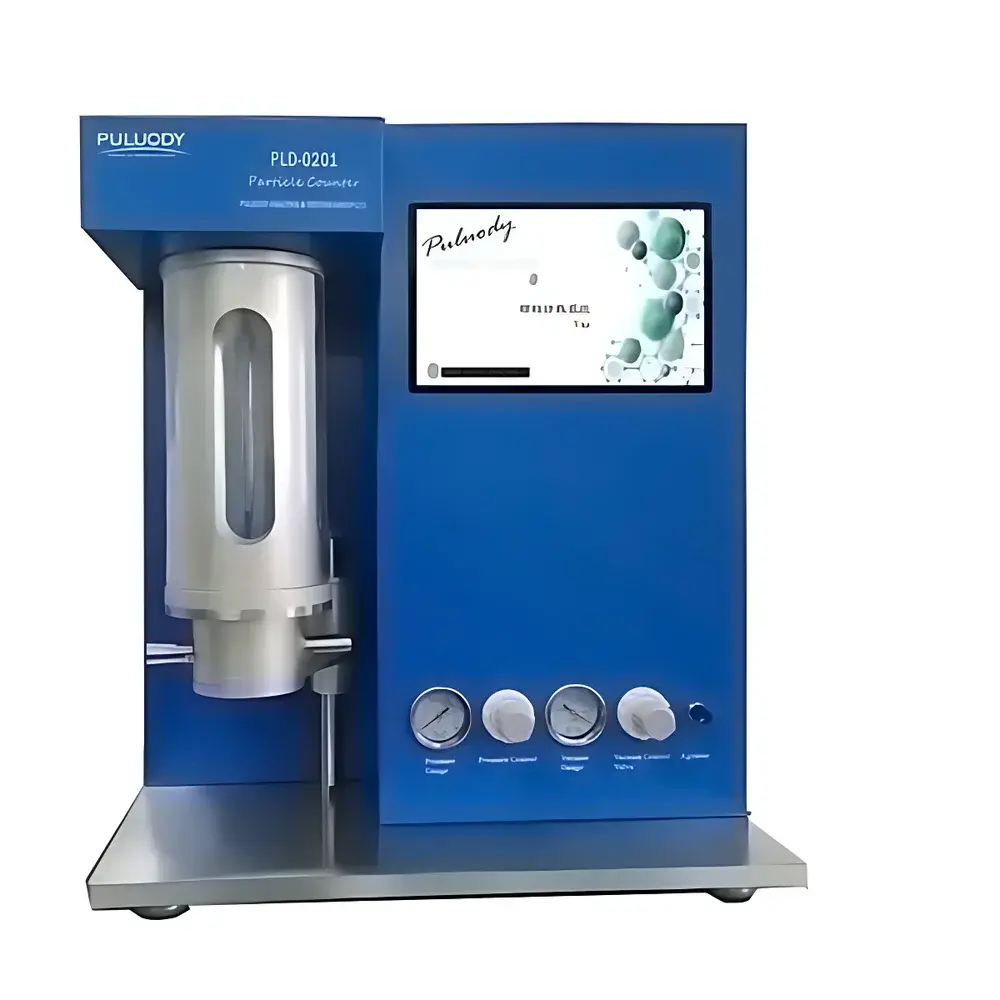
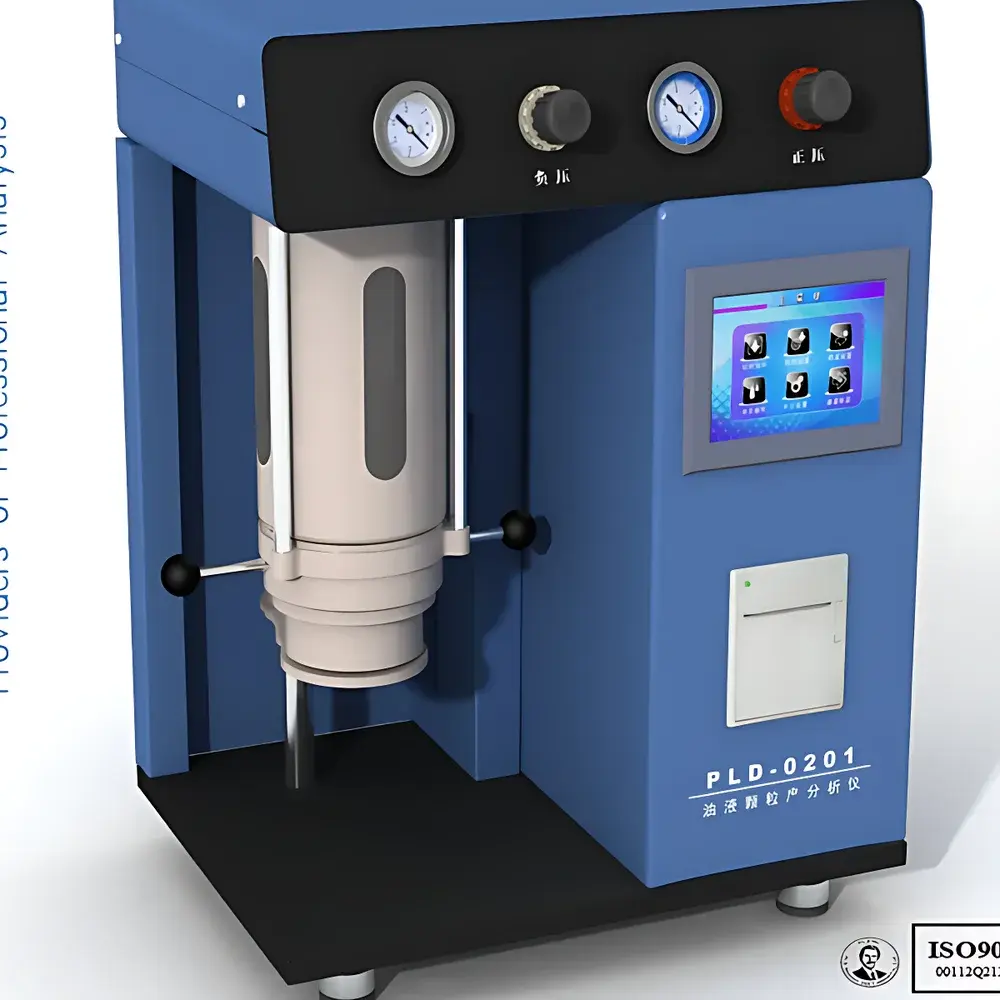
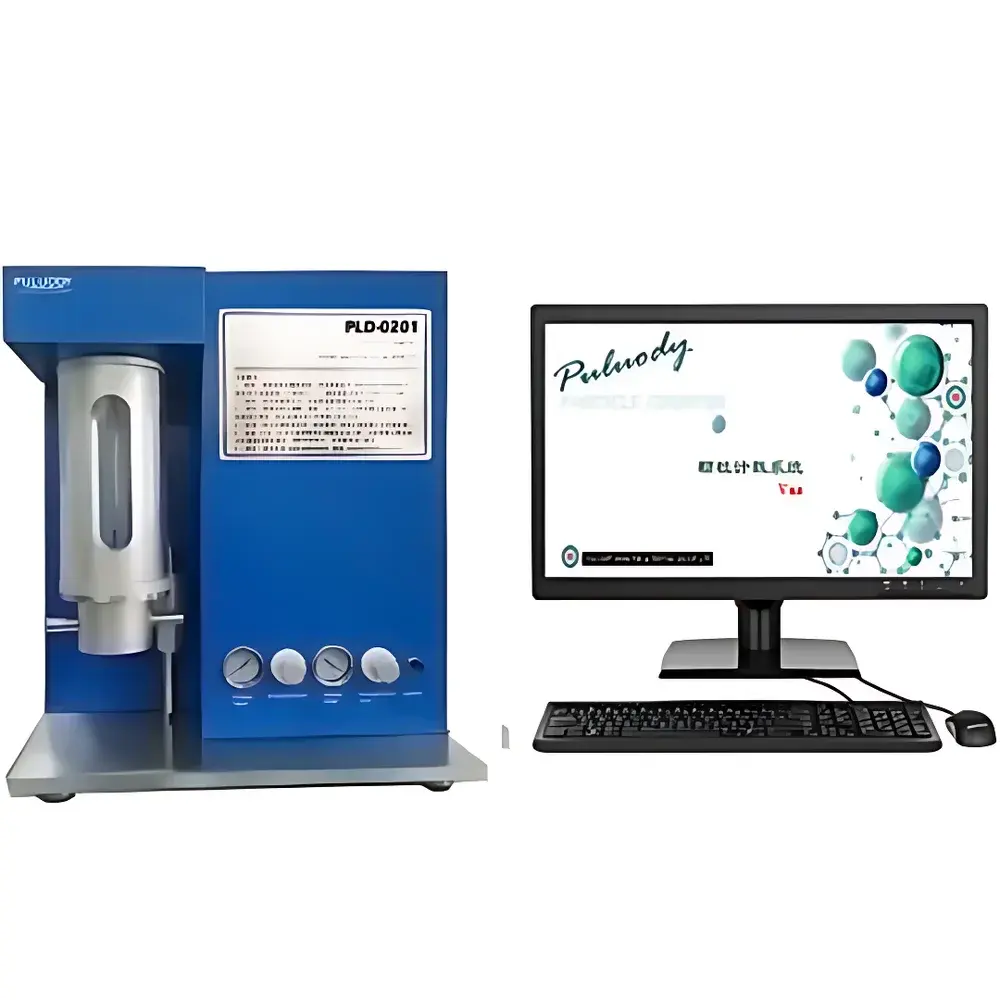
PULUODY PLD-0201-8 Optical Particle Counter for Turbine Lubricating Oil in Thermal Power Generation
| Brand | PULUODY |
|---|---|
| Origin | Shaanxi, China |
| Model | PLD-0201-8 |
| Instrument Type | Optical Particle Counter |
| Detection Principle | Light Obscuration (LO) |
| Calibration Standards | ISO 11171, ISO 4402, GB/T 18854 |
| Measurement Range | 1–1000 µm (configurable sensor |
| typical operational range | 0.5–600 µm) |
| Counting Accuracy | ≤5% coincidence error at 10,000 particles/mL |
| Reporting Standards | ISO 4406:1999/2017, NAS 1638, DL/T 1096, MOOG, ISO 11218 |
| Sample Volume | 1 mL to unlimited (programmable) |
| Flow Control | Precision piston pump + electromagnetic flow regulation |
| Sample Handling | Integrated pressure-assisted degassing, magnetic stirring, and high-viscosity compensation |
| Display & Interface | 7-inch TFT-LCD touchscreen with dual input (touch + keypad), embedded OS, thermal printer |
| Data Output | RS232 serial interface, histogram, size distribution curve, particle count per mL, contamination grade |
| Software | P6.4 Analysis Suite (embedded & PC versions) |
| Compliance Support | FDA 21 CFR Part 11 audit trail (via PC software), GLP/GMP traceability mode |
Overview
The PULUODY PLD-0201-8 Optical Particle Counter is a laboratory-grade, light obscuration (LO)-based instrument engineered for quantitative particulate contamination analysis of turbine lubricating oils used in thermal power generation systems. It operates on the principle of single-particle optical sensing: as oil flows through a precisely dimensioned detection zone, suspended particles interrupt a collimated laser beam, generating voltage pulses proportional to their cross-sectional area. These pulses are classified into user-defined size channels (e.g., ≥4 µm, ≥6 µm, ≥14 µm, ≥21 µm, ≥38 µm, ≥70 µm) to compute particle counts per milliliter and assign standardized contamination grades per ISO 4406 or NAS 1638. Designed specifically for high-viscosity mineral and synthetic turbine oils (ISO VG 32–100), the system integrates active sample conditioning—pressure-driven degassing, magnetic stirring, and temperature-stabilized flow—to minimize air bubble interference and ensure representative sampling of viscous, aged, or aerated fluids. Its architecture meets the metrological rigor required for condition-based maintenance (CBM) programs in critical rotating equipment where particle-induced wear (e.g., bearing spalling, journal scoring, servo valve stiction) directly impacts plant availability and safety.
Key Features
- 8th-generation dual-laser narrow-beam sensor: Enhanced signal-to-noise ratio and improved resolution for sub-5 µm particle discrimination in dark, opaque, or highly viscous oils.
- Programmable volumetric sampling: Precise piston pump delivers 1 mL to unlimited volume with ±0.5% volumetric accuracy, enabling statistically robust counts per ASTM D6786 and ISO 4406 Annex A.
- Integrated sample preparation module: Built-in pressure chamber (up to 0.5 MPa), variable-speed magnetic stirrer, and thermostatic flow path mitigate sedimentation, entrained gas, and viscosity-related laminar flow distortion.
- Multi-standard compliance engine: Preloaded algorithms for ISO 4406:2017, ISO 4406:1999, NAS 1638, MOOG 560, DL/T 1096–2008, and ISO 11218 allow real-time grade assignment without manual lookup tables.
- Embedded industrial control: Standalone operation via rugged 7-inch touchscreen HMI; no external PC required for measurement, reporting, or thermal printing of certified test reports.
- Traceable calibration framework: Supports ISO 11171:2010-accredited calibration using NIST-traceable PSL and ACFTD reference materials; full calibration log storage with operator ID and timestamp.
Sample Compatibility & Compliance
The PLD-0201-8 is validated for use with Group I–III mineral turbine oils, PAO- and ester-based synthetics, and fire-resistant phosphate esters (e.g., Fyrquel, Pyrostop). It accommodates viscosities up to 300 cSt at 40 °C and handles water content ≤0.1% w/w without emulsion-induced counting artifacts. All hardware and firmware comply with IEC 61000-6-3 (EMC) and IEC 61010-1 (safety). When operated with P6.4 PC software, the system supports 21 CFR Part 11-compliant electronic records—including user authentication, audit trails, electronic signatures, and immutable data archiving—meeting GLP and GMP documentation requirements for power utility QA/QC labs. Method validation per ISO/IEC 17025:2017 is supported through documented uncertainty budgets, repeatability studies (RSD ≤3% at 5000 p/mL), and interlaboratory comparison protocols.
Software & Data Management
The embedded P6.4 firmware provides real-time histogram generation, cumulative distribution curves, and dynamic channel reconfiguration. The optional PC-based P6.4 Suite extends functionality with statistical process control (SPC) charts, trend analysis across fleets, automated report generation (PDF/CSV/XLSX), and integration with CMMS platforms via ODBC or REST API. All raw pulse data—including amplitude, width, and time stamp—is retained for forensic reanalysis. Data encryption (AES-256), role-based access control, and configurable retention policies ensure alignment with ISO 27001 information security practices. Calibration certificates, method files, and test logs are digitally signed and time-stamped to satisfy regulatory inspection readiness.
Applications
- Routine acceptance testing of new turbine oil batches against OEM specifications (e.g., GEK 32568, Siemens TLV 9013).
- On-condition monitoring of in-service lube oil in steam turbines, hydro turbines, and gas turbine auxiliary systems.
- Verification of offline filtration efficiency (e.g., βx(c) ratio per ISO 16889) and vacuum dehydration performance.
- Root-cause analysis of abnormal wear debris patterns in conjunction with ferrography or elemental spectroscopy.
- Supporting ISO 4406-based oil change decisions per IEEE Std 1068 and DL/T 1096–2008 guidelines.
- Providing auditable evidence for insurance claims following catastrophic bearing failures attributed to particulate contamination.
FAQ
Does the PLD-0201-8 require annual recalibration?
Yes. Per ISO 11171:2010 and internal quality procedures, sensor verification using certified reference particles must be performed before each daily shift, and full recalibration is recommended every 12 months or after 5000 test cycles.
Can it measure particles in phosphate ester fire-resistant fluids?
Yes. The optical path design and wetted materials (316L SS, FKM seals, fused silica flow cell) are chemically compatible with common phosphate esters; viscosity compensation ensures accurate flow rate control.
Is the instrument suitable for field use or only lab environments?
The PLD-0201-8 is a benchtop laboratory instrument. For portable deployment, PULUODY offers the PLD-0203 and PMT-2 variants with battery operation and shock-mounted optics.
How does it handle air bubbles in sampled oil?
The integrated pressure-assisted degassing module reduces dissolved and free air content to <0.1% v/v, while the dual-laser detection logic discriminates bubble-induced transients from solid particles based on pulse shape and duration.
What standards govern its validation for power industry use?
Validation follows DL/T 1096–2008 (China), ISO 4406:2017, and IEEE Std 1068–2013; method equivalence to ASTM D6786 is documented in the instrument’s Type Approval Certificate issued by CNAS-accredited laboratories.



