
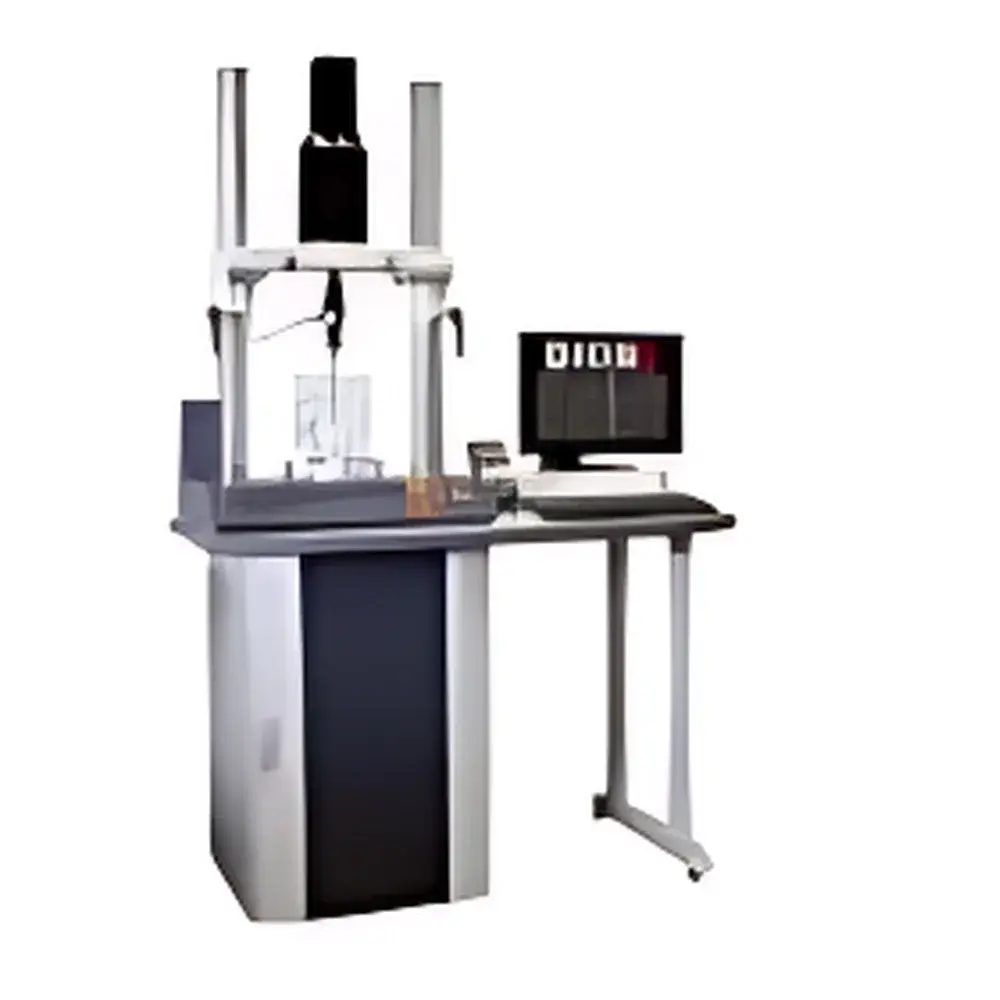
W+B LFV-E Electronic Dynamic Fatigue Testing Machine
| Brand | W+B |
|---|---|
| Origin | Switzerland |
| Model | LFV-E |
| Maximum Test Force | 600 kN |
| Frequency Range | up to 5000 Hz |
| Host Weight | 380 kg |
| Type | Electromechanical Resonant Fatigue Tester |
| Drive System | Servo-Electric, Upper Crosshead-Mounted |
Overview
The W+B LFV-E Electronic Dynamic Fatigue Testing Machine is a high-performance, servo-electric resonant fatigue testing system engineered for precision dynamic mechanical characterization under controlled cyclic loading. Unlike hydraulic or electrodynamic shaker-based systems, the LFV-E employs a direct-drive, upper crosshead-mounted servo-motor architecture that eliminates fluid compressibility, oil contamination risks, and thermal drift—enabling exceptional force fidelity, phase stability, and long-term repeatability across millions of load cycles. Designed in accordance with ISO 1099 (Metallic materials — Fatigue testing — Axial-force-controlled method) and ASTM E466 (Standard Practice for Conducting Force Controlled Constant Amplitude Axial Fatigue Tests), the LFV-E delivers traceable, GLP-compliant fatigue data for R&D laboratories, quality assurance departments, and regulatory submission workflows.
Key Features
- Servo-electric resonant drive system with integrated high-resolution torque motor and precision ball-screw transmission—ensuring zero backlash and sub-micron positioning accuracy.
- Robust dual-column frame with reinforced aluminum-alloy uprights and preloaded linear guideways, optimized for high stiffness (>500 kN/mm) and minimal transverse deflection during axial resonance.
- Real-time closed-loop control of force, displacement, and strain via high-bandwidth digital signal processor (DSP), supporting sinusoidal, block, sawtooth, and user-defined waveform profiles.
- Modular load cell integration (up to 600 kN capacity) with factory-calibrated NIST-traceable certification; optional high-sensitivity 1–2.5 kN miniature load cells available for biomaterial and micro-component testing.
- Integrated environmental compatibility: designed for seamless coupling with climate chambers (−70 °C to +300 °C), vacuum enclosures, and in-situ optical/SEM observation stages.
- Compliance with IEC 61000-6-2 (EMC immunity) and IEC 61000-6-4 (EMC emission) standards; CE-marked and compliant with Machinery Directive 2006/42/EC.
Sample Compatibility & Compliance
The LFV-E accommodates specimens ranging from miniature dental implants (Ø1–5 mm) and polymer sutures to large-scale structural composites (up to 300 mm gauge length). Standard fixtures include wedge-grip, pneumatic grip, and torsional adapters—each engineered to minimize stress concentration and ensure uniform load transfer per ISO 527-4 and ASTM D3410. For biomedical applications, the system supports USP verification protocols and meets essential requirements for ISO 14872 (Implants for surgery — Mechanical testing of orthopedic implants). All test configurations are documented with full audit trails for FDA 21 CFR Part 11 compliance when used with validated software modules.
Software & Data Management
Control and analysis are executed via W+B’s FATIGUEWARE™ v5.2—a Windows-based platform featuring dual-mode operation: real-time test supervision and offline post-processing. The software provides automated S–N curve generation, crack initiation threshold estimation (ΔKth), hysteresis loop analysis, and cycle counting per ASTM E1049. Raw data streams (force, displacement, strain, temperature) are recorded at ≥10 kHz sampling rate in HDF5 format, ensuring interoperability with MATLAB, Python (via h5py), and LIMS environments. Audit trail functionality includes user login tracking, parameter change logs, electronic signatures, and immutable data archiving—fully aligned with ALCOA+ principles for GxP-regulated environments.
Applications
- Mechanical evaluation of Ti-6Al-4V and CoCrMo orthopedic implants under physiological loading spectra (e.g., ISO 14801).
- Fatigue life prediction of carbon-fiber-reinforced polymer (CFRP) laminates used in aerospace primary structures.
- Cyclic degradation testing of hydrogels, electrospun nanofibers, and biodegradable scaffolds per ISO 13781.
- Reliability validation of MEMS actuators, solder joints, and flex circuit interconnects under thermomechanical cycling.
- High-cycle fatigue (HCF) screening of turbine blade alloys at resonant frequencies up to 5 kHz, with modal damping quantification.
FAQ
What distinguishes the LFV-E from hydraulic fatigue testers?
The LFV-E uses a direct-coupled servo-electric resonant drive—eliminating hydraulic fluid, noise, heat generation, and maintenance intervals associated with pump valves and seals.
Can the system perform push-pull testing at variable mean loads?
Yes—through programmable R-ratio (minimum stress / maximum stress) control, enabling tension-tension, compression-compression, and fully reversed loading profiles.
Is third-party calibration support available globally?
W+B-certified service engineers provide on-site calibration and ISO/IEC 17025-accredited verification through authorized partners in North America, EU, and APAC regions.
Does the system comply with FDA 21 CFR Part 11 for electronic records?
When deployed with FATIGUEWARE™ in 21 CFR Part 11 mode—including role-based access, electronic signatures, and audit trail export—the system meets predicate rule requirements for regulated submissions.
What is the typical lead time for delivery and commissioning?
Standard delivery is 14–16 weeks ex-works Zurich; installation, mechanical alignment, and IQ/OQ documentation require an additional 3–5 days on-site by W+B field application engineers.



