
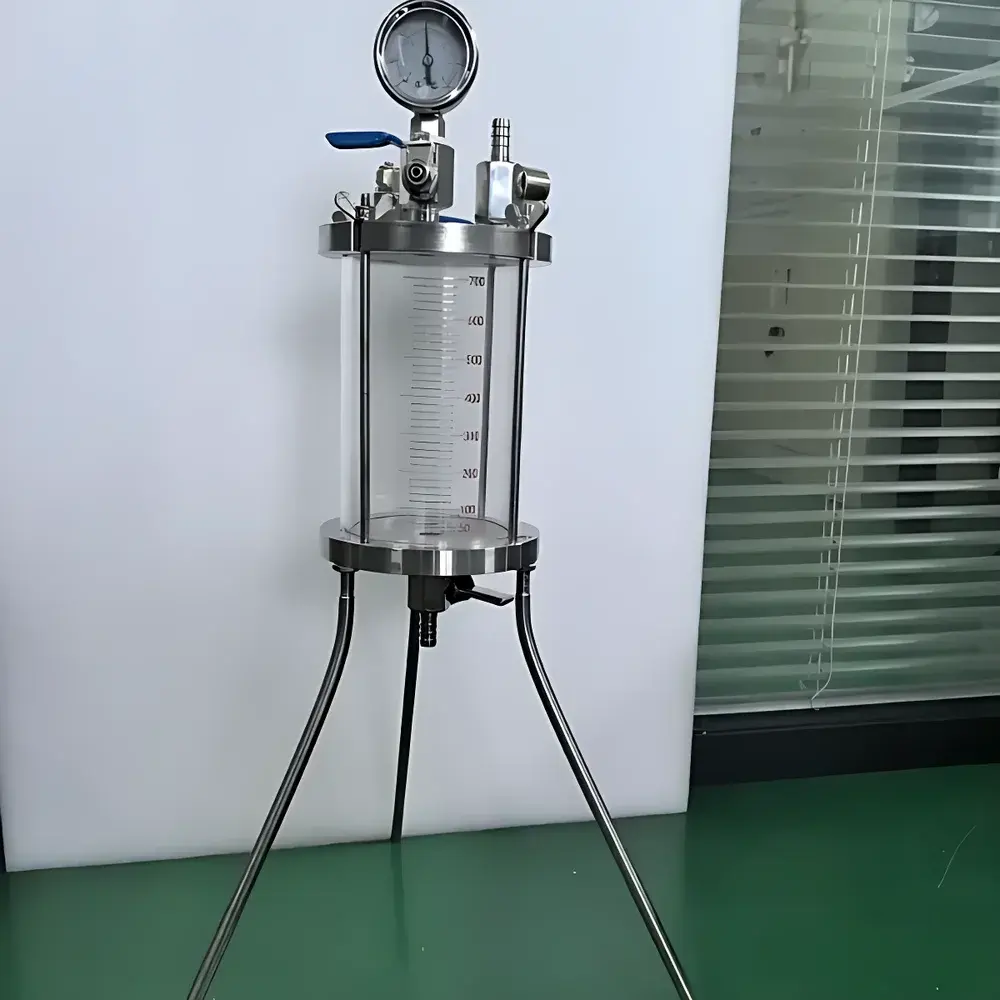
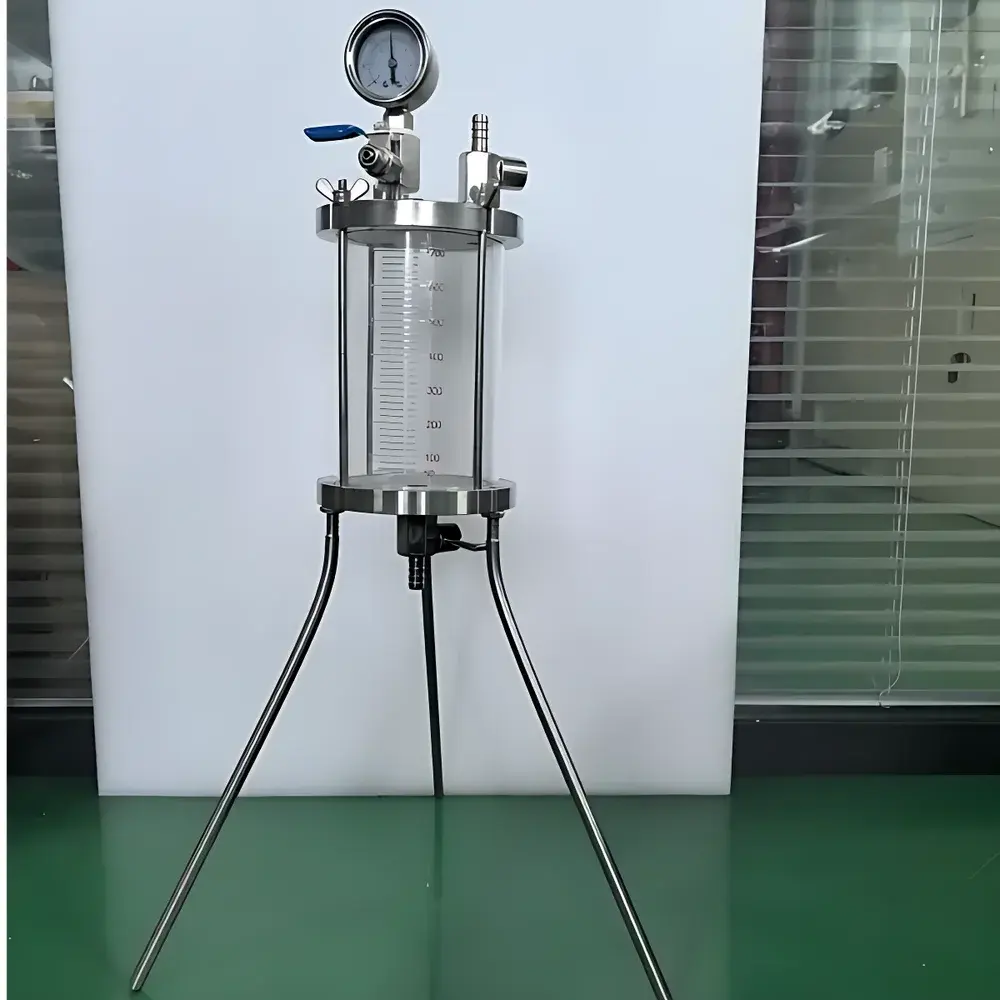
PULUODY PSD-351B Microfiltration Experimental Apparatus for Suspended Solids Determination
| Brand | PULUODY |
|---|---|
| Origin | Shaanxi, China |
| Manufacturer Type | Authorized Distributor |
| Country of Origin | China |
| Model | PSD-351B |
| Price | USD 1,620 (approx.) |
| Applicable Standards | SY/T 5329–2012, GB 11901–1989, GB/T 11133, GB/T 606, GB 7600 |
| Gas Source | Nitrogen (user-supplied or optional integrated regulator) |
| Filtration Area | φ43 mm polymer membrane |
| Sample Volume Capacity | 3500 mL |
| Dimensions (W×D×H) | ≤500×500×800 mm |
| Temperature Monitoring | Digital thermometer with ambient display |
| Timing Method | Precision stopwatch integration |
| Filtration Control | Integrated pressure regulation, bleed valve, inlet/outlet valves, pressure gauge |
| Membrane De-aeration Function | Yes |
| Construction Materials | Borosilicate organic glass, 316 stainless steel, corrosion-resistant fittings |
| Compliance | Designed for GLP-compliant suspended solids quantification per gravimetric methodology |
Overview
The PULUODY PSD-351B Microfiltration Experimental Apparatus is a precision-engineered gravimetric system designed for the quantitative determination of suspended solids (SS) in aqueous samples according to internationally recognized standard methodologies. It operates on the principle of controlled-pressure membrane filtration: a known volume of sample is driven through a standardized high-molecular-weight polymer filter membrane (diameter 43 mm) under regulated nitrogen gas pressure. The retained particulate matter is dried and weighed, enabling calculation of SS concentration (mg/L) per ASTM D5907 and ISO 11923 protocols—both harmonized with GB 11901–1989 and SY/T 5329–2012. Unlike vacuum-based systems, the PSD-351B employs positive-pressure nitrogen delivery, eliminating vacuum-induced membrane distortion and ensuring consistent flux across heterogeneous particulate loads. Its compact footprint (≤500×500×800 mm), modular stainless-steel/organic-glass architecture, and ambient temperature compensation capability make it suitable for field-deployable labs, water quality monitoring stations, and upstream oilfield injection water QA/QC facilities.
Key Features
- Regulated nitrogen-driven filtration: Eliminates suction variability; supports reproducible transmembrane pressure control via integrated pressure regulator and calibrated gauge (0–0.6 MPa range)
- Dedicated de-aeration function: Built-in purge pathway removes entrapped air from membrane surface prior to filtration—critical for accurate volumetric throughput measurement
- Gravimetric compliance architecture: Filter holder and collection vessels designed for direct post-drying weighing without transfer loss; compatible with Class A analytical balances (0.1 mg resolution)
- Real-time environmental monitoring: Digital thermometer displays ambient temperature adjacent to filtration chamber—enabling thermal expansion correction per ISO 5667-3 guidelines
- Modular valve train: Six-function manifold (inlet, outlet, bleed, pressure relief, sample fill, filtrate discharge) permits flexible procedural sequencing and leak-tight isolation
- Chemically inert wetted path: 316 stainless steel fittings, borosilicate-view organic glass chambers, and fluoropolymer-sealed valves ensure compatibility with aggressive industrial effluents and high-salinity injection waters
Sample Compatibility & Compliance
The PSD-351B accommodates a broad spectrum of challenging matrices: surface water, groundwater, municipal wastewater, petrochemical process streams, and produced water from碎屑岩 (clastic) reservoirs. Its 3500 mL sample reservoir enables single-run analysis of low-concentration samples while maintaining statistical representativeness per ISO 5667-2 sampling protocols. All operational parameters—including pressure ramping rate, hold time, and final vacuum drying duration—are fully documentable to support 21 CFR Part 11–compliant audit trails when paired with validated LIMS integration. The apparatus meets essential requirements for GLP and GMP environments: traceable calibration of pressure transducers (NIST-traceable certificate optional), documented material certifications (EN 10204 3.1), and mechanical design conforming to IEC 61000-6-2 EMC immunity standards.
Software & Data Management
While the PSD-351B operates as a hardware-controlled standalone instrument, its procedural workflow is structured to interface seamlessly with laboratory informatics systems. Each test sequence generates a metadata-rich log including timestamp, ambient temperature, applied pressure, filtration duration, initial/final membrane mass (tare and gross), and calculated SS value. These fields map directly to common LIMS templates (e.g., Thermo Fisher SampleManager, LabVantage) via CSV export. Optional USB data logger modules provide continuous pressure/temperature profiling synchronized with stopwatch triggers—enabling kinetic analysis of filter cake formation rates. All firmware updates and calibration certificates are distributed through PULUODY’s secure customer portal, compliant with ISO/IEC 17025 documentation retention mandates.
Applications
- Oilfield injection water qualification: Verification of SS < 2 mg/L per SY/T 5329–2012 clastic reservoir specifications
- Environmental compliance reporting: EPA Method 160.2 and China’s HJ 91.1–2019 wastewater discharge monitoring
- Drinking water treatment validation: Pre- and post-filtration SS profiling across coagulation-sedimentation-filtration trains
- Pharmaceutical water system auditing: USP purified water particulate load assessment using 0.45 µm membranes
- Research-scale membrane fouling studies: Quantitative correlation of SS composition (via SEM-EDS of dried retentate) with hydraulic resistance development
FAQ
What nitrogen pressure range is recommended for routine operation?
Standard operating pressure is 0.1–0.3 MPa; higher pressures (up to 0.6 MPa) may be used for viscous or high-solids samples—but require verification against membrane burst rating.
Can the PSD-351B accommodate alternative membrane diameters?
No—the system is mechanically optimized for 43 mm circular polymer membranes; non-standard sizes compromise sealing integrity and flow uniformity.
Is temperature compensation automated or manual?
Ambient temperature is measured and displayed digitally; users apply ISO 5667-3 thermal correction factors manually during final SS calculation.
Does the apparatus include a built-in drying oven?
No—drying is performed externally in a certified laboratory oven (103–105°C, 2 hours minimum); the PSD-351B provides dedicated cooled handling tools for safe membrane transfer.
How is calibration traceability maintained?
Pressure gauges and thermometers ship with individual NIST-traceable calibration certificates; annual recalibration services are available through PULUODY’s ISO/IEC 17025-accredited service centers.






