
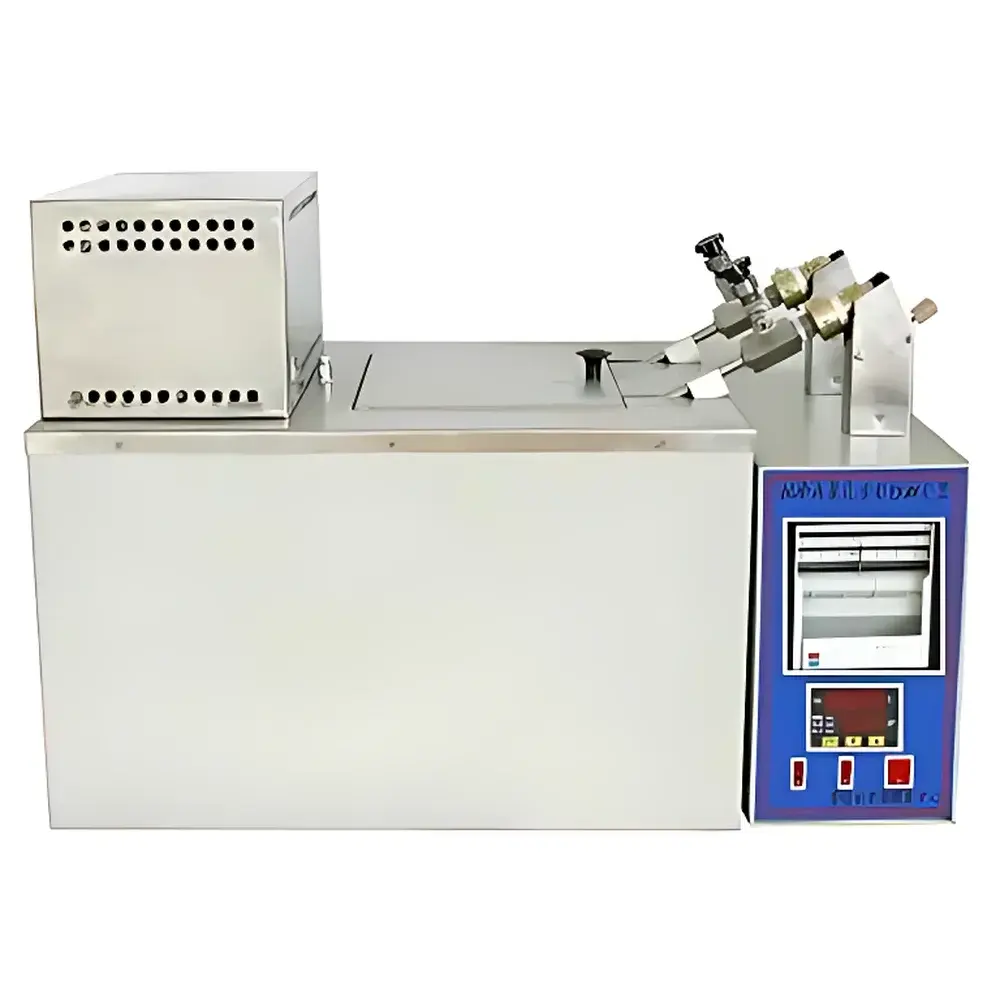
PULUODY PLD-0193A Petroleum Product Oxidation Stability Tester
| Brand | PULUODY |
|---|---|
| Origin | Shaanxi, China |
| Manufacturer Type | Direct Manufacturer |
| Country of Origin | China |
| Model | PLD-0193A |
| Power Supply | AC 220 V ±10%, 50 Hz |
| Main Heating Power | 1500 W |
| Auxiliary Heating Power | 1200 W |
| Pressure Gauge Range | 0–1500 kPa |
| Pressure Gauge Accuracy | ±0.2% FS |
| Oil Bath Temperature Range | 100–160 °C |
| Oil Bath Temperature Stability | ±0.1 °C |
| Printer Model | TpuP-A40PB |
Overview
The PULUODY PLD-0193A Petroleum Product Oxidation Stability Tester is a precision-engineered benchtop instrument designed for the quantitative assessment of oxidative degradation resistance in lubricating oils and related petroleum-based fluids. It operates on the rotating pressure vessel oxidation test (RPVOT) principle—defined by SH/T 0193 (Chinese national standard) and ASTM D2272 (Standard Test Method for Oxidation Stability of Turbine Oils by Rotating Pressure Vessel)—which measures the time required for a defined pressure drop (typically 25.4 kPa or 3.69 psi) to occur in an oxygen-pressurized system containing oil, distilled water, and a copper catalyst coil under controlled thermal and mechanical stress. This method simulates accelerated aging conditions representative of long-term service exposure, enabling predictive evaluation of antioxidant depletion, sludge formation propensity, and base oil stability. The instrument integrates thermally stable silicone oil bath immersion, precise rotational dynamics, and high-fidelity pressure monitoring to deliver repeatable, standards-compliant results essential for quality control, formulation development, and regulatory compliance in refinery, lubricant manufacturing, and power generation laboratories.
Key Features
- Microcontroller-based embedded system with real-time data acquisition, automated test termination upon pressure threshold detection, and timestamped event logging.
- Dual-zone heating architecture: primary 1500 W immersion heater for rapid oil bath temperature ramping; auxiliary 1200 W heater for improved thermal uniformity and reduced gradient across the bath volume.
- Precision oil bath temperature control within ±0.1 °C over the operational range (100–160 °C), validated per ASTM E77 and ISO 17025 traceable calibration protocols.
- Rotating oxygen bomb assembly with adjustable 30° tilt angle and precisely regulated 100 rpm axial rotation—mechanically isolated from the bath to minimize vibration-induced measurement noise.
- High-stability digital pressure transducer (0–1500 kPa full scale, ±0.2% FS accuracy) with zero-drift compensation and temperature-corrected output.
- Integrated thermal printer (TpuP-A40PB) for immediate hardcopy output of test parameters, start/stop timestamps, pressure decay curve summary, and pass/fail status relative to specification thresholds.
Sample Compatibility & Compliance
The PLD-0193A accommodates standard ASTM D2272-compliant glass sample vessels (typically 100 mL capacity) and supports testing of turbine oils, hydraulic fluids, transformer insulating oils, engine oils, and other mineral- or synthetic-based lubricants. It fully conforms to the physical setup, procedural sequence, and acceptance criteria outlined in SH/T 0193 and ASTM D2272. The system design facilitates adherence to Good Laboratory Practice (GLP) requirements, including operator identification, instrument calibration records, raw pressure vs. time data retention, and audit-ready test reports. While not inherently 21 CFR Part 11 compliant, its data output structure supports integration into validated LIMS environments where electronic signature and audit trail functionality are externally managed.
Software & Data Management
The instrument operates via a dedicated firmware interface displayed on a high-contrast dot-matrix LCD screen with tactile membrane keypad navigation. All test configurations—including target temperature, pressure alarm threshold, rotation duration limits, and user-defined sample ID—are stored in non-volatile memory. Raw pressure readings are sampled at 1-second intervals and internally buffered; final test reports include interpolated pressure decay slope, time-to-threshold, and deviation from setpoint temperature history. Export is limited to printed output; however, ASCII-formatted data can be extracted via optional RS-232 serial interface (available as field-upgrade kit) for import into Excel, MATLAB, or laboratory information management systems (LIMS). Calibration constants and maintenance logs are password-protected and modifiable only by authorized technicians.
Applications
- Quality assurance of new lubricant batches prior to release—verifying conformance to OEM specifications (e.g., GEK 32568, Siemens TLV 9013, ISO 8502).
- Antioxidant package screening during R&D—comparing candidate additives or blend ratios under identical oxidative stress conditions.
- In-service oil monitoring—assessing remaining useful life (RUL) of turbine and transformer oils in power plants and industrial facilities.
- Regulatory submission support—generating standardized RPVOT data for technical dossiers submitted to CNPC, Sinopec, or international certification bodies.
- Failure analysis investigations—correlating low oxidation stability with field-reported sludging, varnish deposition, or viscosity increase in critical rotating equipment.
FAQ
What standards does the PLD-0193A explicitly support?
It is engineered to execute tests strictly in accordance with SH/T 0193 and ASTM D2272, including prescribed sample preparation, oxygen partial pressure (620 kPa), bath temperature setpoints (140 °C for insulating oils, 150 °C for turbine oils), and rotation geometry.
Is the instrument suitable for testing synthetic ester-based lubricants?
Yes—provided the fluid remains chemically stable under 150 °C and 620 kPa O₂, and does not degrade the copper catalyst coil or glass sample vessel within the test duration; users should verify material compatibility per manufacturer guidance.
How is temperature uniformity verified across the oil bath?
The system employs dual-sensor feedback (immersion probe + surface reference) and adaptive PID control; verification requires independent NIST-traceable thermometer mapping at three radial positions and two depths per ASTM D1500 Annex A1.
Can test data be exported digitally without printing?
Native digital export is not supported; however, the optional RS-232 module enables ASCII stream output of time-stamped pressure values and metadata for external capture and post-processing.
What maintenance intervals are recommended for pressure sensor calibration?
Annual recalibration against a certified deadweight tester or master pressure calibrator is advised; more frequent checks (quarterly) are recommended in high-throughput QC labs or after any mechanical shock to the oxygen bomb assembly.



