
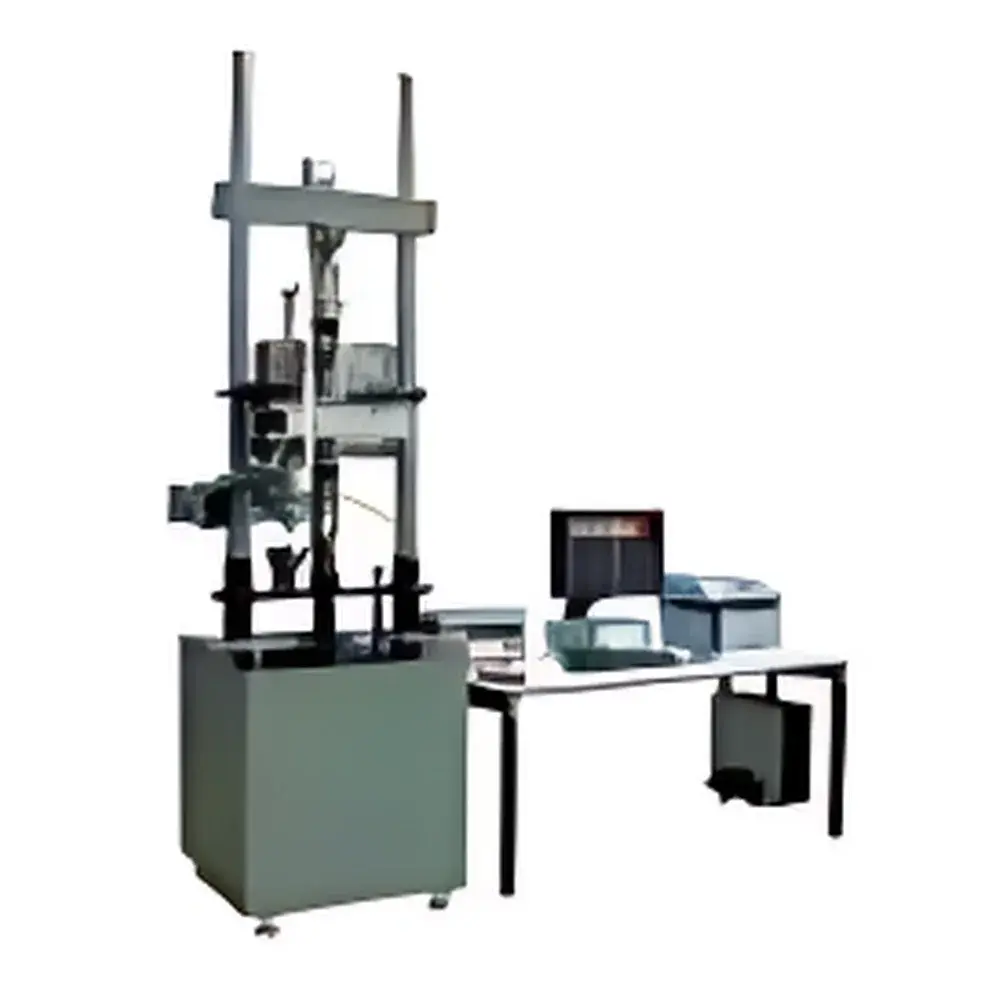
W+B LFMZ Series Creep and Stress Rupture Testing Machine
| Brand | W+B |
|---|---|
| Origin | Switzerland |
| Model | LFMZ |
| Instrument Type | Electromechanical |
| Maximum Test Force | 600 kN |
| Maximum Crosshead Travel | 100 mm |
| Dimensions (W×D×H) | 800 × 900 × 3000 mm |
| Weight | 1000 kg |
Overview
The W+B LFMZ Series Creep and Stress Rupture Testing Machine is a high-precision, electromechanical testing system engineered for long-term mechanical characterization of materials under sustained load conditions. Based on the fundamental principles of uniaxial tensile creep deformation—governed by time-dependent viscoelastic and viscoplastic response—the LFMZ platform utilizes a brushless servo motor coupled to a preloaded, zero-backlash central ball screw drive. This architecture ensures exceptional force stability, minimal thermal drift, and sub-micron positional resolution over extended test durations—critical for compliance with ISO 204 (Metallic materials — Uniaxial creep testing in tension), ASTM E139 (Standard Test Methods for Conducting Creep, Creep-Rupture, and Stress-Rupture Tests of Metallic Materials), and EN 10002-5. Designed specifically for creep, stress relaxation, and low-cycle fatigue (LCF) testing at ambient and elevated temperatures (when integrated with compatible environmental chambers), the LFMZ delivers reproducible data for metallurgical qualification, component life prediction, and regulatory submissions in aerospace, power generation, and nuclear sectors.
Key Features
- Electromechanical actuation with brushless servo motor and preloaded central ball screw—eliminates backlash and ensures force linearity across full stroke
- High-stiffness frame construction (1000 kg mass) optimized for long-duration static loading; vibration-damped base mounting interface
- Precise displacement control over 100 mm travel range, calibrated to ±0.01 mm accuracy per ISO 7500-1 Class 0.5
- Integrated load cell with 600 kN capacity, traceable to national standards, featuring temperature-compensated strain gauge technology
- Modular design supporting optional high-temperature furnace integration (up to 1200 °C), extensometer coupling (capacitive or clip-on), and vacuum or inert-gas test environments
- Real-time force/displacement/temperature synchronization via IEEE 1588–compliant timing architecture
Sample Compatibility & Compliance
The LFMZ accommodates standard creep specimens per ASTM E139 and ISO 204 geometries—including round, flat, and notched configurations—with custom grips available for threaded, shoulder, or pin-loaded configurations. Specimen heating is achieved externally via radiation or conduction furnaces (not included), enabling testing from −70 °C to 1200 °C depending on chamber selection. The system supports full audit trails, electronic signatures, and 21 CFR Part 11–compliant data integrity protocols when operated with W+B’s certified test software. All mechanical components conform to CE Machinery Directive 2006/42/EC, and load train calibration meets ISO/IEC 17025 requirements through accredited third-party verification.
Software & Data Management
Control and analysis are performed using W+B’s proprietary TestXpert II software—validated for GxP environments and compliant with FDA 21 CFR Part 11 Annex 11 requirements. The platform provides automated test sequencing (e.g., step-load creep, ramp-hold relaxation), real-time curve fitting (Norton-Bailey, Monkman-Grant, Larson-Miller parameter derivation), and export to ASTM E29, ISO 80000-1, and ASME B31.1–compatible formats. Raw data is stored in encrypted .tdms archives with immutable metadata (operator ID, calibration certificate ID, environmental timestamps). Audit logs record all user actions—including parameter edits, manual overrides, and report generation—with SHA-256 hashing for forensic traceability.
Applications
- Long-term creep rupture life assessment of turbine disk alloys (e.g., Inconel 718, Waspaloy) under simulated service loads
- Stress relaxation behavior of welded joints in pressurized piping systems (ASME BPVC Section III)
- Low-cycle fatigue (LCF) testing of nickel-based superalloys under thermomechanical cycling (TMF)
- Validation of constitutive models (e.g., Chaboche, Kachanov-Rabotnov) for finite element simulation inputs
- Regulatory documentation for ASME Code Case approvals and NRC licensing submissions
- Material certification per EN 10204 3.1/3.2 for critical structural components
FAQ
What temperature ranges are supported with the LFMZ system?
The base LFMZ frame operates at ambient temperature; elevated-temperature capability requires integration with an external furnace or environmental chamber—typically supporting −70 °C to 1200 °C depending on configuration and sensor compatibility.
Is the system compliant with ISO 17025 for accredited laboratory use?
Yes—the mechanical subsystem and load measurement chain are calibratable per ISO/IEC 17025 by W+B-accredited service partners; full accreditation requires site-specific validation of software, procedures, and personnel training.
Can the LFMZ perform stress relaxation tests in addition to creep?
Yes—displacement-controlled hold modes enable precise stress relaxation protocols, including constant-strain-rate loading followed by extended strain maintenance with continuous force decay monitoring.
What data security features support GLP/GMP compliance?
TestXpert II implements role-based access control, electronic signatures, audit trail encryption, and immutable raw data archiving—all validated per ALCOA+ principles and aligned with EU GMP Annex 11.
Does W+B provide installation and IQ/OQ documentation?
Yes—factory acceptance testing (FAT), site commissioning, and full GxP-compliant IQ/OQ/PQ documentation packages are available as optional services, including metrological traceability statements and uncertainty budgets.



