
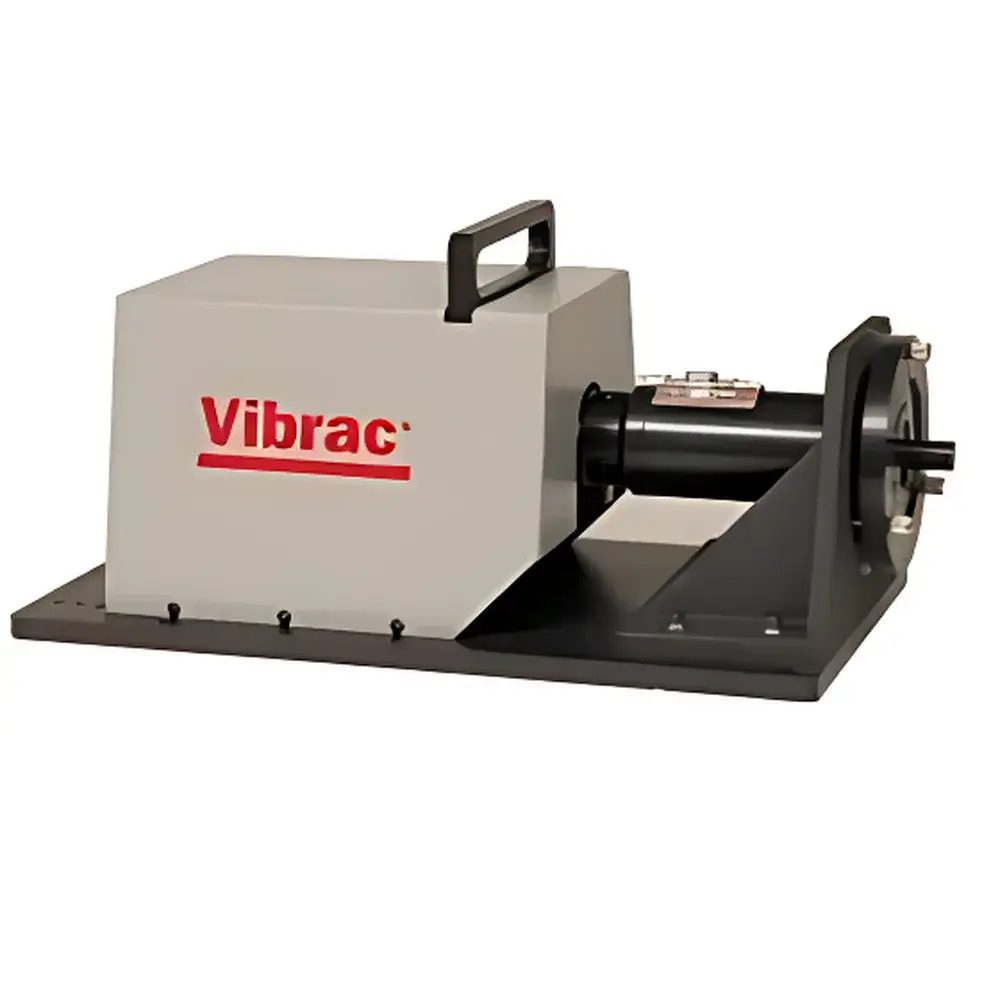
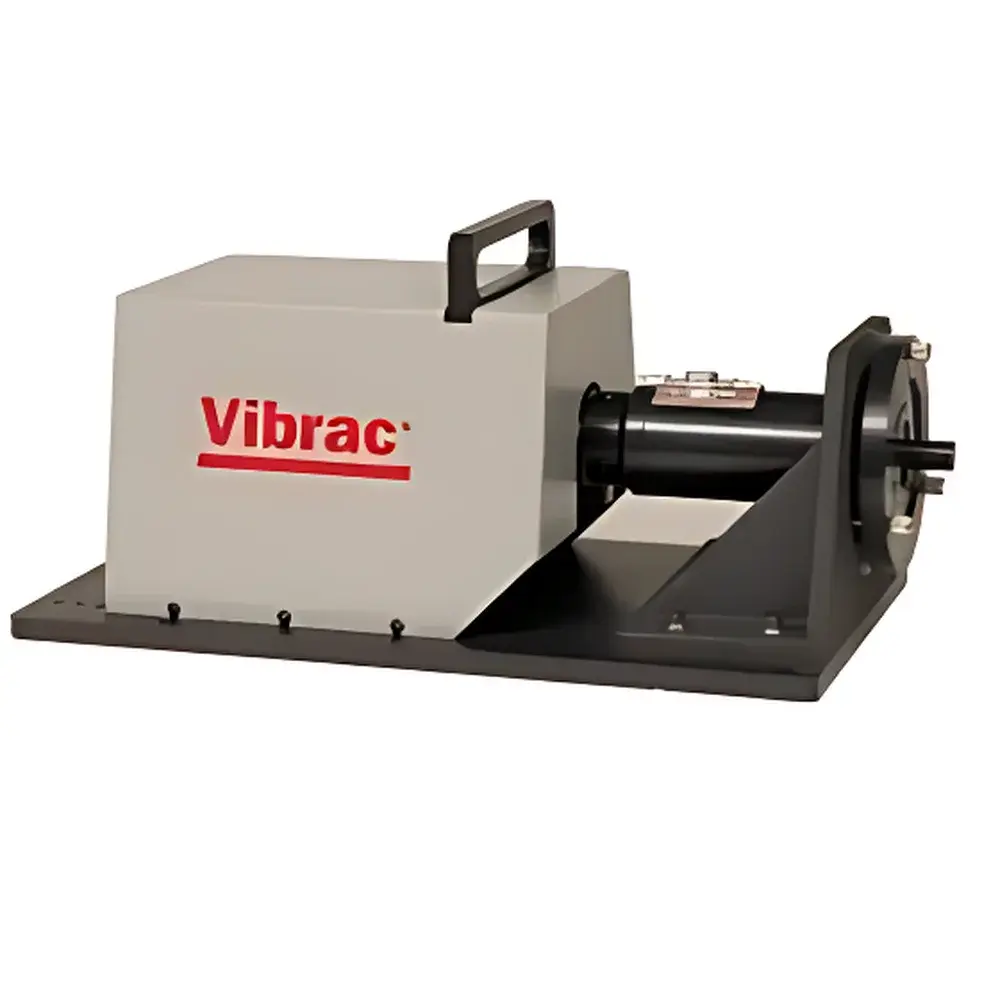
Vibrac 2610DS Motor Torque Testing System
| Brand | Vibrac |
|---|---|
| Origin | USA |
| Model | 2610 DS Series |
| Torque Range | 1 oz·in to 32 lb·in (0.007 N·m to 3.616 N·m) |
| Sensor Type | Patented optical non-contact torque transducer |
| Encoder Resolution | High-resolution digital optical encoder |
| Inertia | Ultra-low rotational inertia |
| Compatibility | Designed for integration with Vibrac 1054 Digital Readout and Control Unit |
| Mounting | Direct-mount interface with Vibrac XY fixture baseplate |
| Compliance | Engineered for ASTM E29, ISO/IEC 17025 traceable calibration practices |
Overview
The Vibrac 2610DS Motor Torque Testing System is a precision-engineered electromechanical measurement platform designed for static and dynamic torque characterization of small- to medium-power rotating components. It operates on the principle of optical torque transduction—utilizing a patented non-contact, brushless optical sensor that measures torsional deflection via polarized light modulation across a precision-twist element. This eliminates signal drift, electrical noise, and mechanical wear associated with slip-ring or strain-gauge-based systems. The system’s ultra-low rotational inertia (< 0.0005 kg·m²), achieved through monolithic aluminum construction and integrated low-inertia couplings, enables high-fidelity transient response essential for evaluating stepper motors, solenoids, BLDC actuators, and brushed DC motors under load-sweep, stall, and step-response conditions. Unlike general-purpose dynamometers, the 2610DS is purpose-built for component-level R&D, production QA, and failure mode analysis where repeatability, thermal stability, and minimal parasitic inertia are critical.
Key Features
- Patented optical torque transducer: Provides analog output proportional to applied torque without contact, eliminating brush wear, electrical interference, and zero-drift over time.
- High-resolution digital optical encoder: Delivers angular position feedback with sub-arcminute resolution for synchronized torque-angle profiling and commutation analysis.
- Integrated electromagnetic brake load unit: Enables programmable loading profiles—including constant-torque, ramped-load, and closed-loop speed control—when paired with the Vibrac 1054 control unit.
- Modular, direct-mount architecture: Test head interfaces seamlessly with Vibrac XY fixture baseplates, forming a self-contained test station requiring no auxiliary support frames, alignment jigs, or external torque reaction structures.
- Thermally stable aluminum housing: Minimizes thermal expansion-induced measurement error during extended-duration tests or ambient temperature fluctuations.
- Calibration-ready design: Includes NIST-traceable calibration documentation and supports periodic verification per ISO/IEC 17025 requirements using standard reference torque artifacts.
Sample Compatibility & Compliance
The 2610DS accommodates motors and actuators with shaft diameters from 3 mm to 12 mm and axial lengths up to 150 mm. It is routinely deployed in laboratories validating compliance with IEC 60034 (rotating electrical machines), UL 1004 (motor safety), and MIL-STD-704 (aircraft power interface). Its measurement uncertainty—validated at ±0.25% FS (full scale) under controlled environmental conditions—meets the repeatability thresholds required for GLP-compliant motor qualification per FDA 21 CFR Part 11 when used with audit-trail-enabled software configurations. All mechanical interfaces conform to ANSI B5.57-2021 mounting standards for torque testing fixtures.
Software & Data Management
When operated with the Vibrac 1054 Digital Readout and Control Unit, the 2610DS supports real-time acquisition of torque, speed, angle, and power at up to 1 kHz sampling rate. The embedded firmware allows configurable trigger logic, pass/fail limit setting, and automated test sequencing (e.g., locked-rotor torque sweep, efficiency mapping across voltage-frequency grids). Exported data conforms to CSV and HDF5 formats for downstream analysis in MATLAB, Python (NumPy/Pandas), or LabVIEW. For regulated environments, optional firmware upgrades enable 21 CFR Part 11–compliant electronic signatures, user access tiers, and immutable audit trails covering all parameter changes and test executions.
Applications
- Stepper motor detent torque and holding torque validation during design verification.
- BLDC motor back-EMF and torque ripple analysis under variable PWM duty cycles.
- DC motor efficiency mapping across load points for battery-powered device optimization.
- Solenoid and voice-coil actuator force-to-current linearity assessment.
- Production-line go/no-go torque testing with statistical process control (SPC) integration.
- Failure root-cause analysis of bearing drag, winding imbalance, or magnetic asymmetry via torque harmonic decomposition.
FAQ
What torque ranges does the 2610DS support, and how is linearity verified?
The system covers 1 oz·in to 32 lb·in (0.007–3.616 N·m) in a single range. Linearity is verified per ASTM E29 using certified deadweight torque standards at five points across the span; typical deviation is ≤ ±0.15% FS.
Can the 2610DS be used for dynamic torque measurement during motor startup?
Yes—the optical sensor’s bandwidth exceeds 5 kHz, enabling accurate capture of transient torque spikes during commutation events and inertial acceleration phases.
Is third-party calibration support available outside the U.S.?
Yes—Vibrac maintains authorized calibration partners in Germany, Japan, and Singapore accredited to ISO/IEC 17025 for torque metrology; certificates include full uncertainty budgets.
Does the system require external cooling or vibration isolation?
No—its passive thermal design and rigid baseplate mounting eliminate need for active cooling or pneumatic isolation under standard lab conditions (20–25°C, <50% RH).
How is mechanical alignment maintained between motor under test and test head?
The XY fixture baseplate incorporates micrometer-adjustable lateral and vertical translation stages with ±10 µm resolution, enabling precise coaxial alignment verified via dial indicator or laser alignment tooling.
Related Products



