
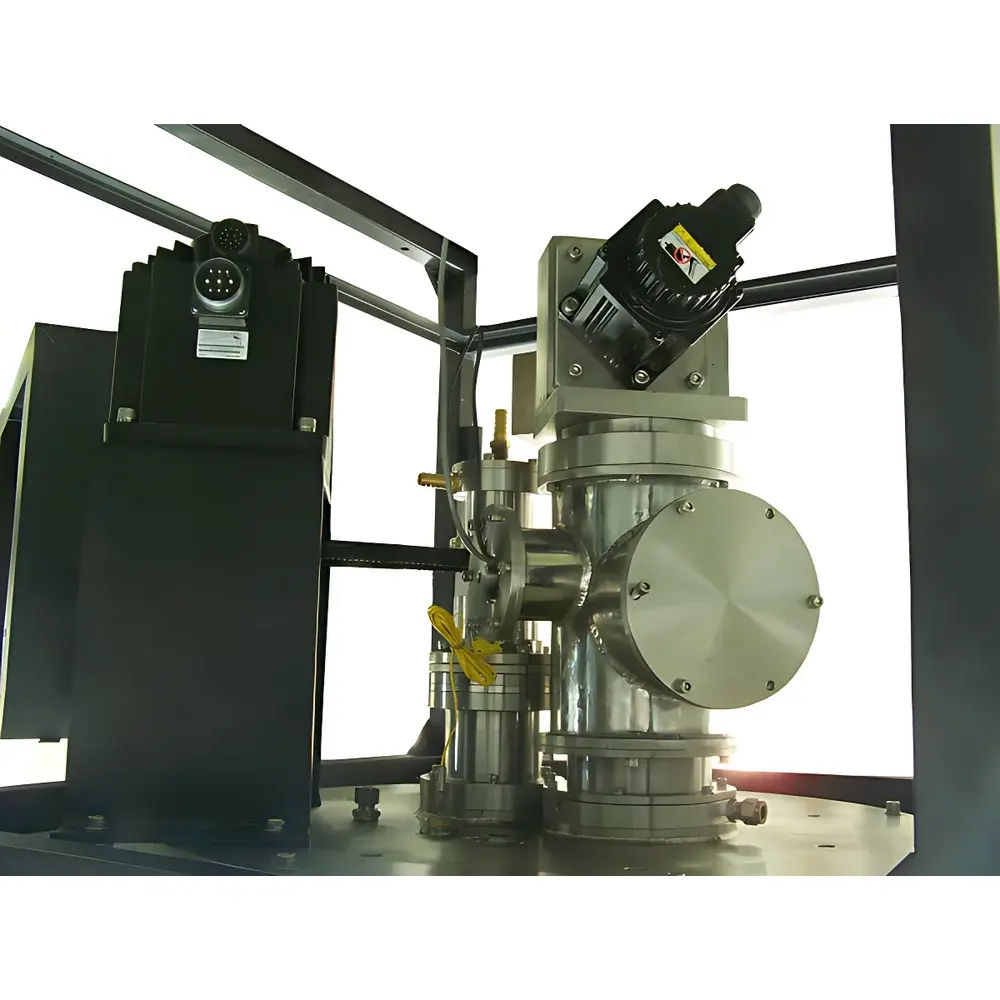
Ducom HPTW High-Temperature High-Pressure Supercritical Water Tribological Tester
| Brand | Ducom |
|---|---|
| Origin | USA |
| Model | HPTW |
| Instrument Type | High-Temperature Tribological Tester |
| Max Friction Force | 2000 N |
| Friction Force Resolution | 2 mN |
| Max Temperature | 300 ℃ |
| Chamber Pressure Range | 5–1000 bar |
| Sliding Velocity | 5–50 m/s |
| Normal Load Range | 100–2000 N |
| Compound Wear Measurement Range | 0–4000 µm |
| Coefficient of Friction Range | 0–1 |
| Frictional Torque Range | 0–10 N·m |
| Temperature Control Accuracy | ±1 ℃ |
| Pressure Control Accuracy | ±0.2% FS |
| Wear Resolution | 1 µm |
| Torque Measurement Accuracy | ±0.05% FS |
| Sliding Velocity Accuracy | ±0.01% FS |
| Normal Load Accuracy | ±0.2% FS |
Overview
The Ducom HPTW High-Temperature High-Pressure Supercritical Water Tribological Tester is an engineered research-grade system designed to quantify tribological behavior—friction, wear, and interfacial shear response—of engineering materials under rigorously controlled supercritical water (SCW) environments. Operating at temperatures up to 300 ℃ and pressures up to 1000 bar, the HPTW replicates service conditions encountered in next-generation nuclear reactor coolant systems, geothermal energy extraction equipment, and high-pressure steam-cycle components. Its core measurement architecture employs a custom-designed, self-aligning disc-on-disc configuration, enabling precise rotational tribometry under dynamic hydrothermal loading. Unlike ambient or inert-gas tribometers, the HPTW integrates a fully ASME Section VIII Division 1–certified pressure chamber, high-integrity mechanical seals rated for continuous SCW exposure, and thermally stabilized fluid delivery pathways—ensuring metrological stability during long-duration, high-stress testing cycles.
Key Features
- ASME Section VIII Division 1–compliant pressure vessel with FEA-validated structural integrity and fatigue life assessment
- Self-centering, precision-ground disc-on-disc tribological module with automatic alignment compensation
- High-speed dual-stage mechanical seal assembly, qualified for >10,000 hours of operation in supercritical water
- Dual-loop thermal management: primary heating circuit (electric cartridge heaters + PID-controlled thermocouple feedback) and independent rapid-cooling loop (pressurized glycol-water mixture) for emergency quenching within <90 seconds
- Real-time non-contact torque sensing via strain-gauge-integrated rotary transducer (±0.05% FS accuracy)
- In-situ compound wear monitoring using calibrated linear variable differential transformers (LVDTs) with 1 µm resolution and ±0.5% linearity
- Integrated load frame with closed-loop servo-hydraulic actuation (100–2000 N range, ±0.2% FS accuracy)
- Programmable start-stop cycling logic supporting automated lifetime tests up to 8 hours per day with user-defined dwell intervals
- Embedded safety controller with hardware-level interlocks for overpressure, overtemperature, torque overload, and seal failure detection
Sample Compatibility & Compliance
The HPTW accommodates flat, cylindrical, and annular specimens up to Ø50 mm × 10 mm thickness, compatible with metallic alloys (e.g., stainless steels, Ni-based superalloys, Zr-alloys), ceramic composites (SiC, Al₂O₃), and advanced coatings (CrN, DLC, MCrAlY). Test fluids are limited to deionized water and saturated steam; no organic solvents or corrosive additives are permitted. The system meets ASME BPVC Section VIII requirements for design, fabrication, and hydrostatic certification. All control firmware and data acquisition modules comply with IEC 61508 SIL-2 functional safety standards. For regulated environments, optional 21 CFR Part 11–compliant audit trail logging and electronic signature modules are available.
Software & Data Management
The HPTW operates under Ducom TriboSoft™ v5.2—a deterministic real-time control platform built on Windows OS with deterministic thread scheduling. It provides synchronized acquisition of friction coefficient (µ), normal load (N), sliding velocity (m/s), chamber temperature (℃), and pressure (bar) at configurable sampling rates up to 1 kHz. Raw sensor data is stored in HDF5 format with embedded metadata (test ID, operator, calibration certificates, environmental logs). Post-test analysis includes wear volume calculation (ASTM G99 Annex A1), Stribeck curve generation, and statistical wear rate trending (ISO 20808). Export options include CSV, MATLAB .mat, and PDF reports compliant with GLP documentation templates.
Applications
- Tribological screening of cladding materials for supercritical water-cooled reactors (SCWRs) per OECD/NEA benchmark protocols
- Wear mechanism mapping of turbine blade coatings under transient thermal-hydraulic loading (ASTM D7757)
- Friction evolution studies of bearing surfaces in high-purity steam environments (IEC 60034-30-2)
- Accelerated corrosion–wear synergy quantification in simulated geothermal brine analogues (ISO 15156-2)
- Validation of multi-physics wear models (Archard–Buckley–Hertz coupling) under coupled thermal–mechanical–chemical stress states
FAQ
What is the maximum allowable test duration per cycle under continuous SCW operation?
Continuous operation is supported for up to 8 hours per cycle, with programmable rest intervals. Total cumulative runtime per test sequence is limited only by specimen degradation and fluid purity maintenance.
Can the system operate below the critical point of water (374 ℃ / 221 bar)?
Yes—the HPTW is fully operational across subcritical liquid, saturated vapor, and supercritical regimes between 5 bar and 1000 bar, and from ambient temperature to 300 ℃.
Is third-party calibration traceable to NIST or PTB standards supported?
All torque, load, temperature, and pressure transducers ship with factory calibration certificates traceable to NIST. On-site recalibration services with ISO/IEC 17025–accredited providers are available upon request.
Does the system support automated specimen exchange?
No—specimen loading and unloading require manual intervention following strict lockout-tagout (LOTO) procedures per OSHA 1910.147. Robotic integration is not offered as a standard option.
What safety certifications does the pressure chamber hold?
The chamber carries ASME “U” Stamp certification per Section VIII Division 1, with full hydrostatic test documentation and material mill test reports (MTRs) provided with each unit.



