
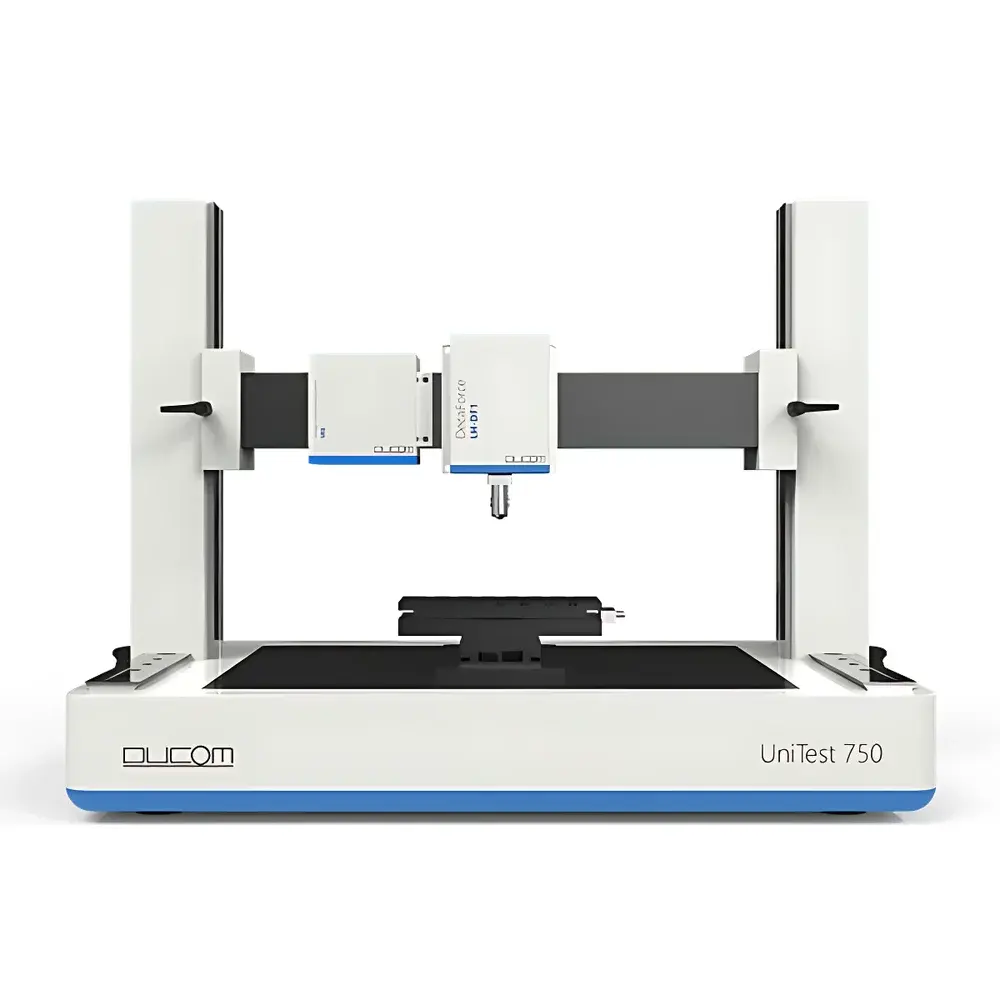
Ducom UniTest 750 Modular Tribological Testing System
| Brand | Ducom |
|---|---|
| Origin | USA |
| Model | UniTest 750 |
| Maximum Friction Force | 1000 N |
| Friction Force Resolution | 1 nN |
| Maximum Test Temperature | 1000 °C |
| Instrument Type | Multi-Functional Tribometer |
| Configuration | Modular, Open-Architecture Desktop Platform |
Overview
The Ducom UniTest 750 Modular Tribological Testing System is an engineered platform for quantitative tribological characterization under controlled mechanical, thermal, and environmental conditions. Built upon the principles of contact mechanics and interfacial energy dissipation, the system enables precise measurement of friction coefficient, wear volume, surface deformation, and real-time tribological response across diverse material pairings and operational regimes. Its open-architecture design integrates modular load application, motion control, environmental conditioning, and in situ surface metrology — all synchronized via a deterministic real-time control loop. Unlike monolithic tribometers with fixed test geometries, the UniTest 750 supports customizable test configurations compliant with ASTM G99 (pin-on-disk), ASTM D3702 (thrust washer), ISO 7148-1 (wear testing), and ASTM G133 (linear reciprocating), making it suitable for both standardized compliance testing and exploratory research in academic and industrial R&D laboratories.
Key Features
- Modular open-architecture platform enabling rapid reconfiguration between test modes without hardware recalibration
- High-precision Z-axis servo with closed-loop feedback for sub-micron positioning accuracy of load modules and imaging sensors
- Integrated environmental monitoring: real-time logging of ambient temperature (±0.1 °C) and relative humidity (±1% RH)
- Scalable force measurement: interchangeable load modules covering 10 mN–1000 N range, each equipped with factory-calibrated 2D force transducers (X/Y or Y/Z)
- Optional high-fidelity sensing: 3D and 6D force/torque transducers, acoustic emission (AE) detectors, and electrochemical contact resistance (ECR) modules for tribo-corrosion analysis
- Multi-degree-of-freedom motion control: interchangeable linear reciprocating, rotational, complex trajectory, ring-on-block, high-speed rotary (>10,000 rpm), and high-frequency linear (>100 Hz) modules
- Environmental test compatibility: integrated liquid bath, fluid circulation, humidity control (10–95% RH), cryogenic (−100 °C), high-temperature (up to 1000 °C), vacuum (<10⁻⁵ mbar), and corrosive gas modules
- In situ surface characterization: vertical/horizontal optical imaging, contact profilometry (2D/3D), and non-contact white-light interferometry for pre-/post-test topography and wear track analysis
Sample Compatibility & Compliance
The UniTest 750 accommodates specimens ranging from micro-scale biomedical implants (e.g., CoCrMo hip joint coupons) to macro-scale engineering components (e.g., gear teeth, brake pads, turbine blades). Sample holders conform to ISO 20422 (tribological specimen geometry) and ASTM E23 (notched bar impact testing fixtures) standards. All modules undergo traceable calibration per ISO/IEC 17025 requirements, with documented uncertainty budgets provided for force (≤0.5% FS), displacement (±0.2 µm), and temperature (±1.5 °C at 1000 °C). The system architecture supports GLP/GMP-compliant workflows, including electronic signatures, audit trails, and data integrity features aligned with FDA 21 CFR Part 11 requirements when used with validated software configurations.
Software & Data Management
Control and analysis are executed through UniTest Control Suite v5.x — a deterministic real-time operating system (RTOS)-based application developed for deterministic sampling (1 kHz base rate, up to 100 kHz burst mode). The software provides scriptable test sequences, PID-tuned motion profiles, synchronized multi-channel acquisition (force, displacement, AE, ECR, temperature), and automated wear volume calculation using ISO 2409-compliant cross-sectional area integration. Raw data is stored in HDF5 format with embedded metadata (sample ID, operator, calibration certificates, environmental logs). Export options include CSV, MATLAB .mat, and ASTM E1447-compliant XML for LIMS integration. Optional validation packages include IQ/OQ documentation and 3Q protocol support for regulated environments.
Applications
The UniTest 750 serves as a primary tribological evaluation tool across sectors requiring materials performance validation under service-relevant conditions. Key use cases include: boundary lubrication screening of engine oils per ASTM D5183; high-temperature oxidation wear of thermal barrier coatings (TBCs) in gas turbines; fretting wear assessment of aerospace fasteners (ASTM F2625); tribocorrosion behavior of stainless steel in saline media (ASTM G192); abrasive wear resistance of mining drill bits; biotribological testing of orthopedic polymer composites (ISO 14242-1); adhesion and scratch resistance of PVD/CVD coatings on cutting tools (ISO 20502); and solid-lubricant efficacy in vacuum mechanisms for space applications. It also supports mechanical testing extensions such as three-point/four-point bending and thermomechanical hardness mapping.
FAQ
What standards does the UniTest 750 comply with for friction and wear testing?
It supports test methods defined in ASTM G99, ASTM D3702, ISO 7148-1, ASTM G133, ISO 20422, and ASTM E23 — with full traceability to NIST standards for force and temperature calibration.
Can the system perform tests under vacuum or inert gas environments?
Yes — optional vacuum chambers (<10⁻⁵ mbar) and gas purge modules (N₂, Ar, H₂, CO₂) are available with integrated mass flow controllers and pressure regulation.
Is the software compliant with FDA 21 CFR Part 11 requirements?
When deployed with the validated UniTest Control Suite configuration and supporting infrastructure (e.g., domain-authenticated user management, electronic signatures, immutable audit logs), it meets core Part 11 expectations for regulated pharmaceutical and medical device testing.
How is wear volume quantified post-test?
Using integrated 3D non-contact profilometry, wear tracks are scanned before and after testing; volumetric loss is computed via ISO 2409 methodology using cross-sectional area integration and track length interpolation.
What maintenance intervals are recommended for long-term metrological stability?
Annual calibration verification is recommended for force transducers and environmental sensors; Z-axis servo alignment and motion module backlash checks are advised every 6 months under continuous operation.



