
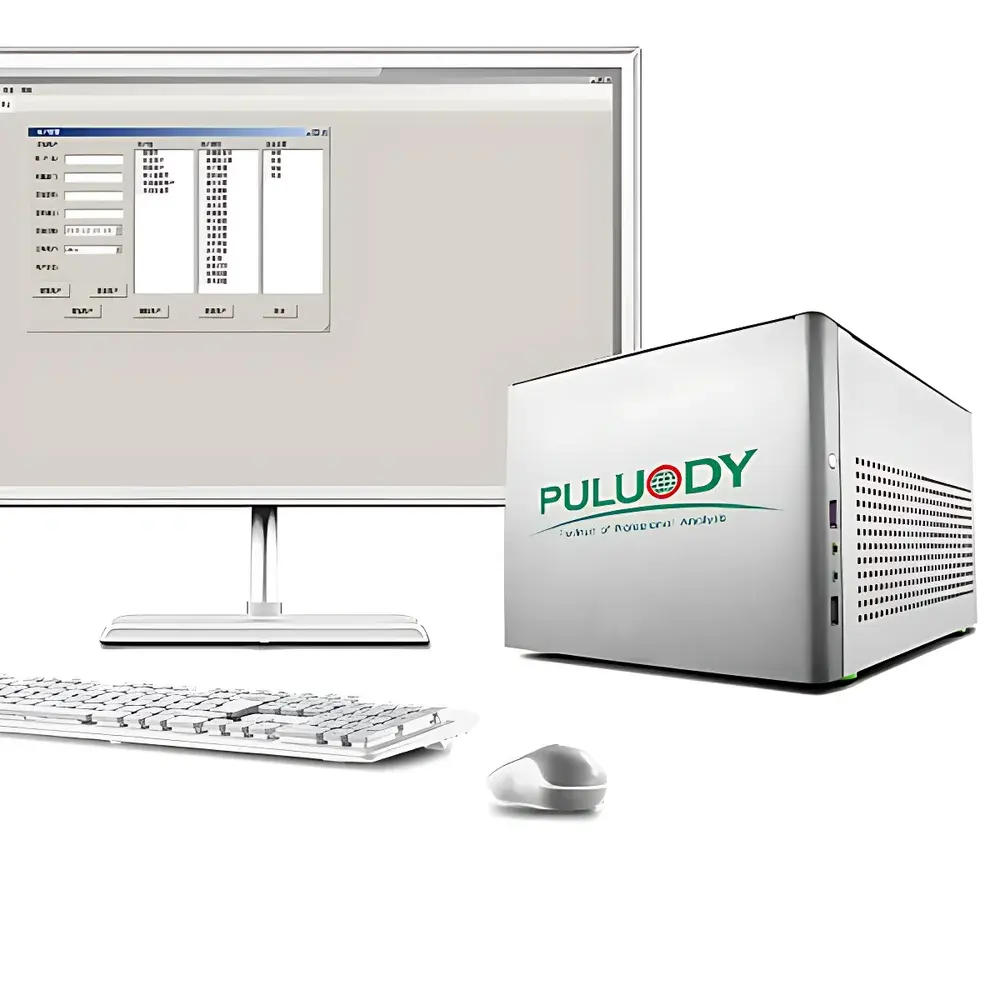
PULUODY PMT-2-12 Optical Liquid Particle Counter
| Brand | PULUODY |
|---|---|
| Model | PMT-2-12 |
| Instrument Type | Optical Particle Counter |
| Detection Principle | Dual-Laser Narrow-Beam Light Scattering |
| Measurement Range | 0.1–0.5 µm and 0.2–2.0 µm (standard) |
| minimum detectable size | 0.1 µm(c) |
| Sampling Method | Precision Piston Pump with Electromagnetic Flow Control |
| Sampling Accuracy | < ±1% |
| Counting Accuracy | ±5% typical |
| Coincidence Limit | ≤5% error at 10,000 particles/mL |
| Output | 4–20 mA analog signal with configurable超标 alarm |
| Data Interface | iPad-compatible wireless acquisition system |
| Calibration Standards | JJG 1061, ISO 21501-2, or NIST-traceable latex sphere reference |
| Software | V8.3 Integrated Analysis & Calibration Software (PC + embedded touchscreen version) |
| Display | Color LCD touch interface + optional wireless keyboard/mouse |
| Power Input | 100–265 VAC, 50–60 Hz |
| Compliance | Designed for GLP/GMP-aligned environments |
Overview
The PULUODY PMT-2-12 Optical Liquid Particle Counter is an advanced inline and offline particle monitoring instrument engineered for high-sensitivity detection of insoluble particulate contamination in ultra-pure and chemically aggressive liquids. Based on eighth-generation dual-laser narrow-beam light scattering technology, the system delivers stable, reproducible quantification of sub-micron particles across two calibrated size channels (0.1–0.5 µm and 0.2–2.0 µm), with optional user-defined sizing windows from 1 µm to 100 µm (c) or 4–70 µm (c). Its core optical sensor employs collimated laser diodes operating at distinct wavelengths to minimize Mie scattering interference and enhance resolution for polydisperse suspensions. The instrument is specifically optimized for use in critical fluid-handling environments—such as semiconductor wet process lines, flat-panel display cleaning baths, photovoltaic wafer rinsing loops, and pharmaceutical-grade water-for-injection (WFI) distribution systems—where real-time particulate data informs process control, contamination root-cause analysis, and regulatory compliance.
Key Features
- Dual-laser narrow-beam optical detection architecture enabling simultaneous multi-channel sizing with minimized coincidence error (<5% at 10,000 particles/mL)
- Precision piston pump sampling system integrated with electromagnetic flow regulation for volumetric accuracy better than ±1%
- Modular design supporting both permanent inline installation (via 1/4″ or 3/8″ sanitary tubing ports) and portable offline measurement using sealed sample vials
- V8.3 embedded software platform with independent calibration and analysis modules—eliminating cross-contamination between metrological verification and routine testing workflows
- Wireless iPad-based data acquisition interface compatible with enterprise LIMS and SCADA integration via Modbus TCP or OPC UA (optional)
- Configurable analog output (4–20 mA) with programmable alarm thresholds for automated process shutdown or notification triggers
- Full compliance with ISO 21501-2 for light-scattering particle counters and traceable calibration per JJG 1061 national metrology verification procedures
Sample Compatibility & Compliance
The PMT-2-12 is validated for use with low-conductivity, low-viscosity, and chemically reactive liquids including deionized water, UPW (ultrapure water), semiconductor-grade solvents (e.g., IPA, acetone), aqueous cleaning formulations, polymer solutions, and organic solvent-based photoresist carriers. It avoids electrochemical interference through non-contact optical detection and features chemically inert wetted path materials (quartz flow cell, PFA and EPDM seals). The instrument meets essential requirements for GMP-relevant environments: electronic records and signatures conform to FDA 21 CFR Part 11 when used with validated V8.3 software configurations; audit trails, user access controls, and calibration event logging are fully implemented. It supports reporting per NAS 1638, ISO 4406, and SAE AS4059 for particulate contamination grading, and aligns with ASTM F3239 for microcontamination assessment in electronics manufacturing fluids.
Software & Data Management
The V8.3 software suite operates in dual-mode architecture: a metrology-certified calibration module (locked during routine operation) and a production-ready analysis module with customizable report templates. All raw scatter pulse data are stored with timestamp, temperature, pressure, and flow rate metadata. Data export formats include CSV, PDF, and XML—compatible with laboratory information management systems (LIMS) and statistical process control (SPC) platforms. The embedded touchscreen interface provides real-time histogram visualization, cumulative count curves, and trend overlays across multiple sampling events. Remote diagnostics and firmware updates are supported via secure HTTPS connection. For regulated labs, optional 21 CFR Part 11 compliance packages include electronic signature workflows, role-based permissions, and immutable audit logs with hash-verified integrity.
Applications
- In-line monitoring of ultrapure water loops in semiconductor front-end fabs to detect filter breakthrough or ion exchange resin shedding
- Offline verification of cleaning efficacy for silicon wafers, TFT glass substrates, and MEMS device carriers
- Quality control of nanofiltration and microfiltration membrane integrity in biopharmaceutical buffer preparation systems
- Contamination trending in electronic-grade chemical delivery lines (e.g., HF, TMAH, HNO₃)
- Validation of final rinse purity in medical device manufacturing cleanrooms
- Research-grade characterization of nanoparticle dispersion stability in polymer matrices and colloidal suspensions
FAQ
What particle size ranges does the PMT-2-12 support out-of-the-box?
Standard configuration covers 0.1–0.5 µm and 0.2–2.0 µm channels. Custom sizing windows (e.g., 4–70 µm(c)) are available upon factory configuration.
Can the instrument be integrated into a PLC-controlled production line?
Yes—via 4–20 mA analog output with programmable alarm setpoints, or optionally through industrial protocols (Modbus RTU/TCP, OPC UA) with certified gateway modules.
Is calibration traceable to international standards?
All calibrations are performed using NIST-traceable polystyrene latex (PSL) spheres per ISO 21501-2 and verified against JJG 1061 national metrology guidelines.
Does the system support Good Manufacturing Practice (GMP) documentation requirements?
When deployed with the validated V8.3 software package and configured audit trail settings, it fulfills core 21 CFR Part 11 and EU Annex 11 expectations for electronic records in regulated environments.
What maintenance intervals are recommended for sustained accuracy?
Optical alignment verification every 6 months; flow calibration check every 3 months; full sensor cleaning after every 500 hours of operation or following exposure to high-particulate samples.
Related Products



