
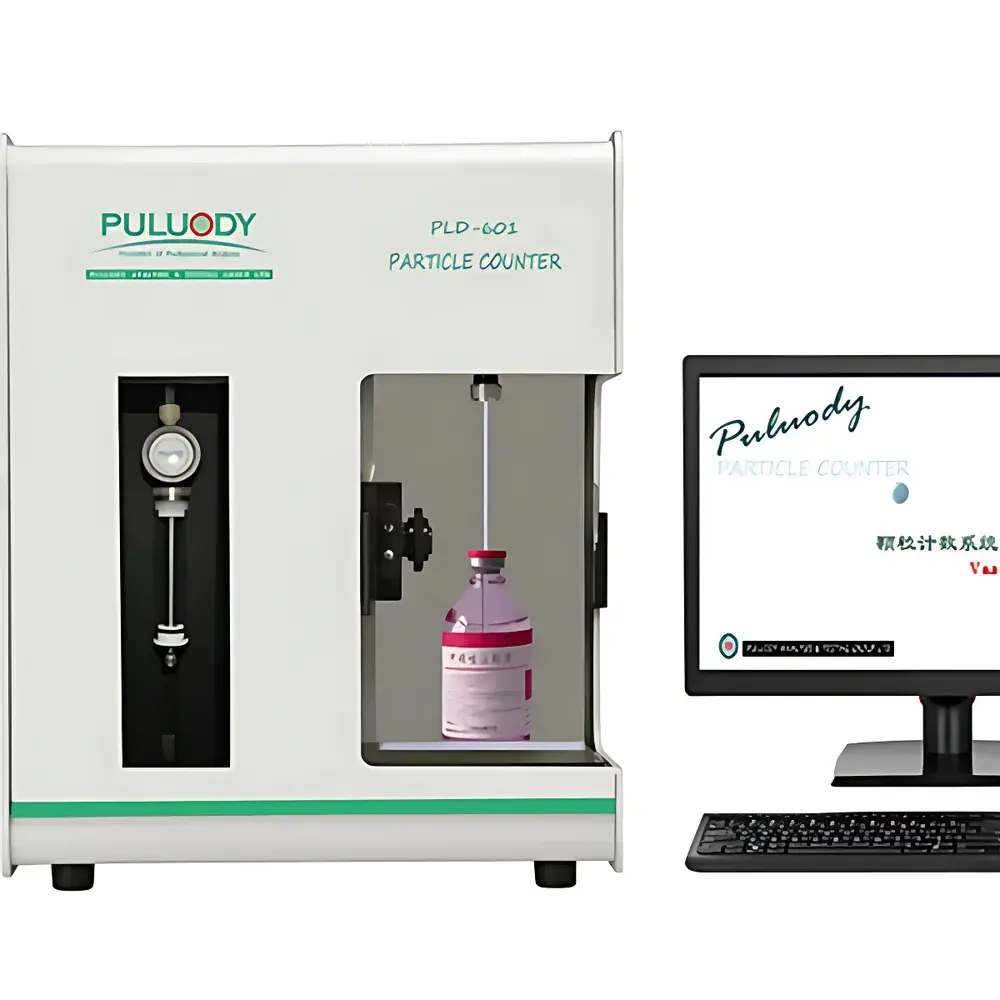
PULUODY PLD-601Y Disposable Needle-Style Insoluble Particle Counter
| Brand | PULUODY |
|---|---|
| Origin | Shaanxi, China |
| Model | PLD-601Y |
| Instrument Type | Optical Particle Counter (Light Obscuration Principle) |
| Detection Principle | Dual-Laser Narrow-Beam Light Obscuration |
| Sensor Generation | 8th-Generation Dual-Laser Sensor |
| Flow Control | Precision Metering Plunger Pump + Ultra-Precise Electromagnetic Flow Control System |
| Sample Introduction | Disposable Needle Sampling Probe |
| Channel Resolution | 1000 Adjustable Channels (Down to 0.01 µm) |
| Detection Range | 1–450 µm (Extended Options: 0.03–3000 µm) |
| Accuracy | ±3% (Typical), Calibration Traceable to JJG1061, ISO 21501, or NIST-Traceable Latex Standards |
| Counting Repeatability | ≤3% Coincidence Error at 1000 particles/mL |
| Resolution | >95% (Ph. Ch. 2015/2020 compliant), <10% (USP/ISO 21501 compliant) |
| Flow Rate | Sample: 5–150 mL/min |
| Rinse | 5–500 mL/min |
| Fluid Temperature Range | 0–80 °C |
| Operating Ambient | −15–50 °C |
| Software | V8.9 Integrated PC & Touchscreen Analysis Suite |
| Compliance | FDA 21 CFR Part 11 (Audit Trail, Electronic Signature, Role-Based 5-Tier Permissions), GLP/GMP-Ready Data Integrity Architecture |
| Standards Supported | USP <788>, <789>, <797> |
Overview
The PULUODY PLD-601Y Disposable Needle-Style Insoluble Particle Counter is a regulatory-grade optical particle counter engineered for high-precision, non-destructive quantification of insoluble particulate contamination in parenteral and ophthalmic pharmaceuticals, biologics, medical device extracts, and ultra-pure process liquids. It operates on the light obscuration (LO) principle—where particles suspended in a liquid stream pass through a focused dual-laser narrow-beam detection zone, generating transient light attenuation signals proportional to particle cross-sectional area. The instrument’s 8th-generation dual-laser sensor delivers enhanced signal-to-noise ratio and superior discrimination of sub-micron particles (down to 0.01 µm nominal threshold), enabling compliance with stringent pharmacopoeial requirements for injectable drug quality control. Unlike fixed-flow traditional counters, the PLD-601Y integrates a precision metering plunger pump and an ultra-stable electromagnetic flow control system, ensuring volumetric accuracy better than ±1% and minimizing flow-induced coincidence error—critical for accurate reporting of particle concentration per unit volume (e.g., particles per mL ≥10 µm and ≥25 µm per USP ). Its disposable needle probe design eliminates carryover risk and cross-contamination between samples, satisfying ALCOA+ data integrity principles and supporting fully validated workflows in GMP environments.
Key Features
- Dual-laser narrow-beam optical detection architecture with real-time pulse height analysis for improved sizing resolution and reduced refractive index dependency
- 1000 fully customizable particle size channels—configurable from 0.01 µm upward—enabling simultaneous multi-standard compliance (e.g., USP, EP, ChP, ISO)
- Discrete, single-use stainless-steel needle sampling probe with integrated fluid path—no reusable wetted components requiring cleaning validation
- Regulatory-compliant software (V8.9) with full 21 CFR Part 11 functionality: role-based 5-tier user permissions, immutable audit trail, electronic signatures, and automated backup/recovery
- Dynamic flow calibration and automatic viscosity compensation across temperature range (0–80 °C), supporting aqueous and low-viscosity organic solvents
- Integrated rinse cycle with programmable flow rate (5–500 mL/min) and timed purge protocols to ensure residual-free transition between sample batches
- Touchscreen HMI with bilingual (English/Chinese) interface and optional wireless keyboard/mouse support for lab-integrated operation
Sample Compatibility & Compliance
The PLD-601Y is validated for use across Class I–III medical devices, sterile drug products, and high-purity process fluids. It supports direct analysis of solution-type injections, lyophilized powders (after reconstitution), concentrated solutions, ophthalmic preparations, vaccines, sterile active pharmaceutical ingredients (APIs), injection water (WFI), pharmaceutical packaging extracts (per YBB00272004–2015), and infusion sets (per GB 8368). Its modular fluid path accommodates low-volume (<1 mL) and high-volume (up to 100 mL) testing modes without hardware modification. The system meets ISO/IEC 17025 traceability requirements via calibration against NIST-traceable polystyrene latex standards (PSL) or certified reference materials aligned with JJG1061 and ISO 21501-2. All measurement reports include metadata required for regulatory submissions: instrument ID, operator ID, calibration certificate number, environmental conditions, and raw pulse data export capability.
Software & Data Management
The V8.9 analysis suite provides a unified platform for method development, execution, review, and archival. It includes pre-loaded pharmacopoeial templates (USP , ChP , EP 2.9.19), configurable pass/fail logic per particle size bin, and automated report generation in PDF/A-2 format with embedded digital signatures. Audit trails record every action—including parameter edits, result overrides, and data exports—with timestamp, user ID, and IP address. Data files are stored in encrypted SQLite databases with SHA-256 hashing; backups follow ICH E6(R3) retention guidelines (minimum 15 years for clinical trial–supporting data). Raw signal waveforms and channel histograms are exportable in CSV and HDF5 formats for third-party statistical analysis or AI-driven trend modeling. The software is compatible with LIMS integration via ASTM E1384-compliant HL7 and RESTful API endpoints.
Applications
- Pharmaceutical QC: Routine batch release testing of injectables, verification of terminal filter integrity (e.g., 0.22 µm sterilizing filters), and extractables/leachables assessment of primary packaging
- Biotechnology: Monitoring microaggregate formation in monoclonal antibody formulations and cell culture media particulates
- Medical Device Testing: Quantifying particulate shedding from IV tubing, syringes, and stopcocks per ISO 8536-4 and AAMI TIR42
- Water & Semiconductor: Ultra-pure water (UPW) monitoring in fab tool recirculation loops (per SEMI F63), CMP slurry cleanliness grading (ISO 14644-1 Class 1–5), and wafer rinse validation
- Chemical & Materials: Nanoparticle dispersion stability in inks, lubricants, and functional coatings; catalyst slurry homogeneity assessment
- Food & Cosmetics: Verification of filtration efficacy in sterile-filtered beverages and preservative-free ophthalmic cosmetics
FAQ
Does the PLD-601Y comply with FDA 21 CFR Part 11 for electronic records and signatures?
Yes—the V8.9 software implements full Part 11 controls including system validation documentation, audit trail encryption, role-based access, and electronic signature workflows with biometric or PKI-based authentication options.
Can the instrument be calibrated to ISO 21501-2 using NIST-traceable standards?
Yes—calibration is performed using ISO 11171-certified PSL standards traceable to NIST SRM 1960 or equivalent national metrology institutes (e.g., NIM, NPL, PTB); certificates include uncertainty budgets per GUM.
Is method transfer supported between PLD-601Y units in multi-site manufacturing networks?
Yes—method files (.pmd), calibration profiles, and SOP templates are portable across instruments; inter-unit reproducibility is verified per ISO 5725-2 with ≤5% RSD for identical samples across three independent units.
What maintenance intervals are recommended for GMP operation?
Preventive maintenance is scheduled every 6 months or 1,000 operating hours, including optical alignment verification, flow calibration, and sensor cleanliness inspection—documented per ASTM E2500-22 Annex A2.
How does the disposable needle probe ensure data integrity during high-throughput testing?
Each probe is individually serialized and assigned a unique QR code; usage history (sample count, rinse cycles, pressure logs) is auto-recorded and linked to audit trail entries—eliminating manual logbook entries and transcription errors.



