
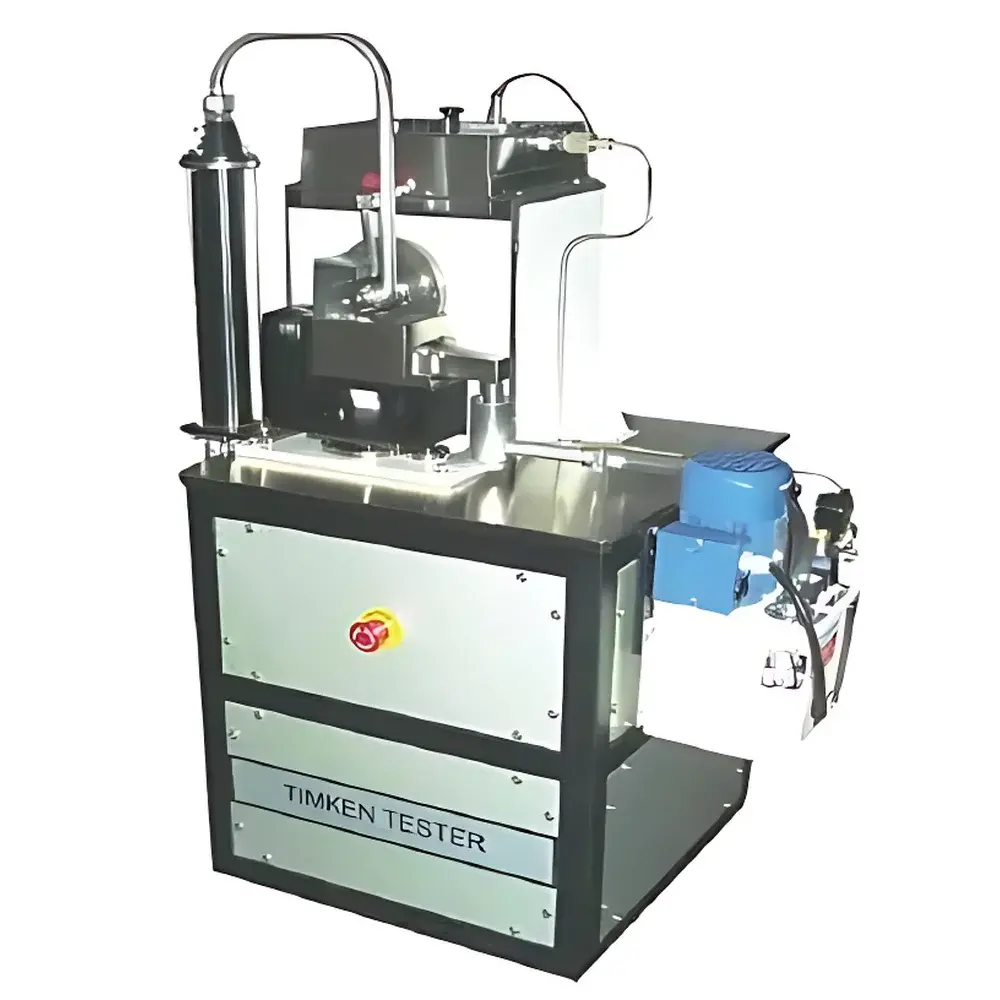
Timken OK Tribological Tester
| Brand | JHT (Yi Cheng Heng Da) |
|---|---|
| Origin | USA |
| Manufacturer Type | Authorized Distributor |
| Product Category | Imported Instrument |
| Model | TIMKEN OK |
| Price Range | USD 70,000 – 140,000 |
| Instrument Type | Boundary Lubrication Load Capacity Tester |
| Maximum Friction Force | 20 N |
| Friction Force Resolution | 0.4 mN |
| Maximum Test Temperature | 1000 °C |
| Standards Compliance | ASTM D2509, ASTM D2782, IP 240, IP 326, JIS K2220, JIS K2519 |
Overview
The Timken OK Tribological Tester is a precision-engineered boundary lubrication load capacity tester originally derived from the legacy Timken O.K. machine design, first introduced in 1935 and standardized through industrial practice until 1972. It operates on the fundamental principle of line-contact tribology: a rotating bearing raceway (typically AISI 52100 steel) is pressed against a stationary flat test specimen under controlled normal load, generating a Hertzian contact zone representative of real-world rolling-sliding interfaces found in gears, bearings, and cam-follower systems. As the applied load is incrementally increased at constant speed and temperature, the lubricant film thickness diminishes until boundary lubrication conditions dominate and surface asperity contact initiates. The maximum load sustained prior to visible scuffing—defined as the “O.K. Load”—is quantified as a critical performance metric for extreme pressure (EP) additives and base oil formulation efficacy. This test method directly correlates with real-world failure thresholds under high-load, low-speed, or elevated-temperature service conditions.
Key Features
- Line-contact geometry replicating kinematic conditions of rolling element contacts
- High-resolution friction force measurement (0.4 mN resolution) via calibrated load cell
- Thermally stable test chamber supporting continuous operation up to 1000 °C with inert atmosphere compatibility
- Programmable loading profiles: constant, stepwise, or ramped load application with user-defined dwell times
- Integrated automatic lubricant delivery system ensuring consistent replenishment at the contact interface
- Modular safety enclosure compliant with ISO 13857 and ANSI B11.19 requirements
- Motorized actuation with closed-loop torque and speed control (±0.5% repeatability)
Sample Compatibility & Compliance
The instrument accommodates standard test specimens per ASTM D2509 (19 mm diameter × 6.35 mm thick steel discs) and ASTM D2782 (flat plates), but also supports custom geometries—including pins, rings, and cylinder-on-flat configurations—via interchangeable fixtures. All mechanical components are constructed from corrosion-resistant stainless steel and hardened tool steels to ensure dimensional stability during thermal cycling. The system meets full regulatory alignment with ASTM D2509 (Standard Test Method for Load-Carrying Capacity of Lubricating Greases Using the Timken Apparatus), ASTM D2782 (Standard Test Method for Load-Carrying Capacity of Lubricating Oils Using the Timken Apparatus), IP 240, IP 326, JIS K2220, and JIS K2519. Data acquisition and audit trails comply with GLP/GMP documentation requirements, including timestamped metadata, operator ID logging, and exportable raw data files meeting FDA 21 CFR Part 11 electronic record integrity criteria.
Software & Data Management
TriboAcquire software serves as the unified control and acquisition platform, featuring a validated Windows-based GUI with intuitive parameter configuration wizards for load ramp rate, rotational speed, temperature setpoint, and dwell duration. Real-time visualization includes synchronized plots of friction coefficient (μ), tangential force (N), and contact temperature (°C). All acquired signals are sampled at ≥1 kHz and stored in HDF5 format for long-term archival integrity. The CompariView module enables side-by-side overlay of up to four independent test datasets—including O.K. Load curves, friction evolution traces, and scuffing onset markers—with customizable axis scaling, curve fitting (linear, polynomial, exponential), and region-of-interest zoom functionality. Export options include ASCII (.csv), MATLAB (.mat), and PDF report generation with embedded calibration certificates and test summary tables.
Applications
- Quantitative evaluation of EP additive packages in automotive gear oils and industrial greases
- Screening of biobased lubricants and synthetic esters under high-temperature boundary conditions
- Formulation development for aerospace lubricants requiring >800 °C oxidative stability
- Quality assurance testing for batch-to-batch consistency in grease manufacturing
- Correlation studies between O.K. Load values and field performance metrics such as gear pitting resistance (ISO 6336) or bearing fatigue life (ISO 281)
- Research into tribofilm formation mechanisms using post-test SEM/EDS surface analysis
FAQ
What defines the “O.K. Load” in this test method?
The O.K. Load is the highest applied normal load, expressed in pounds-force (lbf) or newtons (N), at which no visible scuffing or scoring occurs on the stationary specimen after one complete rotation cycle under specified speed and temperature conditions.
Can the system operate under inert or reactive gas atmospheres?
Yes—the test chamber features dual gas inlet ports and vacuum-rated seals, enabling operation under N₂, Ar, H₂, or controlled CO₂ environments up to 1 bar absolute pressure.
Is third-party calibration certification included with shipment?
Each unit ships with NIST-traceable calibration certificates for force, temperature, and rotational speed sensors, valid for 12 months from date of installation.
How is scuffing detection performed—visually or instrumentally?
Scuffing is assessed both optically (via integrated USB microscope with 10×–100× magnification) and instrumentally (abrupt rise in friction coefficient >0.3 within 0.5 s, confirmed by derivative thresholding in TriboAcquire).
Does the software support automated pass/fail logic based on predefined O.K. Load thresholds?
Yes—user-configurable acceptance criteria can trigger audible alerts, stop test execution, and auto-generate compliance flags in exported reports.



