VNIIOFI BB2000gr High-Temperature Blackbody Radiation Source
| Brand | VNIIOFI |
|---|---|
| Origin | Russia |
| Model | BB2000gr |
| Instrument Category | Blackbody Furnace |
| Temperature Range | 900 °C to 2000 °C |
| Stability | ≤ ±0.5 °C per 60 min |
| Temperature Resolution | 0.01 °C |
| Heating Time | 2 h |
| Cooling Time | 2 h |
| Cavity Aperture Diameter | 40 mm |
| Cavity Opening Diameter | 50 mm |
| Cavity Length | 350 mm |
| Max Current | 800 A |
| Max Voltage | 30 V |
| Emissivity | 0.995 ± 0.003 |
| Operating Gas | Argon (2–4 L/min) |
| Cooling Medium | Water |
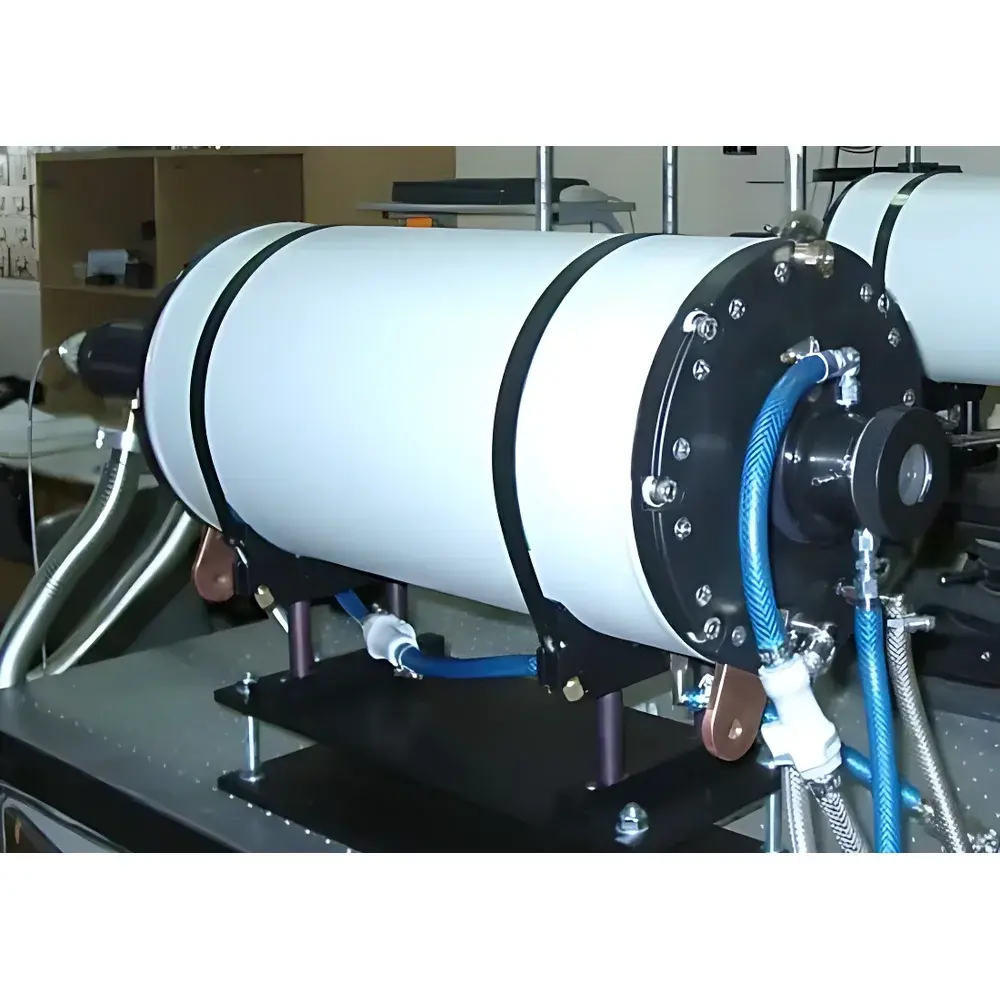
| Housing Diameter | 260 mm |
| Housing Length | 920 mm |
Overview
The VNIIOFI BB2000gr is a high-temperature blackbody radiation source engineered for primary and secondary radiometric calibration in national metrology institutes and accredited calibration laboratories. Designed and validated by the All-Russian Research Institute for Optical and Physical Measurements (VNIIOFI)—a designated institute under the Federal Agency for Technical Regulation and Metrology of Russia—the BB2000gr operates on the principle of thermal equilibrium radiation from a precisely characterized graphite cavity. It functions as a spectrally stable, spatially uniform, and highly emissive reference source across the UV-VIS-IR spectrum (200 nm to 25 µm), enabling traceable calibration of spectral radiance, spectral irradiance, and radiation thermometers. Its cavity geometry—cylindrical, graphite-lined, with a 40 mm effective aperture and 350 mm depth—ensures near-ideal blackbody behavior (emissivity = 0.995 ± 0.003) at temperatures ranging from 900 °C to 2000 °C. The device complies with fundamental requirements of ISO/IEC 17025:2017 for calibration laboratories and supports realization of the International Temperature Scale of 1990 (ITS-90) above the freezing point of silver (961.78 °C).
Key Features
- Graphite cavity construction with optimized aspect ratio (length/diameter > 8.75) to minimize non-uniformity and maximize effective emissivity
- High-precision temperature control system delivering stability ≤ ±0.5 °C over 60 minutes at any setpoint between 900 °C and 2000 °C
- Temperature resolution of 0.01 °C, traceable to national primary standards via integrated Pt/Pd thermocouples calibrated against fixed points (e.g., Cu, Ag, Au)
- Argon-purged cavity environment (2–4 L/min flow rate) to suppress oxidation and maintain graphite integrity at elevated temperatures
- Water-cooled stainless-steel housing ensuring safe external surface temperatures (< 60 °C) during continuous operation
- Electrical supply interface rated for up to 800 A at 30 V DC, supporting rapid thermal ramping and stable steady-state operation
- Compact mechanical footprint (260 mm diameter × 920 mm length) designed for integration into optical benches and calibration workstations
Sample Compatibility & Compliance
The BB2000gr is compatible with all radiation-based measurement systems requiring a high-fidelity thermal reference, including FTIR spectroradiometers, scanning monochromators equipped with Si, InGaAs, or MCT detectors, and filter-based radiometers used in photometry and radiometry. It meets essential metrological criteria defined in ASTM E2758–22 (Standard Practice for Calibration of Spectral Radiance Sources) and ISO 11664-6:2023 (Colorimetry — Part 6: CIE standard illuminants). Its design and validation protocol align with the technical requirements for primary standard sources outlined in the BIPM CCT-WG3 guidelines on high-temperature fixed points and blackbody sources. As a certified reference source, it supports compliance with ISO/IEC 17025:2017 clause 6.4.10 (reference material traceability) and facilitates audit readiness for GLP and GMP environments where radiometric traceability is required.
Software & Data Management
The BB2000gr operates with a dedicated controller unit featuring embedded PID algorithms and real-time logging of cavity temperature, current, voltage, gas flow, and coolant pressure. All operational data are timestamped and exportable in CSV format for post-processing and uncertainty budgeting per GUM (JCGM 100:2008). Optional integration with LabVIEW™ or Python-based automation frameworks enables remote monitoring and synchronized acquisition with spectroradiometric systems. Audit trails—including operator ID, parameter changes, and calibration event timestamps—are retained locally for ≥12 months, satisfying documentation requirements under FDA 21 CFR Part 11 (electronic records and signatures) when deployed in regulated pharmaceutical or aerospace QA/QC settings.
Applications
- Primary calibration of spectral radiance standards used in satellite sensor pre-launch characterization (e.g., VIIRS, MODIS ground truth verification)
- Validation and intercomparison of optical pyrometers and radiation thermometers across industrial and research-grade temperature ranges
- Establishment of spectral irradiance scales in national metrology institutes (NMIs) participating in CIPM key comparisons (e.g., CCT-K9, CCT-K10)
- Uncertainty analysis of infrared thermography systems used in turbine blade testing and semiconductor process monitoring
- Characterization of detector linearity and responsivity in NIST-traceable radiometric test beds
- Supporting the dissemination of ITS-90 above 961.78 °C through fixed-point-assisted blackbody interpolation
FAQ
What is the recommended warm-up procedure prior to calibration use?
Allow the BB2000gr to reach thermal equilibrium at the target temperature for a minimum of 60 minutes before initiating measurements. Pre-stabilization at 900 °C for 30 minutes is advised before ramping to higher setpoints.
Can the BB2000gr be operated continuously at 2000 °C?
Yes, but continuous operation at maximum temperature is limited to 500 hours total exposure time to preserve graphite cavity integrity and emissivity stability. Usage logs must be maintained for lifecycle tracking.
Is argon the only permissible purge gas?
Argon is mandatory; nitrogen or air must not be used due to risk of graphite oxidation above 700 °C. Helium may be substituted only after full revalidation of cavity emissivity and thermal gradients.
How is traceability to SI units ensured?
Traceability is established through direct comparison with national primary standards maintained by VNIIOFI and documented in calibration certificates issued under ISO/IEC 17025 accreditation. Each unit ships with a certificate referencing ITS-90 fixed points and cavity emissivity measurement uncertainty (k=2).
Does the BB2000gr support automated shutter control for background subtraction?
No built-in shutter is included; however, the 40 mm aperture is dimensionally compatible with third-party motorized shutters (e.g., Thorlabs SH1, Newport ESP300) for synchronized dark-signal acquisition in radiometric workflows.