VNIIOFI LABB Ultra-Large-Aperture Cryogenic Blackbody Calibrator
| Brand | VNIIOFI |
|---|---|
| Origin | Russia |
| Model | LABB |
| Temperature Range | −60 °C to +180 °C |
| Temperature Stability | ±0.02 °C (maintained by liquid thermostat) |
| Aperture Diameter | 500 mm |
| Effective Emissivity @ −60 °C | ≥0.99 |
Overview
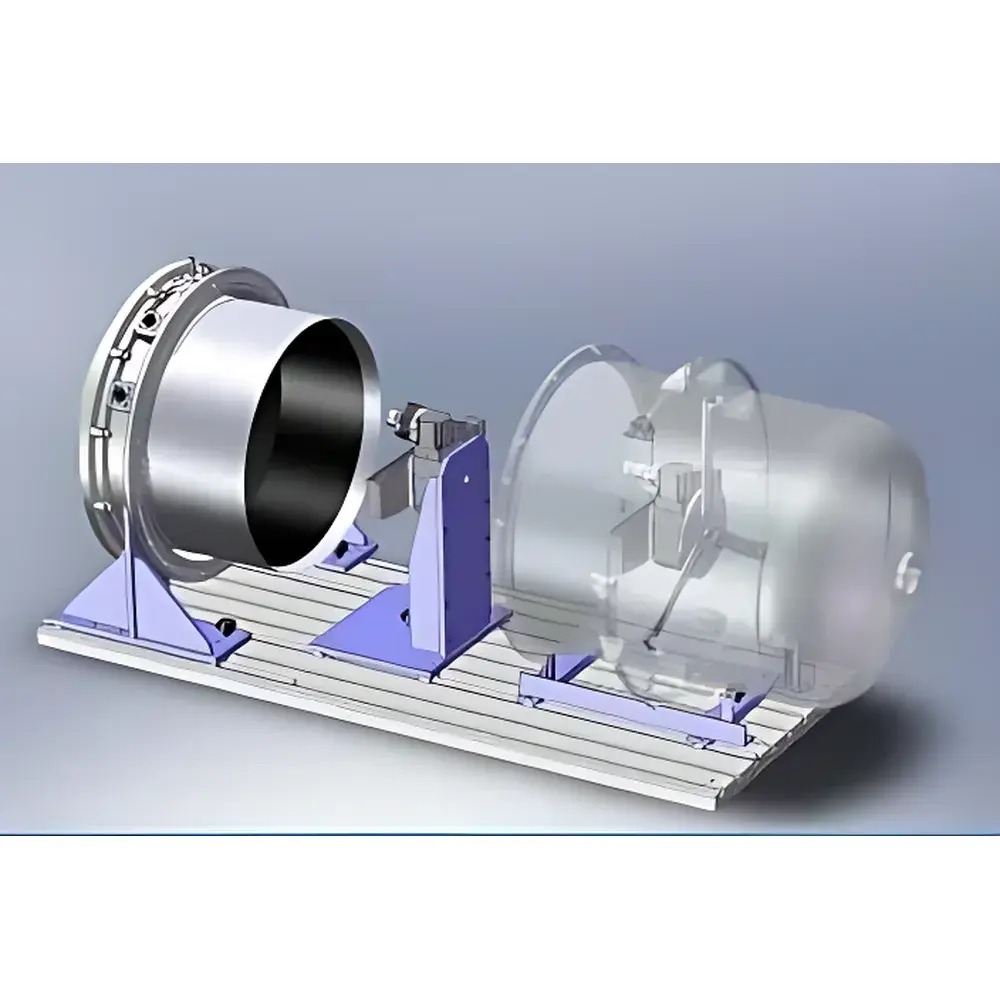
The VNIIOFI LABB Ultra-Large-Aperture Cryogenic Blackbody Calibrator is a high-precision reference source engineered for radiometric and thermographic calibration of infrared (IR) sensors, thermal imagers, radiation thermometers, and spectral radiometers operating across cryogenic to moderate temperature ranges. Based on fundamental blackbody radiation physics—governed by Planck’s law, Wien’s displacement law, and the Stefan–Boltzmann equation—the LABB achieves near-ideal thermal emission characteristics through a precisely temperature-controlled cavity design. Its core architecture integrates a deep-cryogenic liquid thermostat system capable of sustaining stable operation from −60 °C up to +180 °C, enabling traceable calibration under conditions that replicate real-world low-temperature industrial, aerospace, and cryometrology applications. The 500 mm aperture diameter supports full-field calibration of large-format IR focal plane arrays (FPAs), wide-angle lenses, and scanning radiometers—eliminating vignetting and spatial non-uniformity errors common with smaller sources.
Key Features
- Ultra-large 500 mm effective aperture ensures uniform irradiance distribution over extended optical paths and accommodates high-numerical-aperture collimators and wide-field-of-view imaging systems.
- Cryogenic capability down to −60 °C, enabled by a closed-loop liquid thermostat with active pressure regulation and low-vapor-pressure coolant circulation—ensuring minimal thermal drift and condensation control.
- Temperature stability of ±0.02 °C (k = 2) over 30-minute intervals, verified via redundant platinum resistance thermometers (PRTs) traceable to national standards (e.g., VNIIM, PTB).
- Effective emissivity ≥0.99 at −60 °C, validated per ASTM E1933-19 (Standard Test Methods for Measuring and Compensating for Emissivity of Blackbody Cavities) using absolute reflectometer-based cavity characterization.
- Robust stainless-steel cavity construction with optimized cone geometry and high-emissivity coating (E-type pyrolytic graphite or sputtered tantalum nitride) to minimize wall reflections and stray radiation contributions.
- Modular thermal shielding and vacuum-jacketed outer housing reduce ambient thermal loading and support integration into Class 1000 cleanroom or controlled-environment metrology labs.
Sample Compatibility & Compliance
The LABB is compatible with calibration workflows compliant with ISO/IEC 17025:2017, ASTM E1256-22 (Standard Test Methods for Radiation Thermometers), and IEC 62906-5-2 (Laser display devices — Part 5-2: Measurement methods). It meets the geometric and radiometric requirements for primary and secondary calibration of IR instruments used in satellite sensor validation (e.g., VIIRS, MODIS pre-launch testing), cryogenic process monitoring in semiconductor fabrication, and cold-target verification in defense-grade thermal signature analysis. All temperature setpoints are programmable and logged with NIST-traceable timestamps; calibration certificates include uncertainty budgets evaluated per GUM (JCGM 100:2008) and reported at k = 2 coverage factor.
Software & Data Management
The LABB operates via a dedicated Windows-based control interface supporting RS-232, Ethernet (TCP/IP), and optional IEEE-488 (GPIB) communication protocols. Real-time temperature monitoring, ramp/soak profiling, and automated sequence execution are implemented with audit-trail logging compliant with FDA 21 CFR Part 11 requirements—including electronic signatures, user access levels, and immutable event records. Raw PRT readings, cavity thermocouple data, and environmental sensor outputs (ambient temperature, humidity, barometric pressure) are time-synchronized and exportable in CSV, HDF5, or SI-traceable .cal formats. Integration with MET/CAL® or Thermo-CAL™ software suites enables direct linkage to laboratory information management systems (LIMS) and automated certificate generation aligned with EURAMET cg-18 guidelines.
Applications
- Primary calibration of infrared reference standards at national metrology institutes (NMIs) and accredited calibration laboratories.
- End-to-end verification of thermal imaging systems used in cryogenic storage facility monitoring (e.g., LNG tank integrity inspection).
- Validation of radiometric performance for Earth observation payloads during thermal vacuum chamber testing.
- Uncertainty analysis of low-temperature emissivity measurements in materials science laboratories studying phase-change phenomena.
- Traceable calibration of handheld and fixed-mount IR thermometers deployed in pharmaceutical cold-chain logistics and bioreactor temperature mapping.
FAQ
What is the uncertainty budget for temperature calibration at −60 °C?
The expanded uncertainty (k = 2) is ≤ ±0.035 °C, including contributions from PRT calibration, spatial non-uniformity, emissivity correction, and liquid thermostat stability—fully documented in the supplied calibration certificate.
Can the LABB be integrated into an automated calibration line?
Yes. Its SCPI-compliant command set and hardware-trigger I/O ports support synchronization with robotic sample handlers, shutter controllers, and multi-sensor test stands.
Is vacuum operation supported?
The standard configuration operates at atmospheric pressure; however, optional vacuum-compatible variants (up to 10⁻³ Pa) with feedthrough-rated sensors and differential expansion compensation are available upon request.
Does the system comply with GLP/GMP documentation requirements?
All firmware logs, calibration reports, and maintenance records adhere to ALCOA+ principles (Attributable, Legible, Contemporaneous, Original, Accurate, Complete, Consistent, Enduring, Available) and support regulatory audits under ISO 13485 and 21 CFR Part 820.