VNIIOFI BB3500MP High-Temperature Pyrolytic Graphite Blackbody Furnace
| Brand | VNIIOFI |
|---|---|
| Origin | Russia |
| Model | BB3500MP |
| Temperature Range | 1800 K – 3500 K |
| Cavity Inner Diameter | 59 mm |
| Aperture Diameter | 30–50 mm (unwindowed) or with removable high-temp quartz window |
| Emissivity | 0.9995 ± 0.0005 (350 nm – 2500 nm) |
| Max. Current | 1000 A |
| Max. Voltage | 30 V |
| Operating Gas | Argon or vacuum |
| Main Gas Flow | 2–4 L/min |
| Shield Gas Flow | 0.4 L/min |
| Cooling Water Flow | 20 L/min at 15 °C |
| Cavity Material | Pyrolytic graphite |
| Dimensions (L × Ø) | 850 mm × 370 mm |
| Mounting | Vertical or horizontal |
| Lifetime | 500 h at 2800 K, 150 h at 3200 K |
Overview
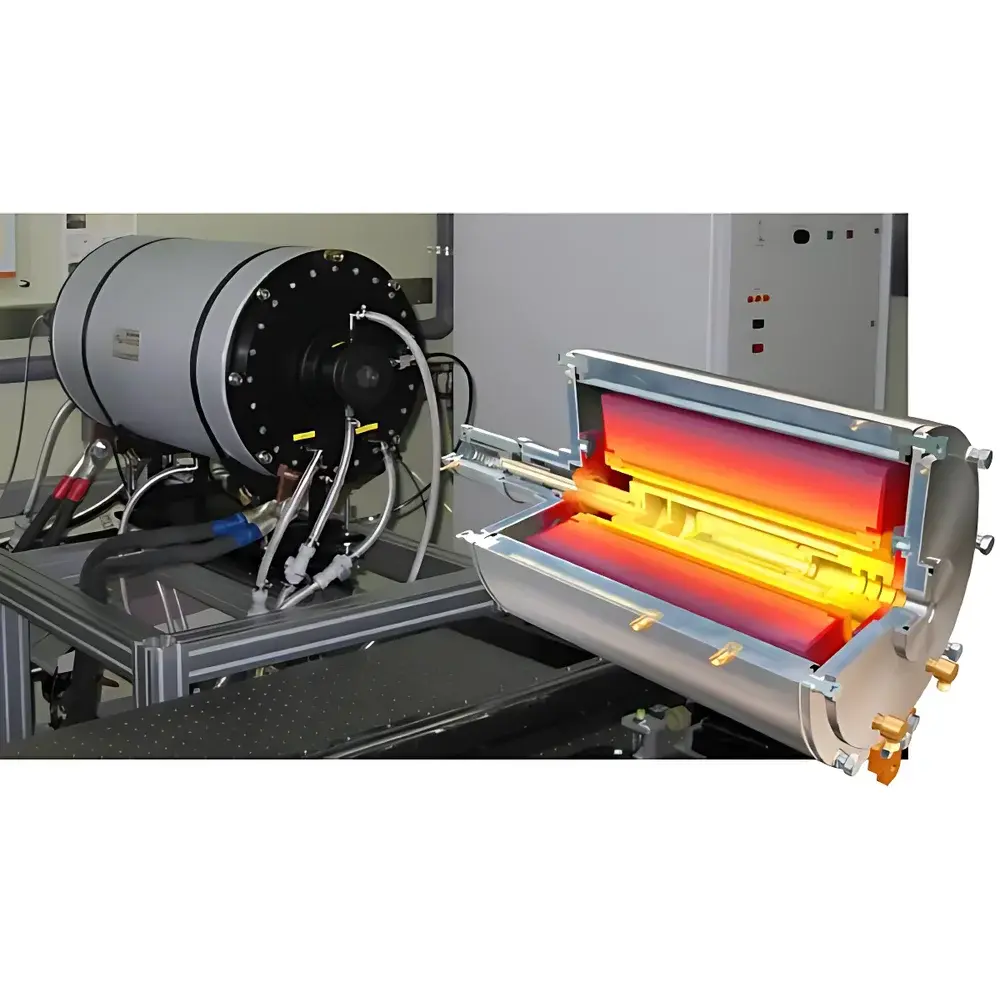
The VNIIOFI BB3500MP is a primary-standard-level high-temperature blackbody furnace engineered for radiometric calibration and thermodynamic temperature realization in national metrology institutes and advanced radiometry laboratories. Based on the fundamental principle of Planckian radiation, it generates spectrally stable, spatially uniform, and highly emissive thermal radiation from a pyrolytic graphite cavity operating under controlled inert atmosphere or vacuum. Designed to serve as a reference source across the UV–VIS–NIR spectral range (350 nm – 2500 nm), the BB3500MP functions as a defining standard for spectral radiance, spectral irradiance, and radiation thermometry traceable to the International Temperature Scale of 1990 (ITS-90) and its ongoing redefinition under the mise en pratique for the kelvin (MeP-K). Its operational range—spanning 1800 K to 3500 K—encompasses critical metal–carbon eutectic fixed points, including TiC–C (3033 K), ZrC–C (3155 K), and HfC–C (3453 K), enabling direct realization of thermodynamic temperature above the copper point via high-temperature fixed-point (HTFP) methodology.
Key Features
- Pyrolytic graphite cavity (59 mm inner diameter) ensuring exceptional thermal homogeneity and mechanical stability at ultra-high temperatures
- Measured spectral emissivity of 0.9995 ± 0.0005 over 350 nm – 2500 nm, validated per ISO/IEC 17025-accredited procedures
- Unwindowed aperture (30–50 mm) optimized for absolute radiometric measurements; optional removable synthetic fused silica viewport rated for continuous operation up to 1200 °C
- Dual-gas delivery system: main purge (2–4 L/min Ar) and annular gas curtain (0.4 L/min Ar) to suppress oxidation and maintain cavity purity
- Water-cooled housing with precisely regulated flow (20 L/min at 15 °C inlet) ensuring thermal management and long-term operational integrity
- Flexible mounting configuration—vertically or horizontally aligned—to accommodate integration into custom optical benches, cryogenic radiometers, or FTIR-based calibration setups
- Robust electrical architecture supporting up to 1000 A at 30 V DC, delivering rapid thermal stabilization and low-drift plateau performance
Sample Compatibility & Compliance
The BB3500MP is not intended for sample heating or material processing. It serves exclusively as a calibrated radiation source for optical and radiometric instrumentation. Its design and validation conform to internationally recognized metrological frameworks, including ISO/IEC 17025 requirements for reference standards used in accredited calibration laboratories. The furnace supports compliance with ASTM E2758 (Standard Practice for Calibration of Spectral Radiometers), ISO 18434-1 (Condition monitoring — Thermography — Part 1: General principles), and EU Regulation (EU) No 1025/2012 on standardization. When operated as an HTFP, it fulfills the technical criteria outlined in CCT-WG5 documentation for high-temperature fixed-point cells and is compatible with uncertainty budgets required for CIPM Mutual Recognition Arrangement (CIPM MRA) signatory laboratories.
Software & Data Management
The BB3500MP operates with programmable temperature controllers capable of synchronized ramp-hold profiles, real-time thermocouple (Type C or WRe5–26) and pyrometer feedback integration, and digital I/O for external trigger synchronization. While no proprietary software suite is bundled, the controller outputs analog voltage signals (0–10 V) and RS-485/Modbus RTU interfaces, enabling seamless integration with LabVIEW, Python-based automation frameworks (e.g., PyVISA), or enterprise metrology management systems (e.g., MET/TEAM, Qualer). All temperature setpoints, dwell times, gas flows, and cooling parameters are logged with timestamped audit trails compliant with GLP and FDA 21 CFR Part 11 when deployed with validated third-party data acquisition platforms.
Applications
- Primary calibration of imaging radiometers, scanning spectroradiometers, and Fourier-transform infrared (FTIR) systems
- Realization and dissemination of thermodynamic temperature via metal–carbon eutectic fixed points (TiC–C, ZrC–C, HfC–C)
- Validation of radiation thermometers, optical pyrometers, and multiwavelength pyrometry systems
- Characterization of detector linearity, spectral responsivity, and stray-light rejection in spaceborne Earth observation sensors
- Interlaboratory comparison campaigns organized by BIPM, EURAMET, or APMP in support of CCT Key Comparisons (KCDB entries)
- Reference source for spectral emissivity measurement of high-temperature materials using comparative reflectometry techniques
FAQ
What is the recommended operating atmosphere for long-term cavity integrity?
Argon gas at ≥99.999% purity is strongly recommended; vacuum operation is permissible but requires additional outgassing protocols and increases risk of graphite sublimation above 3000 K.
Can the BB3500MP be used for non-contact thermometer calibration below 1800 K?
No—it is optimized for high-temperature radiometric applications only; lower-temperature calibration should employ dedicated variable-temperature blackbodies (e.g., 273 K–1273 K range) with appropriate cavity geometry and emissivity validation.
Is the quartz viewport included as standard equipment?
No—the unwindowed configuration is standard; the high-purity fused silica viewport is available as an optional accessory and must be installed/disassembled under controlled cleanroom conditions.
How is temperature uniformity characterized within the cavity?
Uniformity is evaluated via multi-point pyrometric mapping and validated against ISO 18434-1 Annex B guidelines; typical axial and radial gradients remain ≤±0.1 K at stabilized 3200 K plateaus.
Does VNIIOFI provide NIST-traceable calibration certificates?
VNIIOFI issues factory calibration reports traceable to the Russian National Metrology Institute (FSUE VNIIM); end-users may obtain supplementary NIST-traceable verification through authorized calibration service providers accredited to ISO/IEC 17025.