
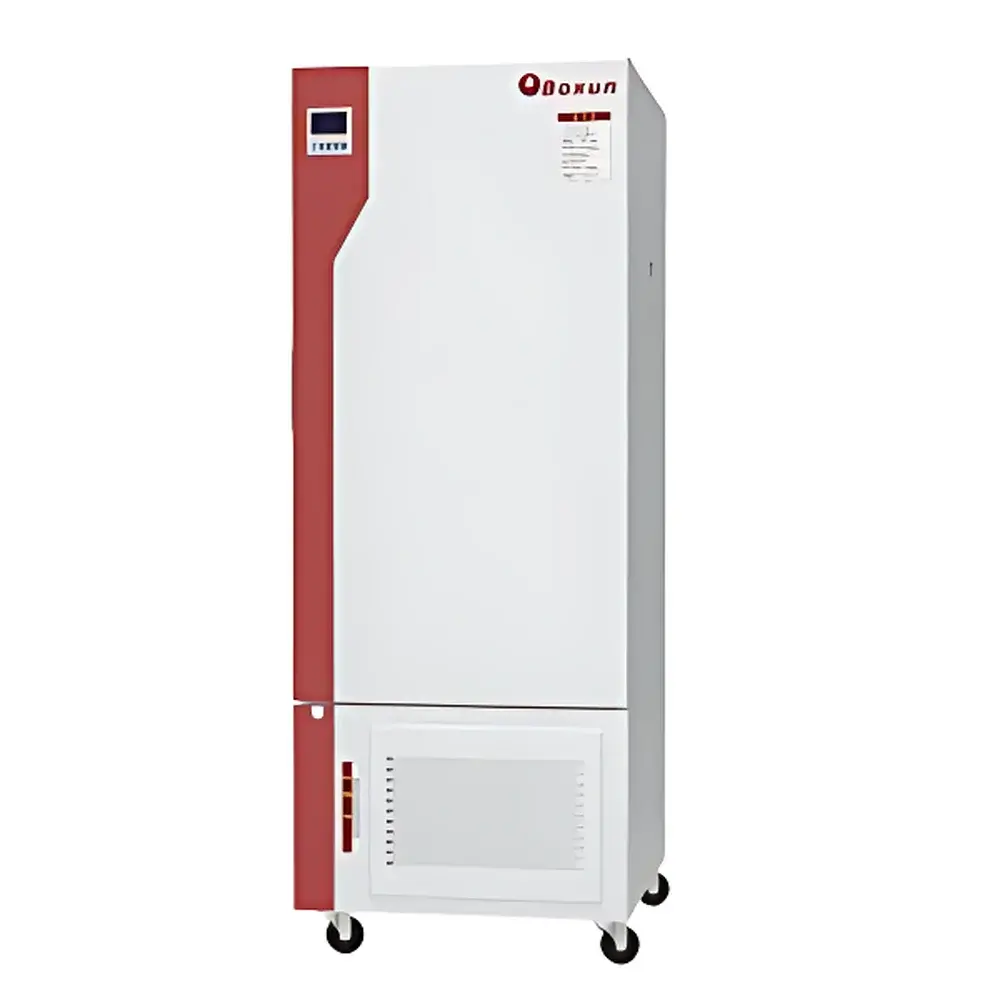
Boxun BSD-150 Orbital Shaking Incubator
| Brand | Boxun |
|---|---|
| Origin | Shanghai, China |
| Manufacturer Type | Direct Manufacturer |
| Product Origin | Domestic (China) |
| Model | BSD-150 |
| Price Range | USD 1,400 – 2,800 |
| Temperature Range | 0°C to 60°C |
| Temperature Uniformity | ±1°C (at 37°C) |
| Humidity Control | Not Available |
| Chamber Capacity | 150 L |
| Temperature Resolution | 0.1°C |
| Temperature Fluctuation | ±0.5°C |
| Power Input | 1050 W |
| Timer Range | 0–9999 minutes |
| Inner Dimensions (W×D×H) | 510 × 390 × 760 mm |
| Outer Dimensions (W×D×H) | 650 × 680 × 1400 mm |
| Shelf | 1 adjustable stainless steel tray |
| Shaking Mode | Orbital (rotary) |
| Speed Range | 0–220 rpm (adjustable) |
| Orbit Diameter | 20 mm |
| Reciprocating Mode | Optional (0–300 cpm, amplitude 30 mm) |
| Tray Size | 420 × 320 × 200 mm |
| Interface | RS-485 for PC/data logger connectivity |
| Safety Features | Over-temperature alarm, mechanical door lock, auto-recovery after power interruption, non-energy-consuming defrosting system |
| Programmability | 10 segments × 99 cycles |
| Air Exchange | Independent fresh-air inlet with on/off control |
| Construction | Cold-rolled steel exterior with electrostatic powder coating |
Overview
The Boxun BSD-150 Orbital Shaking Incubator is an integrated temperature-controlled shaking platform engineered for reproducible cultivation of microbial, cellular, and biochemical samples under precisely regulated thermal and mechanical conditions. Designed around a dual-function architecture—combining high-stability microprocessor-based temperature control with variable-speed orbital agitation—the unit enables simultaneous incubation and homogeneous suspension of cultures in flasks, tubes, or multi-well plates. Its operational principle relies on forced-air convection via a centrifugal blower and a proprietary air-channel design that ensures rapid thermal equilibration and minimal spatial gradient across the 150 L chamber. The system operates within a calibrated range of 0°C to 60°C (±0.5°C fluctuation, ±1°C uniformity at 37°C), making it suitable for mesophilic bacterial growth, yeast propagation, enzyme kinetics studies, and aerobic biodegradation assays such as BOD5 determination. Unlike static incubators, the BSD-150 integrates mechanical oscillation—up to 220 rpm with 20 mm orbit diameter—to maintain oxygen transfer efficiency and prevent cell sedimentation, thereby supporting higher-density cultures and improved metabolic consistency.
Key Features
- Microprocessor-controlled PID temperature regulation with 0.1°C resolution and real-time LCD display of setpoint, actual temperature, elapsed time, and remaining time
- Orbital shaking mechanism with continuously adjustable speed (0–220 rpm) and fixed 20 mm orbit; optional reciprocating mode (0–300 cpm, 30 mm stroke)
- Dual-layer insulation and sealed chamber construction enabling stable operation in ambient environments up to 35°C
- Independent fresh-air inlet valve allowing controlled ventilation without compromising internal temperature stability
- Integrated refrigeration system using internationally certified R134a-free refrigerant and high-efficiency compressor for low-noise, energy-conscious operation
- Auto-diagnostic firmware with self-checking routines for compressor status, sensor integrity, and heating element functionality
- Non-energy-consuming defrost cycle activated only when condensation thresholds are exceeded—eliminating thermal disturbance during long-term runs
- Mechanical door lock and over-temperature cut-off circuitry compliant with IEC 61010-1 safety requirements for laboratory equipment
- Power-loss recovery function preserving all active parameters and resuming operation upon grid restoration
Sample Compatibility & Compliance
The BSD-150 accommodates standard culture vessels including Erlenmeyer flasks (up to 2 L), test tubes, Petri dishes, and deep-well microplates mounted on its 420 × 320 mm stainless steel shaking tray. Its chamber geometry supports stacked configurations with optional auxiliary shelves (sold separately). While humidity control is not implemented—making it unsuitable for hygroscopic or desiccation-sensitive specimens—the unit meets essential performance criteria outlined in ISO 13408-1 (aseptic processing) and ASTM E1759-18 (laboratory incubator verification protocols). It is routinely deployed in GLP-compliant environmental testing labs conducting wastewater biodegradability assessments per EPA Method 524.2 and APHA Standard Methods 5210B. All electrical components conform to CE marking requirements and RoHS Directive 2011/65/EU.
Software & Data Management
The built-in RS-485 serial interface supports Modbus RTU protocol for integration into centralized lab monitoring systems or third-party data loggers. Users may configure up to 10 programmable temperature-shake profiles, each comprising 99 sequential steps with independent ramp rates, dwell times, and agitation setpoints. Parameter memory retains all user-defined settings—including calibration offsets—through power cycles. Optional accessories include a thermal printer module for time-stamped curve output and GPRS-enabled remote alarm modules transmitting SMS alerts on temperature deviation, door opening, or system fault codes. While native software is not provided, the device is compatible with open-source platforms such as LabVIEW™ and Python-based PySerial implementations for automated data acquisition and audit-trail generation—facilitating alignment with FDA 21 CFR Part 11 requirements when paired with appropriate electronic signature workflows.
Applications
- Biochemical oxygen demand (BOD) analysis in municipal and industrial effluent monitoring
- Cultivation of Escherichia coli, Bacillus subtilis, and fungal isolates for antimicrobial susceptibility testing
- Seed germination and plant tissue culture under controlled photoperiod-independent conditions
- Enzyme production optimization in submerged fermentation processes
- Preparation of competent cells and plasmid amplification in molecular biology workflows
- Environmental simulation studies involving temperature-dependent microbial community dynamics
- QC/QA testing of pharmaceutical excipients requiring aerobic stability assessment
FAQ
Does the BSD-150 support humidity control?
No. This model is a dry-air orbital incubator; relative humidity is not regulated or monitored.
What is the maximum flask size supported on the shaking platform?
Two 2 L Erlenmeyer flasks can be accommodated simultaneously using the standard tray configuration.
Is the RS-485 interface galvanically isolated?
Yes—the communication port includes opto-isolation to prevent ground-loop interference in multi-device networks.
Can the unit operate continuously for 72+ hours without maintenance?
Yes. The compressor duty cycle, passive defrost logic, and thermal protection architecture enable unattended operation exceeding 30 days under nominal load.
Are calibration certificates traceable to NIST or equivalent national standards available?
Factory calibration reports are provided with each unit; NIST-traceable certification may be requested at time of order (additional lead time and fee apply).






