ZEISS SPECTRUM verity Bridge Coordinate Measuring Machine
| Brand | ZEISS |
|---|---|
| Origin | Shanghai, China |
| Manufacturer Type | Original Equipment Manufacturer (OEM) |
| Country of Origin | China |
| Model | SPECTRUM verity |
| Configuration | Bridge-type |
| Operation Mode | Fully Automatic |
| Orientation | Vertical CMM |
| Measurement Principle | Hybrid Contact & Non-contact (Tactile + Optical) |
| Primary Application Sectors | Automotive, Electronics, General Industrial Manufacturing |
| Sensor Platform | VAST XT gold active scanning probe system |
| Scanning Capability | Continuous high-speed tactile scanning with real-time force control |
Overview
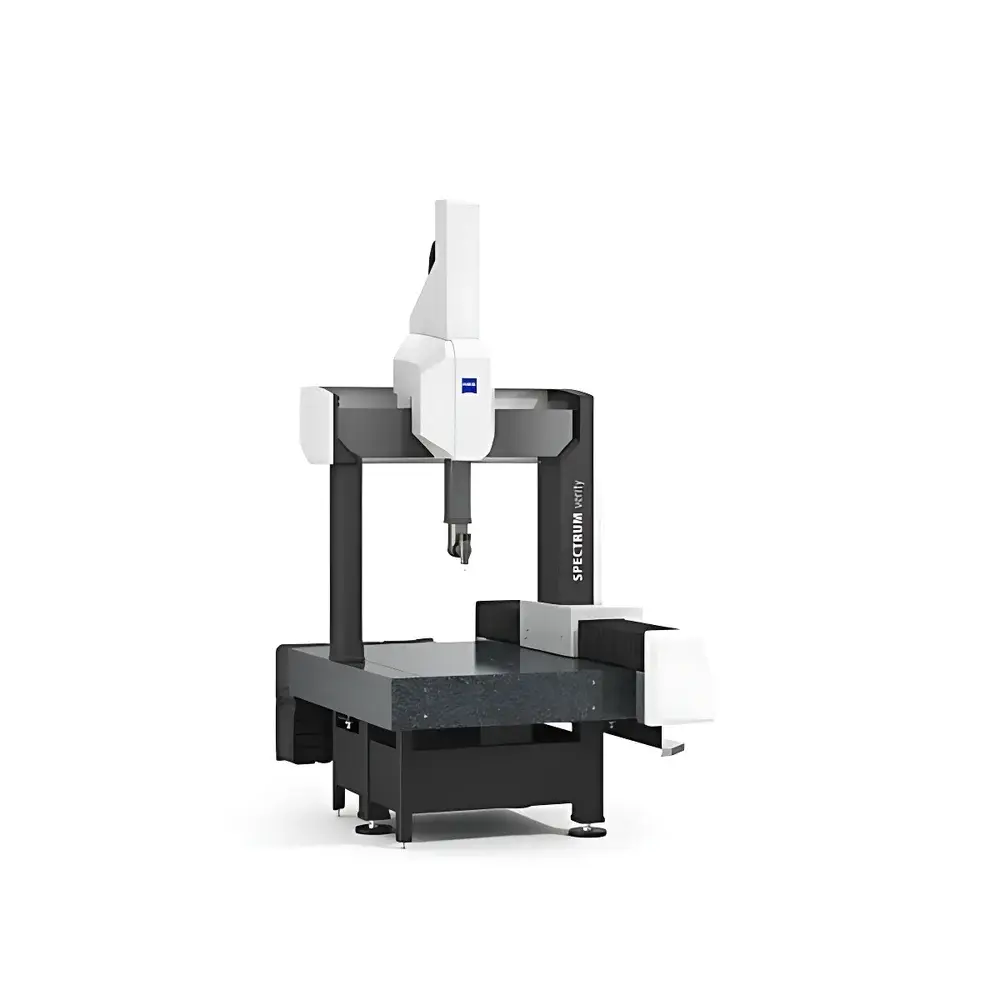
The ZEISS SPECTRUM verity is a high-performance bridge-type coordinate measuring machine (CMM) engineered for precision geometric metrology in demanding production and quality assurance environments. Designed and manufactured by ZEISS in Shanghai, this vertical CMM integrates advanced tactile measurement architecture with optional non-contact sensor modules—enabling hybrid inspection strategies across complex, multi-material components. Its core measurement principle relies on high-fidelity tactile probing via the ZEISS VAST XT gold active scanning probe, which operates on electromagnetic force feedback control rather than passive mechanical deflection. Unlike conventional single-point probing—where discrete point acquisition risks missing form deviations between points—the SPECTRUM verity captures up to thousands of measurement points per second during continuous path scanning. This dense spatial sampling delivers statistically robust surface characterization, minimizing interpolation uncertainty and enabling traceable evaluation of form, profile, orientation, and location tolerances per ISO 1101 and ASME Y14.5 standards.
Key Features
- Bridge structural design with granite base and thermally stable aluminum bridge—optimized for rigidity, vibration damping, and long-term metrological stability.
- VAST XT gold active scanning probe: electromagnetically controlled, real-time force-regulated tactile sensor with programmable measurement force (0.01–0.3 N range), ensuring consistent contact behavior across varying probe extensions, stylus configurations, and part geometries.
- High-velocity continuous scanning: achieves scanning speeds up to 30 mm/s while maintaining sub-micron repeatability (MPEP ≤ 1.9 + L/350 µm, where L is in mm), validated per ISO 10360-2.
- Hybrid sensor readiness: integrated mounting interfaces and software support for optional optical sensors—including chromatic confocal, structured light, or laser line scanners—for complementary non-contact assessment of reflective, fragile, or soft-surface features.
- Automatic calibration routine with ZEISS CALYPSO-compatible artifact libraries—supporting on-machine verification of probe qualification, kinematic error mapping, and volumetric compensation.
Sample Compatibility & Compliance
The SPECTRUM verity accommodates parts ranging from small electronic housings (<50 mm) to mid-sized automotive components (up to 1,200 × 1,000 × 800 mm working volume). Its modular probe head (ZEISS RDS or RAMS) supports rapid stylus exchange and angular positioning, enabling access to deep cavities, narrow slots, and compound-curvature surfaces. All measurement routines comply with ISO/IEC 17025 requirements for accredited calibration laboratories and support full GLP/GMP audit trails when deployed with ZEISS CALYPSO software under FDA 21 CFR Part 11-compliant configuration. System validation documentation—including IQ/OQ/PQ protocols and uncertainty budgets—is provided per customer-specific quality management system (QMS) requirements.
Software & Data Management
Controlled exclusively via ZEISS CALYPSO v2023 or later, the SPECTRUM verity delivers seamless integration into enterprise manufacturing execution systems (MES) and quality information systems (QIS). CALYPSO provides parametric programming, GD&T-aware reporting, statistical process control (SPC) dashboards, and automated report generation in PDF, Excel, or XML formats. Measurement data is stored in an encrypted, timestamped database with full revision history, user access logs, and electronic signature capability. Optional ZEISS PiWeb interface enables real-time dashboarding, cross-machine comparison, and trend analysis aligned with IATF 16949 clause 9.1.3 requirements.
Applications
This CMM serves as a primary inspection platform in Tier-1 automotive suppliers for engine manifolds, transmission housings, and ADAS sensor brackets—where tight position tolerances (≤ ±0.02 mm) and surface finish correlation are critical. In electronics manufacturing, it verifies coplanarity of BGA packages, solder paste volume estimation (via height mapping), and PCB warpage assessment. General industrial users apply it for first-article inspection of machined castings, turbine blade root geometry, and additive-manufactured lattice structures—leveraging its ability to handle both rigid metallics and semi-rigid polymers without stylus-induced deformation.
FAQ
What distinguishes active scanning (VAST XT gold) from passive scanning?
Active scanning uses closed-loop electromagnetic force control to maintain constant, low net contact force regardless of probe extension or surface slope—reducing deformation errors on thin-walled or compliant parts.
Can the SPECTRUM verity be integrated into automated production lines?
Yes—equipped with ZEISS Automation Interface (ZAI), it supports PLC handshake signals, robotic part loading/unloading, and cycle-time-optimized inspection sequences.
Is thermal compensation included?
Standard configuration includes dual-axis temperature sensors and real-time volumetric error correction based on ambient and machine body temperature readings per ISO 230-3.
Does ZEISS provide on-site validation and certification?
All systems ship with factory acceptance test (FAT) reports; ZEISS Metrology Services offers ISO 17025-accredited on-site verification, uncertainty analysis, and Gage R&R studies upon delivery.
What training options are available for operators and programmers?
ZEISS offers certified CALYPSO operator courses (Level 1–3), metrology fundamentals workshops, and custom on-site programming support aligned with internal QA procedures.