
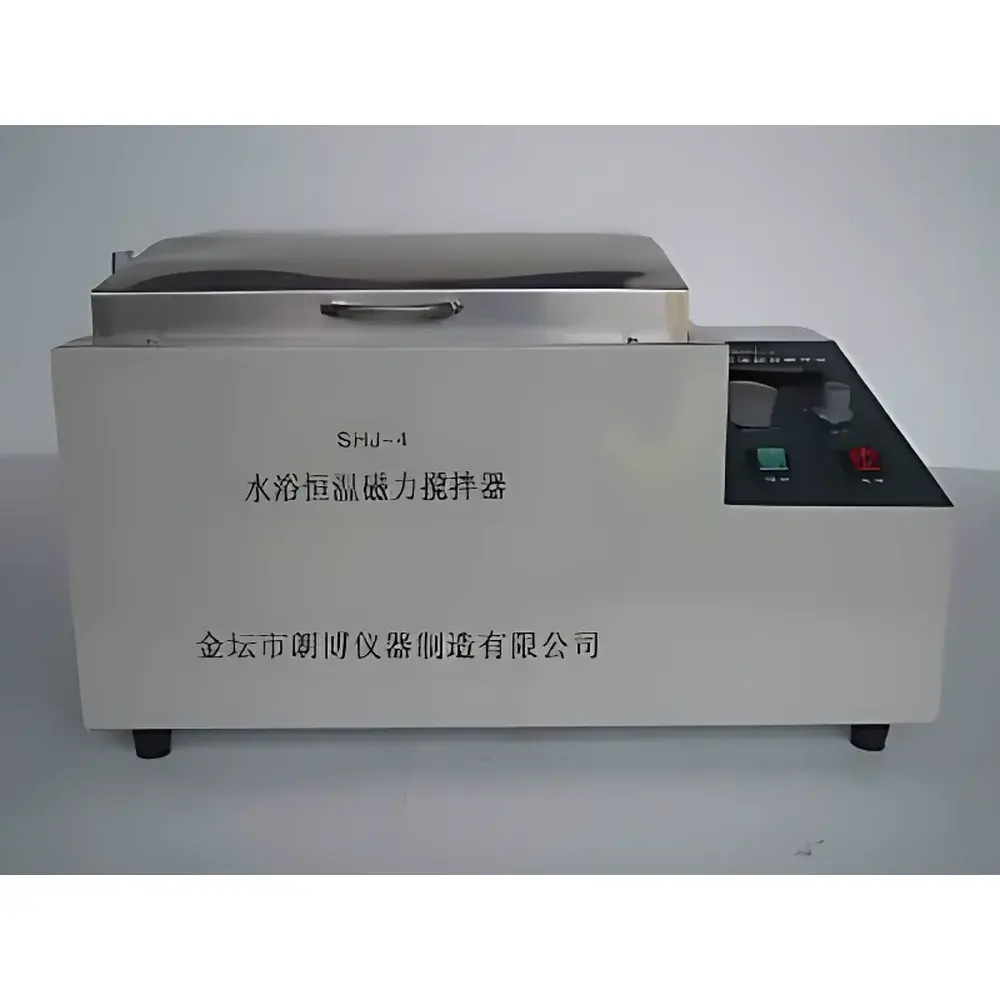
SHJ-4 Constant-Temperature Water Bath Magnetic Stirrer
| Origin | Jiangsu, China |
|---|---|
| Manufacturer Type | Distributor |
| Origin Category | Domestic |
| Model | SHJ-4 |
| Price | USD 540 (FOB) |
| Temperature Control Range | Ambient to 100 °C |
| Speed Range | 0–2400 rpm |
| Display | LED Digital |
| Heating Power | 1000 W |
| Stirring Motor Power | 25 W × 4 Stations |
| Stir Bar Material | PTFE-Coated Neodymium Magnet |
| Compliance | CE, RoHS, ISO 9001 |
Overview
The SHJ-4 Constant-Temperature Water Bath Magnetic Stirrer is a multi-station laboratory instrument engineered for simultaneous temperature-controlled mixing of up to four samples in sealed or open vessels. It integrates precise conductive heating via a fully enclosed stainless-steel heating plate with independent magnetic stirring across four positions, enabling uniform thermal distribution and consistent rotational agitation without mechanical shaft penetration. The system operates on the principle of electromagnetic induction: a rotating magnetic field generated beneath the bath surface couples with PTFE-coated neodymium stir bars placed inside sample containers, inducing controlled vortex motion while maintaining vessel integrity. Designed for long-duration operation under stable thermal conditions, it supports applications requiring both thermal equilibration and homogeneous dispersion—such as buffer preparation, enzymatic reaction incubation, dissolution testing, and reagent synthesis.
Key Features
- Four independent stirring stations with individual speed control (0–2400 rpm), each driven by low-noise DC motors ensuring smooth torque delivery and minimal vibration transmission.
- Integrated water bath with PID-based digital temperature regulation (ambient to 100 °C), ±0.3 °C accuracy at setpoint, and real-time LED display for both target and actual bath temperature.
- 1000 W high-efficiency heating element embedded in a corrosion-resistant, fully sealed aluminum alloy housing—eliminates hot-spot formation and enables rapid thermal recovery after sample loading.
- PTFE-coated stir bars (included) rated for continuous use up to 100 °C, resistant to strong acids, alkalis, and organic solvents; magnetic strength optimized for viscous media up to 5000 mPa·s.
- Stainless steel bath chamber with integrated overflow drain port and removable lid for easy cleaning and safe handling of heated liquids.
- Over-temperature protection circuit and auto-shutdown function activated upon dry-run detection or thermal runaway conditions.
Sample Compatibility & Compliance
The SHJ-4 accommodates standard laboratory glassware including beakers (50–1000 mL), Erlenmeyer flasks, and jacketed reactors up to 120 mm in diameter per station. Its sealed bath design permits operation with aqueous, ethanolic, glycerol-based, and silicone oil heat-transfer media. All electrical components conform to IEC 61010-1 safety standards for laboratory equipment. The unit is CE-marked and RoHS-compliant, meeting EU directives for electromagnetic compatibility (EMC Directive 2014/30/EU) and hazardous substance restrictions. Manufacturing quality assurance follows ISO 9001:2015 protocols, supporting traceability requirements in GLP environments. While not FDA 21 CFR Part 11 validated out-of-the-box, audit-ready operational logs can be maintained manually per internal SOPs.
Software & Data Management
The SHJ-4 operates as a standalone analog-digital hybrid instrument with no embedded firmware or network interface. Temperature setpoints and stirring speeds are configured via front-panel rotary dials and push-button controls, with LED readouts providing immediate feedback. No proprietary software, drivers, or cloud connectivity are required—ensuring compatibility with air-gapped lab networks and minimizing cybersecurity exposure. For laboratories requiring electronic recordkeeping, external data loggers (e.g., Omega OM-DAQPRO-5300 series) may be connected via analog voltage outputs (0–5 VDC) for time-synchronized capture of bath temperature and motor speed signals. Calibration certificates for temperature and speed sensors are available upon request and include NIST-traceable references.
Applications
- Pharmaceutical QC: Dissolution testing per USP , buffer equilibration prior to HPLC mobile phase preparation.
- Materials science: Nanoparticle dispersion in aqueous colloids, polymer solution homogenization prior to rheological characterization.
- Life sciences: Cell culture medium warming and pH-adjustment mixing, antibody conjugation reactions under controlled thermal conditions.
- Environmental analysis: Extraction solvent heating and agitation during EPA Method 3510C liquid-liquid extraction procedures.
- Academic research: Teaching labs for kinetics experiments requiring concurrent thermal and mechanical input control.
FAQ
What is the maximum recommended viscosity for effective stirring with the SHJ-4?
For optimal performance across all four stations, the system is validated for Newtonian fluids up to 5000 mPa·s at 25 °C using 30 mm PTFE stir bars. Higher viscosities require reduced speed settings and verification of vortex formation under actual process conditions.
Can the SHJ-4 operate without water in the bath chamber?
No. The unit must contain a minimum volume of heat-transfer fluid (water or silicone oil) covering the heating element. Dry operation will trigger thermal cutoff and may damage the heater assembly.
Is the temperature sensor calibrated to NIST standards?
Each unit undergoes factory calibration against reference thermometers traceable to NIST SRM 1750. A certificate of conformance is supplied; full NIST calibration documentation is available as an optional add-on service.
How often should the stir bars be replaced?
Under typical usage (≤8 hrs/day, ≤100 °C), PTFE-coated stir bars retain magnetic integrity and surface integrity for ≥2 years. Visual inspection for coating wear or demagnetization is recommended quarterly.
Does the SHJ-4 support external temperature probe input for sample-specific feedback control?
No. The system regulates only bath temperature. For sample-core temperature control, a secondary external probe and programmable controller (e.g., Watlow F4T) must be integrated externally.



