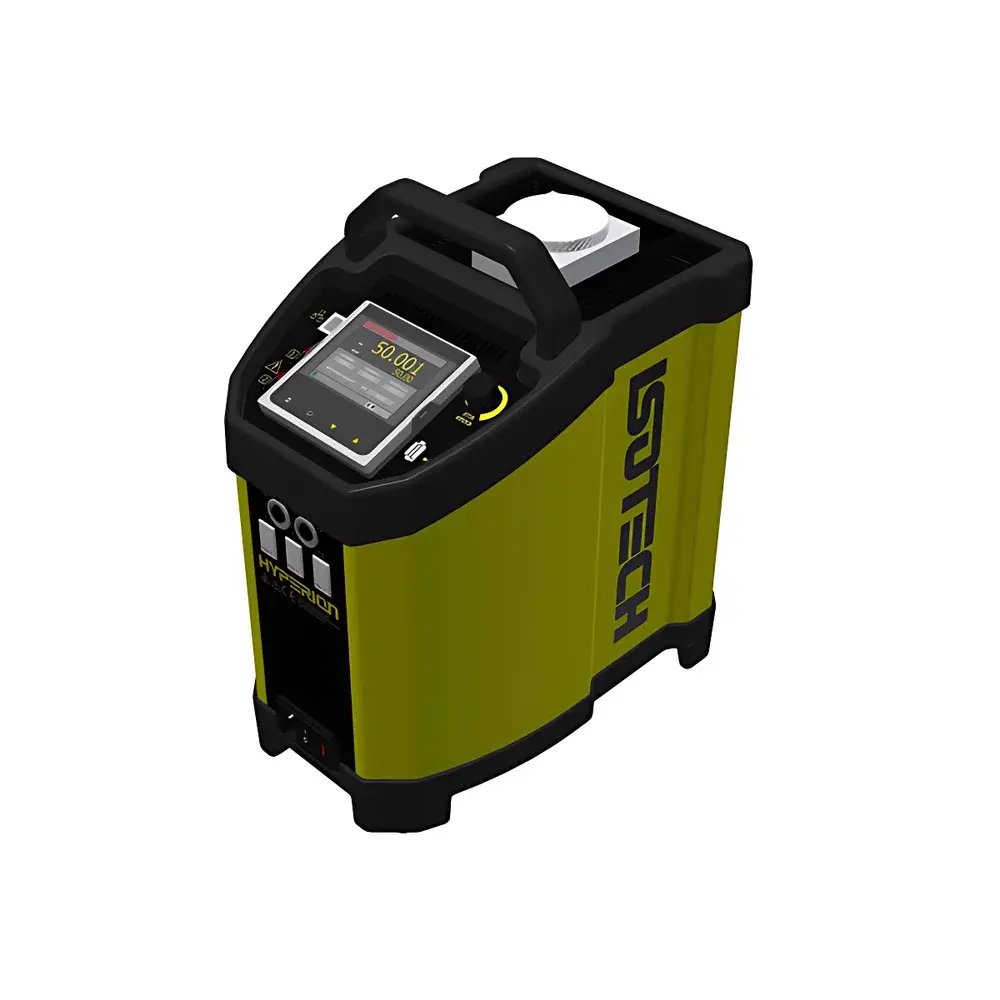
ISOTECH Hyperion H4936 and Drago D4934 Multi-Function Dry-Block Calibrators
| Brand | ISOTECH |
|---|---|
| Origin | United Kingdom |
| Model | H4936 and D4934 |
| Instrument Type | Dry-Block Temperature Calibrator |
| Temperature Range | –20 °C to 142 °C (H4936), 30 °C to 250 °C (D4934) |
| Stability (Liquid Bath & Dry-Block Modes) | ±0.005 °C |
| Temperature Resolution | 0.001 °C (full scale) |
| Heating Time | –20 °C to 140 °C in 40 min (H4936) |
| Cooling Time | 140 °C to 20 °C in 90 min (H4936) |
| Horizontal Uniformity (Bath Mode) | <0.009 °C (H4936), <0.007 °C (D4934) |
| Vertical Uniformity (40 mm zone, Bath Mode) | <0.011 °C (H4936), <0.013 °C (D4934) |
| Calibration Well Dimensions | Ø65 mm × 160 mm depth |
| Input Channels | Thermocouples (E/J/K/N/R/S/T), RTDs (Pt100/Pt1000), (4–20) mA process signals, switch inputs |
| CJC Accuracy | ±0.35 °C |
| Display Resolution | 0.01 °C (–19.99 °C to 99.99 °C), 0.1 °C elsewhere |
| Display Accuracy | ±0.15 °C |
| Power Supply | 220 VAC, 50/60 Hz, 200 W (H4936), 1000 W (D4934) |
| Dimensions (H×W×D) | 384 × 212 × 312 mm |
| Weight | 12 kg (H4936), 8 kg (D4934) |
Overview
The ISOTECH Hyperion H4936 and Drago D4934 are high-precision, multi-mode temperature calibration systems engineered for metrology-grade verification across laboratory and field environments. Unlike conventional dry-block calibrators limited to single-function operation, these instruments integrate six distinct calibration modalities within a single robust platform: dry-block calibration, liquid-bath simulation, blackbody cavity calibration for infrared thermometers, surface temperature probe verification, ice-point reference generation, and ITS-90 fixed-point cell support (achieving uncertainties down to ±0.0005 °C with appropriate primary standards). Both models employ dual-zone thermal control architecture—separating heating element regulation from well temperature feedback—to minimize thermal gradients and maximize short-term stability. The H4936 operates from –20 °C to 142 °C with exceptional low-temperature capability, while the D4934 extends to 250 °C for high-temperature industrial applications. Their 65 mm diameter, 160 mm deep calibration wells accommodate large-diameter probes, multi-sensor arrays, or stacked sensor configurations—enabling simultaneous calibration of multiple devices under identical thermal conditions.
Key Features
- Multi-modal operation: seamless switching between dry-block, liquid-bath emulation, blackbody, surface, ice-point, and ITS-90 fixed-point modes without hardware modification
- High-stability thermal control: ±0.005 °C short-term stability in both dry-block and bath-equivalent modes, verified per ISO/IEC 17025 calibration procedures
- Uniformity-optimized well geometry: horizontal uniformity <0.009 °C (H4936) and <0.007 °C (D4934) over full well cross-section; vertical uniformity <0.011 °C within 40 mm axial zone (bath mode)
- Integrated metrology-grade input channels: direct measurement and verification of thermocouples (E/J/K/N/R/S/T), RTDs (Pt100/Pt1000), (4–20) mA loop signals, and digital switch outputs—eliminating need for external readouts during functional testing
- Networked remote access: Ethernet interface with embedded web server enables real-time monitoring, setpoint adjustment, and data export via browser on PC, tablet, or smartphone—fully compatible with time-synchronized audit trails required under FDA 21 CFR Part 11
- Modular insert system: standard well configuration includes eight 8 mm and two 4.5 mm bores (157 mm deep), supporting interchangeable inserts for specialized probe geometries or custom calibration fixtures
Sample Compatibility & Compliance
The H4936 and D4934 accommodate a broad spectrum of temperature sensing technologies—including sheathed thermocouples (Type K up to 12 mm OD), Pt100 RTD probes (3-wire and 4-wire), infrared thermometer targets (emissivity-adjustable blackbody cavities), contact surface sensors (thermistor tapes, RTD patches), and miniature ITS-90 cells (e.g., Sn, Zn, Al fixed points). Each unit is supplied with full traceable calibration certificates issued by UKAS-accredited laboratories, compliant with ISO/IEC 17025:2017 and aligned with ASTM E2877 (Standard Guide for Calibration of Thermal Imaging Systems) and IEC 60584-1 (Thermocouple reference tables). The integrated CJC (cold-junction compensation) subsystem meets IEC 60584-2 requirements with ±0.35 °C uncertainty. All firmware and calibration software modules support GLP/GMP audit logging, including user authentication, electronic signatures, and immutable timestamped event records.
Software & Data Management
Calibration workflows are managed through ISOTECH’s CalSoft Pro suite—a Windows-based application certified for use in regulated environments. The software supports automated sequence execution (ramp-hold-soak cycles), uncertainty budgeting per GUM (JCGM 100:2008), and report generation compliant with ISO 17025 Annex A.5. Raw temperature readings, environmental logs (ambient pressure/humidity), and device-under-test (DUT) metadata are stored in encrypted SQLite databases with SHA-256 hashing. Export formats include CSV, PDF/A-2b (archival), and XML for LIMS integration. Firmware updates preserve all user-defined configurations and maintain cryptographic integrity checks. USB mass-storage mode allows direct transfer of calibration records to external drives without host PC dependency—critical for cleanroom or classified facility deployments.
Applications
- Primary and secondary calibration laboratories performing accredited temperature verification per ISO/IEC 17025
- Pharmaceutical manufacturing sites validating sterilization autoclaves, lyophilizers, and environmental chambers (aligned with EU GMP Annex 15 and USP <1058>)
- Aerospace and power generation facilities verifying turbine inlet sensors, bearing temperature monitors, and fire detection loops
- Research institutions conducting inter-laboratory comparisons using ITS-90 fixed points or developing novel thermometric materials
- Field service teams performing on-site calibration of HVAC controls, process transmitters, and safety-critical temperature switches in petrochemical plants
FAQ
What distinguishes the H4936 from the D4934 beyond temperature range?
The H4936 features enhanced low-temperature performance (–20 °C minimum) with optimized refrigeration-assisted cooling, whereas the D4934 prioritizes high-power resistive heating (1000 W) and ceramic insulation for sustained 250 °C operation. Their well uniformity specifications, power supplies, and physical weights differ accordingly.
Can the units perform simultaneous calibration of multiple sensors at different setpoints?
No—both models maintain a single, spatially uniform thermal zone. However, their large well volume enables concurrent calibration of multiple sensors at the same temperature, with individual readout via integrated input channels.
Is external reference thermometer required for liquid-bath mode accuracy?
Yes. While the built-in sensor provides control stability, achieving ±0.005 °C uncertainty in bath mode requires a traceable PRT (e.g., 25.5 Ω SPRT) inserted into the well alongside DUTs, as specified in EURAMET cg-18.
Does the system support automated compliance reporting for FDA or ISO audits?
Yes. CalSoft Pro generates 21 CFR Part 11-compliant reports with electronic signatures, change history, and audit trail exports in tamper-evident format.
Are replacement inserts available for non-standard probe diameters?
Yes. ISOTECH offers custom-machined inserts (aluminum, stainless steel, or Inconel) with bore diameters from 1.5 mm to 12 mm, configurable to match OEM probe footprints or legacy calibration fixtures.