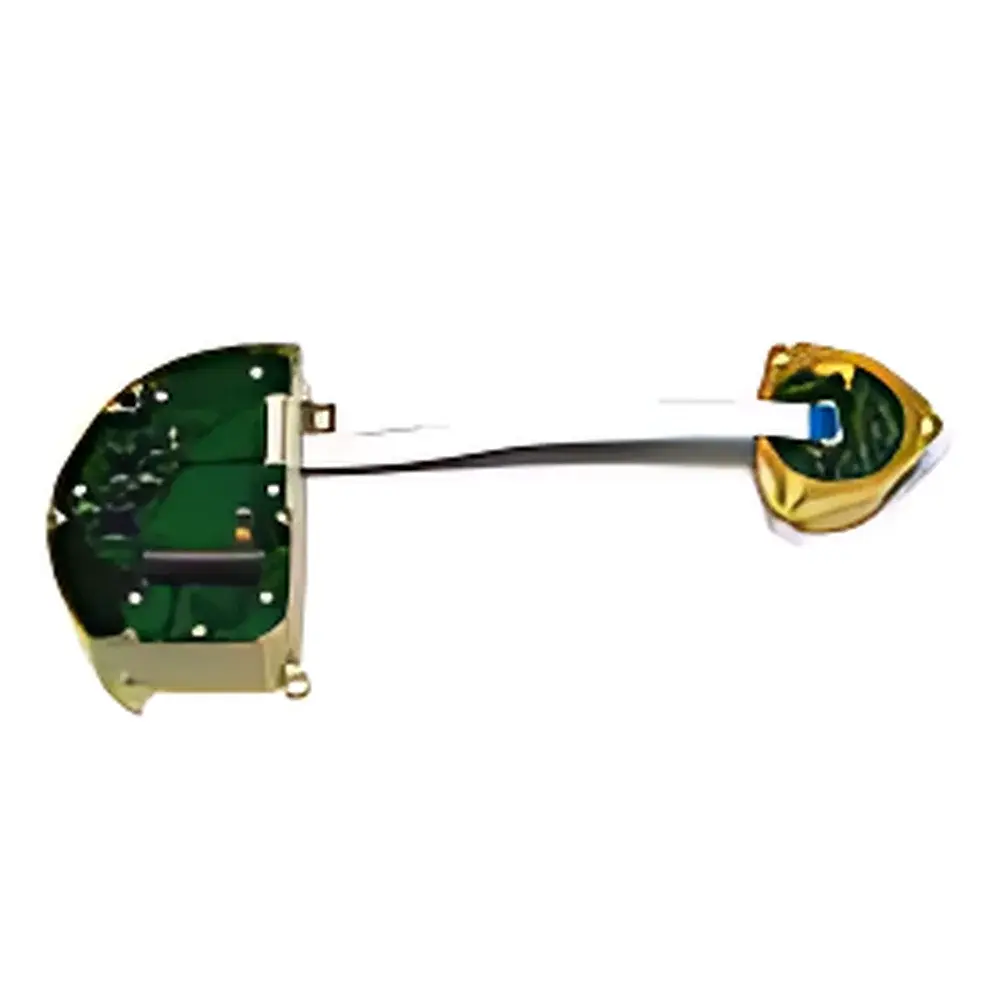
INNALABS INL-CVG-G100 Single-Axis Digital Output Coriolis Vibratory Gyroscope
| Brand | INNALABS |
|---|---|
| Origin | Germany |
| Model | INL-CVG-G100 |
| Output Interface | RS-232/RS-422/RS-485 |
| Output Data Rate | 2000–9000 Hz |
| Measurement Range | ±110 deg/s |
| Bandwidth | 300 Hz |
| Bias Stability (Room Temp, 1σ) | <0.1 deg/hr |
| Bias Stability (Full Temp Range, 1σ) | <10 deg/hr |
| Angle Random Walk | <0.008 deg/√hr |
| In-Run Noise (0.1–100 Hz, RMS) | <0.008 deg/s |
| Scale Factor Error (Full Temp Range, 1σ) | <2500 ppm |
| Scale Factor Linearity | <500 ppm |
| Startup Time | <1 s |
| Misalignment | <8 mrad |
| Input Voltage | +12 to +36 VDC (MIL-STD-704 / MIL-STD-1275 compliant) |
| Power Consumption | <1.7 W @ 15 VDC |
| Operating Temperature | −40 °C to +85 °C |
| Storage Temperature | −55 °C to +90 °C |
| Vibration (Operational) | 12 g RMS, 1–2000 Hz, 10 min/axis |
| Vibration (Transport) | 3 g RMS, 1–2000 Hz, 1 h/axis |
| Shock | 500 g, 0.5 ms half-sine |
| MTBF (MIL-HDBK-217F) | 500,000 hr |
| EMI Susceptibility | Unshielded (no shielding required per design) |
| Lifetime | 17 years |
| Sensor Mass | 71 g |
| Damping Assembly Mass | 26 g |
| Electronics & Connector Mass | 73 g |
| Dimensions (Sensor Core) | 25 mm H × 29.4 mm D |
| Built-in Self-Test (BIT) | Yes |
Overview
The INNALABS INL-CVG-G100 is a high-performance, single-axis Coriolis vibratory gyroscope engineered for demanding inertial sensing applications where precision, reliability, and environmental resilience are non-negotiable. Unlike optical or MEMS-based angular rate sensors, the G100 leverages a resonant silicon tuning-fork structure operating in a controlled vacuum environment, enabling measurement of angular velocity via the Coriolis effect—where rotation induces orthogonal motion in the vibrating proof mass. This principle delivers inherent immunity to acceleration-induced errors and eliminates reliance on moving mechanical bearings or optical alignment, resulting in exceptional long-term bias stability and repeatability. Designed and manufactured in Germany, the G100 meets stringent requirements for aerospace, defense, and industrial stabilization systems, supporting operation across extreme thermal, vibrational, and shock environments without performance degradation.
Key Features
- Ultra-low bias instability: <0.1°/hr (1σ, room temperature), <10°/hr (1σ, full −40°C to +85°C range)
- High bandwidth response: 300 Hz analog-equivalent signal path with digital output update rates configurable from 2 kHz to 9 kHz
- Exceptional noise floor: <0.008°/s RMS (0.1–100 Hz band); angle random walk <0.008°/√hr
- Ruggedized construction: Qualified to 500 g, 0.5 ms half-sine shock and 12 gRMS vibration (1–2000 Hz)
- Integrated temperature compensation: Real-time correction of bias and scale factor across full operational temperature range
- Wide input voltage tolerance: +12 VDC to +36 VDC, compliant with MIL-STD-704 and MIL-STD-1275 power interface standards
- Low power consumption: <1.7 W at 15 VDC, enabling integration into size-, weight-, and power-constrained platforms
- Built-in self-test (BIT): Hardware-level diagnostics verifying sensor integrity and electronics functionality at power-on and during operation
Sample Compatibility & Compliance
The INL-CVG-G100 is suitable for integration into sealed or vented enclosures depending on host system requirements. Its hermetically sealed silicon resonator and robust packaging eliminate sensitivity to humidity, particulate contamination, or pressure differentials—making it compatible with both airborne and ground-based mobile platforms. The device complies with MIL-STD-810G for environmental stress screening and meets radiated and conducted emissions thresholds per MIL-STD-461F (without external shielding). While not certified to DO-160 or RTCA/DO-178C out-of-the-box, its deterministic behavior, traceable calibration, and BIT architecture support qualification under aviation safety standards when embedded in certified avionics architectures. For defense programs, the G100 aligns with key elements of MIL-PRF-32132 and supports configuration control per MIL-STD-973.
Software & Data Management
The G100 outputs synchronous, time-stamped digital data via RS-232, RS-422, or RS-485 serial interfaces—selectable via hardware jumpers. Protocol framing includes packet header, CRC-16 checksum, and optional timestamping using internal oscillator synchronization. No proprietary drivers are required; standard UART libraries enable direct integration with FPGA, ARM Cortex-M, or x86-based real-time controllers. Configuration parameters—including output rate, filter coefficients, and BIT execution mode—are programmable via command set defined in the INNALABS G100 Communication Protocol Specification (Rev. 3.2). All factory calibration coefficients (bias, scale factor, misalignment, temperature polynomials) are stored in non-volatile memory and applied transparently within the onboard signal processing chain. Audit-ready logging of BIT results and runtime status registers supports GLP/GMP-aligned test documentation and field maintenance reporting.
Applications
- Inertial Measurement Units (IMUs) for tactical-grade navigation in unmanned aerial, ground, and underwater vehicles (UAVs, UGVs, UUVs)
- Attitude and Heading Reference Systems (AHRS) requiring high dynamic fidelity and low drift in GPS-denied environments
- Stabilization subsystems for electro-optical/infrared (EO/IR) turrets, satellite communication antennas, and radar platforms
- Platform stabilization in marine survey vessels, autonomous construction equipment, and precision agriculture machinery
- Redundant angular rate sensing in fault-tolerant flight control systems (e.g., rotorcraft, VTOL aircraft)
- Calibration reference units for laboratory-grade gyro testing and metrology traceability
FAQ
What communication protocols does the G100 support?
The G100 supports asynchronous serial communication over RS-232, RS-422, or RS-485 physical layers. The protocol is ASCII-based with configurable baud rates up to 921.6 kbps and includes CRC-16 error checking.
Is the G100 calibrated traceable to NIST or PTB standards?
Yes—each unit undergoes multi-point, temperature-compensated calibration at INNALABS’ ISO/IEC 17025-accredited facility in Germany. Calibration reports include uncertainty budgets referenced to PTB-traceable primary standards.
Can the G100 be used in safety-critical systems requiring DO-254 or DO-178 compliance?
The G100 itself is not DAL-certified, but its deterministic architecture, BIT capability, and documented failure modes make it suitable as a component in DAL-B or DAL-C systems when integrated under a qualified system development process.
Does the G100 require external temperature sensing for compensation?
No—the device incorporates an integrated, factory-calibrated temperature sensor with polynomial compensation applied in real time to both bias and scale factor outputs.
What is the recommended mounting orientation for optimal performance?
The G100 is axis-specific (X or Y sensitive axis as configured per order). Mechanical mounting must avoid stress-induced misalignment; INNALABS provides torque specifications and recommended fastener materials in the Integration Guide (Doc. INL-G100-IG-001).