
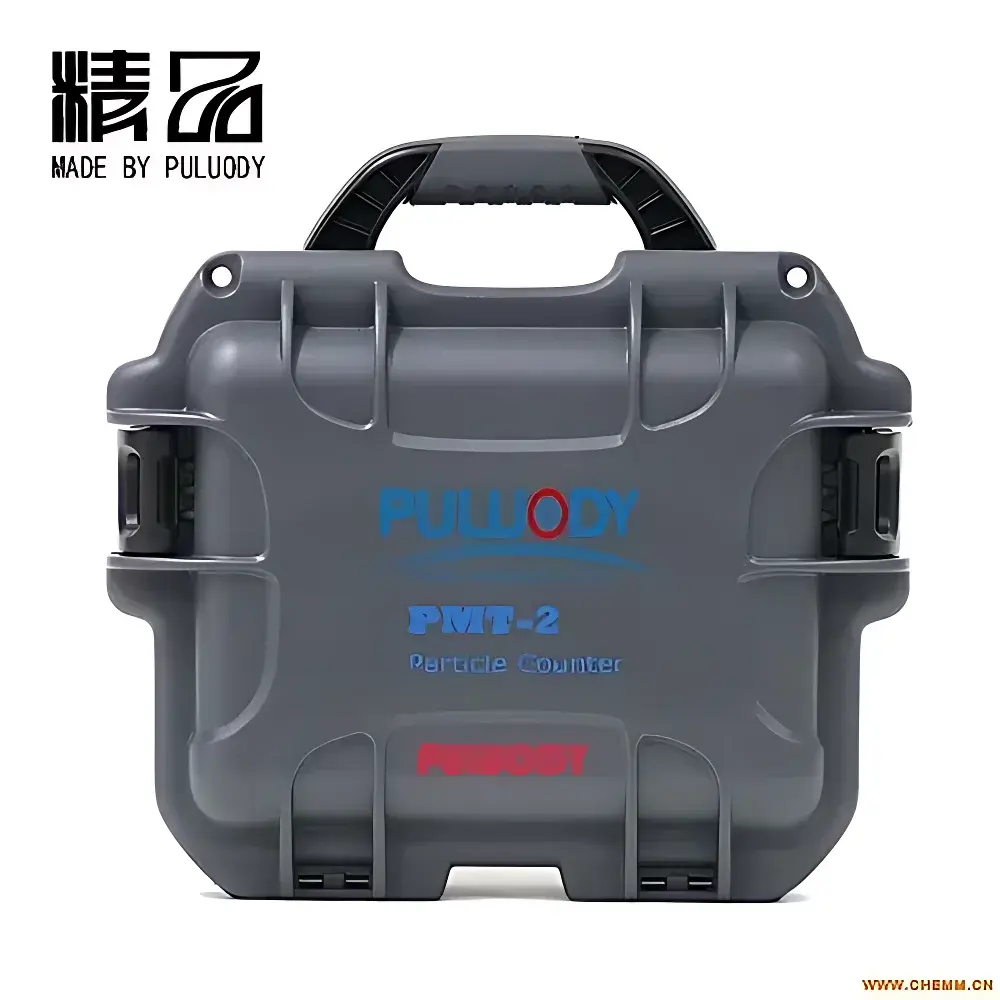
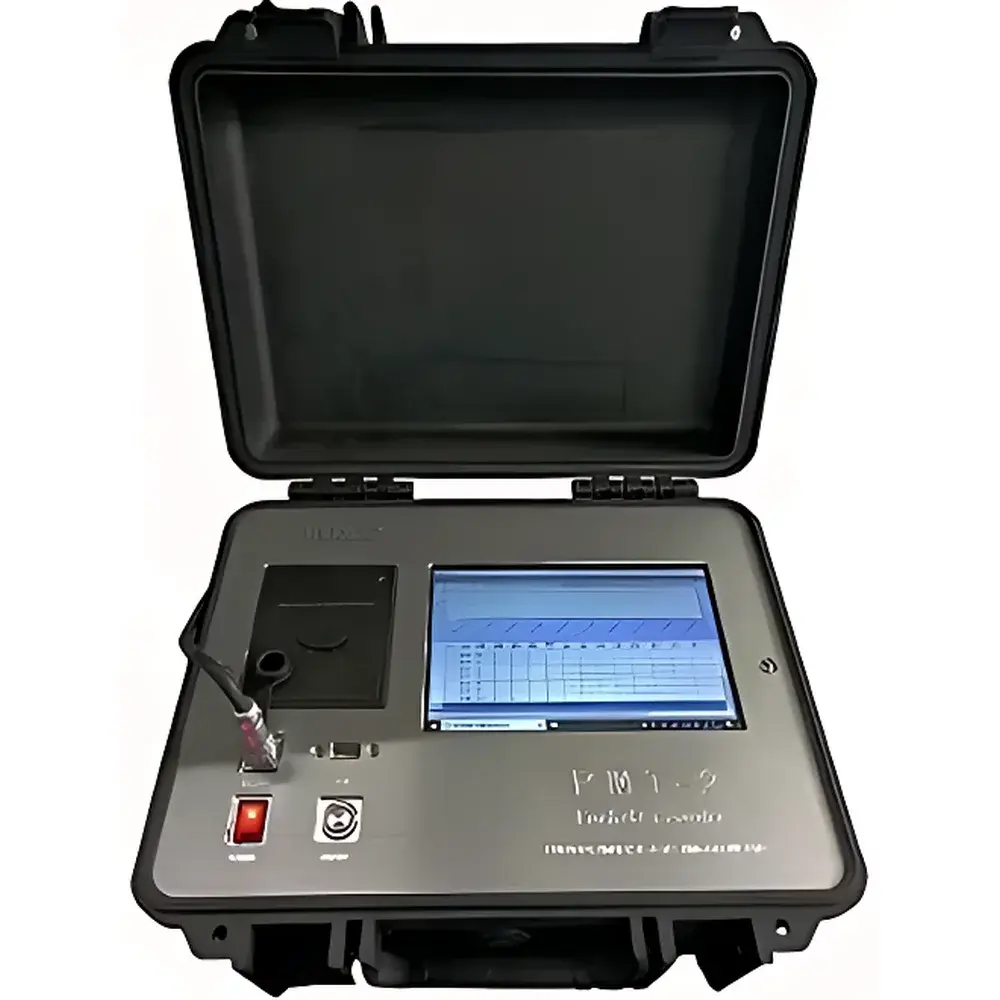
PULUODY PMT-2 Portable Oil Contamination Analyzer
| Brand | PULUODY |
|---|---|
| Model | PMT-2 |
| Type | Optical Particle Counter (Light Obscuration Principle) |
| Detection Range | 0.03 µm – 3000 µm (sensor-configurable: 2–100 µm or 4–70 µm(c)) |
| Channel Count | 16 user-selectable size channels from 1000 total bins |
| Accuracy | <3% typical |
| Sampling Flow Rate | 10–60 mL/min |
| Online Pressure Range | 0–0.6 MPa (standard), up to 50 MPa (with pressure regulator) |
| Viscosity Range | Offline ≤99 mm²/s |
| Operating Temperature | Fluid 0–80 °C, Ambient −15–50 °C |
| Compliance Standards | ISO 4406, ISO 11171, ISO 11500, NAS 1638, GB/T 14039, DL/T 432, GJB 420B, MIL-STD-1246C |
Overview
The PULUODY PMT-2 Portable Oil Contamination Analyzer is a field-deployable, light obscuration–based particle counter engineered for rapid, quantitative assessment of solid particulate contamination in liquid media—primarily hydraulic oils, lubricants, insulating oils, turbine oils, and other industrial fluids. It implements the eighth-generation photoelectric light blockage (obscuration) principle, where particles suspended in a flowing fluid stream pass through a focused laser beam, generating transient signal pulses proportional to their cross-sectional area. These pulses are digitized and classified into user-defined size channels, enabling direct enumeration of particles per milliliter and subsequent assignment of ISO 4406 or NAS 1638 cleanliness codes. Designed for both offline laboratory use and online in-situ monitoring (with optional pressure regulation), the PMT-2 supports real-time condition-based maintenance decisions in critical rotating and hydraulic systems across aerospace, power generation, marine, and heavy machinery sectors.
Key Features
- Field-portable architecture with integrated industrial-grade touch-screen interface (color LCD) and embedded controller—no external PC required for basic operation.
- Dual-laser, narrow-beam seventh-generation optical sensor optimized for high signal-to-noise ratio and minimal coincidence error across sub-micron to coarse particle ranges (0.03–3000 µm).
- Configurable 16-channel analysis from a 1000-bin histogram, supporting standard thresholds (e.g., ≥4 µm(c), ≥6 µm(c), ≥14 µm(c), ≥21 µm(c), ≥25 µm(c), ≥38 µm(c), ≥50 µm(c), ≥68 µm(c)) as well as custom binning down to 0.1 µm(c).
- Integrated precision metering pump with adjustable flow (10–60 mL/min) and dedicated cleaning circuit (20–150 mL/min), ensuring repeatable sample delivery and minimal carryover between tests.
- Comprehensive compliance framework: firmware-embedded calibration traceability to ISO 11171 (MTD) and ISO 4402 (ACFTD), with validation protocols aligned with GB/T 18854 and JJG 066.
- Multi-standard reporting engine supporting ISO 4406:1999/2017, NAS 1638, SAE AS4059D, and military specifications including MIL-STD-1246C and GJB 420B.
- Onboard data storage for ≥20,000 test records; expandable via USB mass storage; export formats include CSV, PDF, and XML for LIMS integration.
Sample Compatibility & Compliance
The PMT-2 accommodates a broad range of fluid types—including mineral and synthetic hydraulic oils, transformer oil (IEC 60296), turbine oil (ASTM D4378), gear oils (ISO 8573-4), aviation fuels (JP-8, Jet A-1), water-glycol and phosphate ester fire-resistant fluids, and non-aqueous polymer solutions—provided kinematic viscosity remains within specified limits (offline: ≤99 mm²/s; online: ≤500 mm²/s). It operates under fluid temperatures from 0 to 80 °C and ambient conditions from −15 to 50 °C. The instrument meets electromagnetic compatibility (EMC) requirements per IEC 61326-1 and carries CE marking for industrial environments. Calibration and verification procedures align with ISO/IEC 17025–accredited metrology practices, with traceability documented to the National Northwest Metrology Testing Center (civil applications) and the No. 116 Particle Measurement Station under China’s State Administration of Defense Science, Technology and Industry (defense applications).
Software & Data Management
Bundled P6.4 Analysis Software (integrated and PC versions) provides full instrument control, real-time particle distribution visualization, statistical trend analysis, and automated report generation compliant with GLP and GMP documentation standards. Audit trail functionality records all user actions, parameter changes, and calibration events with timestamps and operator IDs—meeting FDA 21 CFR Part 11 requirements when deployed in regulated pharmaceutical or biotech manufacturing environments. Data export supports direct ingestion into enterprise CMMS (Computerized Maintenance Management Systems) and predictive analytics platforms via RS232, RS485-to-USB, or native USB interfaces. Optional analog output (4–20 mA) enables connection to PLCs for continuous process monitoring and alarm triggering based on user-defined contamination thresholds.
Applications
- Routine oil health monitoring during preventive maintenance of hydraulic actuators, servo valves, and turbine control systems.
- Wear debris analysis in gearbox and bearing sump oils to support root-cause failure investigation.
- Acceptance testing of new or reclaimed oils prior to system commissioning or replenishment.
- In-line contamination surveillance in critical lube oil circuits of gas turbines and nuclear plant auxiliary systems.
- Quality assurance of ultra-pure solvents used in semiconductor wafer cleaning and photolithography processes.
- Validation of filter performance (beta-ratio testing) per ISO 16889 and ISO 4572 methodologies.
FAQ
What particle detection principle does the PMT-2 employ?
It uses light obscuration (also known as light blockage or photoelectric blocking), where particles passing through a collimated laser beam attenuate the received light intensity proportionally to their projected area.
Can the PMT-2 be used for online monitoring without sample extraction?
Yes—when equipped with the optional high-pressure regulator kit, it supports direct installation in pressurized fluid loops up to 50 MPa, enabling continuous real-time measurement without bypass or dilution.
Is the instrument compliant with ISO 11171 for calibration traceability?
Yes—the optical sensor is calibrated using certified ISO Medium Test Dust (MTD) reference materials, and firmware enforces ISO 11171–defined pulse height–to–size transfer functions.
Does the system support multi-language user interfaces?
The embedded touchscreen interface defaults to English; additional language packs (including simplified Chinese, Spanish, and German) are available upon request and firmware update.
How is data integrity ensured during long-term deployment?
All measurements include embedded digital signatures, time-stamped audit logs, and checksum-verified data storage—fully compatible with 21 CFR Part 11 electronic record requirements when configured with user authentication and role-based access control.



