
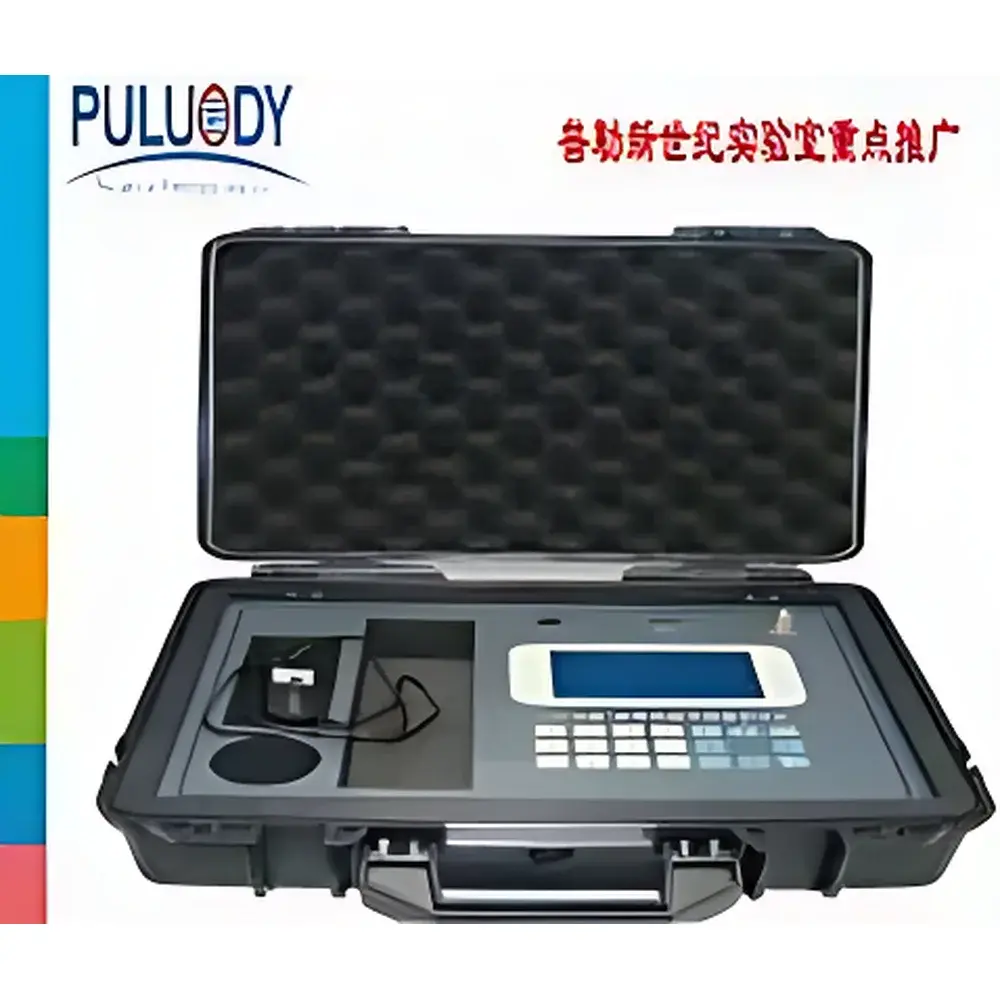
PULUODY PLD-CX Portable Gasoline Octane Number and Diesel Cetane Number Analyzer
| Brand | PULUODY |
|---|---|
| Origin | Shaanxi, China |
| Manufacturer Type | Manufacturer |
| Product Origin | Domestic |
| Model | PLD-CX |
| Measurement Parameters | Gasoline Octane Number (RON), Diesel Cetane Number |
| Portability | Portable |
| Measurement Range | 40–120 (Octane), 20–100 (Cetane) |
| Measurement Accuracy | ±0.5–1.0 units |
| Measurement Time | ≤10 seconds per sample |
| Sample Volume | 10 mL |
| Compliance Standard | GB/T 18339–2001 (Gasoline Octane Number Determination by Dielectric Constant Method) |
Overview
The PULUODY PLD-CX Portable Gasoline Octane Number and Diesel Cetane Number Analyzer is a field-deployable, microprocessor-controlled instrument engineered for rapid, on-site determination of gasoline research octane number (RON) and diesel cetane number (CN) using the dielectric constant correlation method. Unlike combustion-based engine test methods (e.g., ASTM D2699/D2700 for RON/MON or ASTM D613 for CN), the PLD-CX leverages empirically validated dielectric permittivity–hydrocarbon composition relationships to deliver quantitative hydrocarbon fuel quality assessment without requiring standardized test engines, reference fuels, or controlled laboratory environments. Its operational principle is grounded in the linear and polynomial regression models established between the bulk dielectric constant (measured at radio frequencies) and the volumetric hydrocarbon composition—particularly aromatic, olefinic, and paraffinic fractions—which collectively govern ignition resistance in spark-ignition fuels and autoignition propensity in compression-ignition fuels. This physics-based correlation approach enables traceable, repeatable measurements compliant with GB/T 18339–2001, which specifies dielectric constant methodology for gasoline octane evaluation in China’s petroleum quality control framework.
Key Features
- True portable architecture: Integrated sensor head and handheld display unit, weighing under 2.8 kg with integrated rechargeable Li-ion battery supporting >8 hours of continuous operation.
- Dual-fuel capability: Single-instrument calibration for both gasoline (RON 40–120) and diesel (CN 20–100) via mode-selectable firmware configuration.
- Microprocessor-driven signal processing: Embedded ARM Cortex-M7 CPU performs real-time compensation for temperature drift (via integrated Pt100 sensor), electrode polarization effects, and sample conductivity artifacts.
- Patented coaxial dielectric sensor: Stainless-steel probe with guarded electrode geometry ensures stable capacitance measurement across variable fuel conductivity (0.1–500 pS/m) and vapor pressure conditions.
- Two operational modes: Scan mode for broad-range screening; segmented mode aligned with Chinese national gasoline grade classifications (e.g., 92#, 95#, 98#) for direct RON readout without interpolation.
- On-device calibration workflow: Supports two-point verification using certified reference fuels (e.g., toluene/isooctane blends for octane; cetane/heptamethylnonane blends for cetane) with audit-trail logging.
Sample Compatibility & Compliance
The PLD-CX is validated for use with unleaded gasoline, ethanol-blended gasoline (E5–E15), biodiesel-diesel blends (B5–B20), and low-sulfur diesel fuels meeting GB 17930–2016 and GB 19147–2016 specifications. It excludes applicability to oxygenated additives beyond ethanol (e.g., MTBE, ETBE) without revalidation, and is not intended for aviation turbine fuels or heavy fuel oils. Instrument compliance extends to GB/T 18339–2001 for gasoline octane determination, and its measurement uncertainty budget has been verified against NIM (National Institute of Metrology, China) reference materials. While not certified to ASTM or ISO engine-test standards, its dielectric correlation model is traceable to primary octane/cetane reference standards through interlaboratory round-robin validation studies conducted under CNAS-accredited QA protocols.
Software & Data Management
Data acquisition, calibration management, and reporting are handled via the embedded firmware interface with optional PC synchronization through USB-C or Bluetooth 5.0. All measurement records include timestamp, ambient temperature, sensor ID, calibration status flag, and raw dielectric constant (pF) output. Audit trails capture user-initiated calibrations, firmware updates, and parameter modifications—supporting GLP-aligned documentation requirements. Export formats include CSV and PDF reports compliant with internal QC documentation templates. The system does not implement FDA 21 CFR Part 11 electronic signature functionality but supports manual operator identification and printed report signing per organizational SOPs.
Applications
- Field verification at gas stations and retail fuel dispensing points to confirm grade labeling accuracy against regulatory mandates.
- Quality assurance during fuel transfer at depot terminals and inland oil depots prior to distribution.
- Rapid screening of blended fuels during refinery off-gas or blending rack operations to detect formulation deviations.
- Contractor and third-party inspection services performing statutory fuel audits per provincial market supervision bureau directives.
- Educational laboratories teaching fuel property–composition relationships, where engine-based methods are impractical due to infrastructure constraints.
FAQ
Does the PLD-CX require reference fuel standards for daily operation?
No—only periodic verification (recommended every 30 days or after 200 measurements) using traceable reference fuels is required. Routine measurements use factory-installed correlation curves.
Can the instrument measure motor octane number (MON)?
No—it is calibrated exclusively for research octane number (RON) per GB/T 18339–2001. MON determination requires a different correlation model and is outside its scope.
Is temperature compensation automatic?
Yes—integrated Pt100 sensor provides real-time dielectric constant correction across –10 °C to +50 °C ambient operating range.
What maintenance is required?
Annual sensor cleaning with analytical-grade isopropanol and verification of electrode insulation resistance (>10 GΩ) using onboard diagnostics.
Is firmware upgrade supported remotely?
Yes—updates are delivered via encrypted .bin files transferred via USB-C; no internet connectivity is required on the device.




