
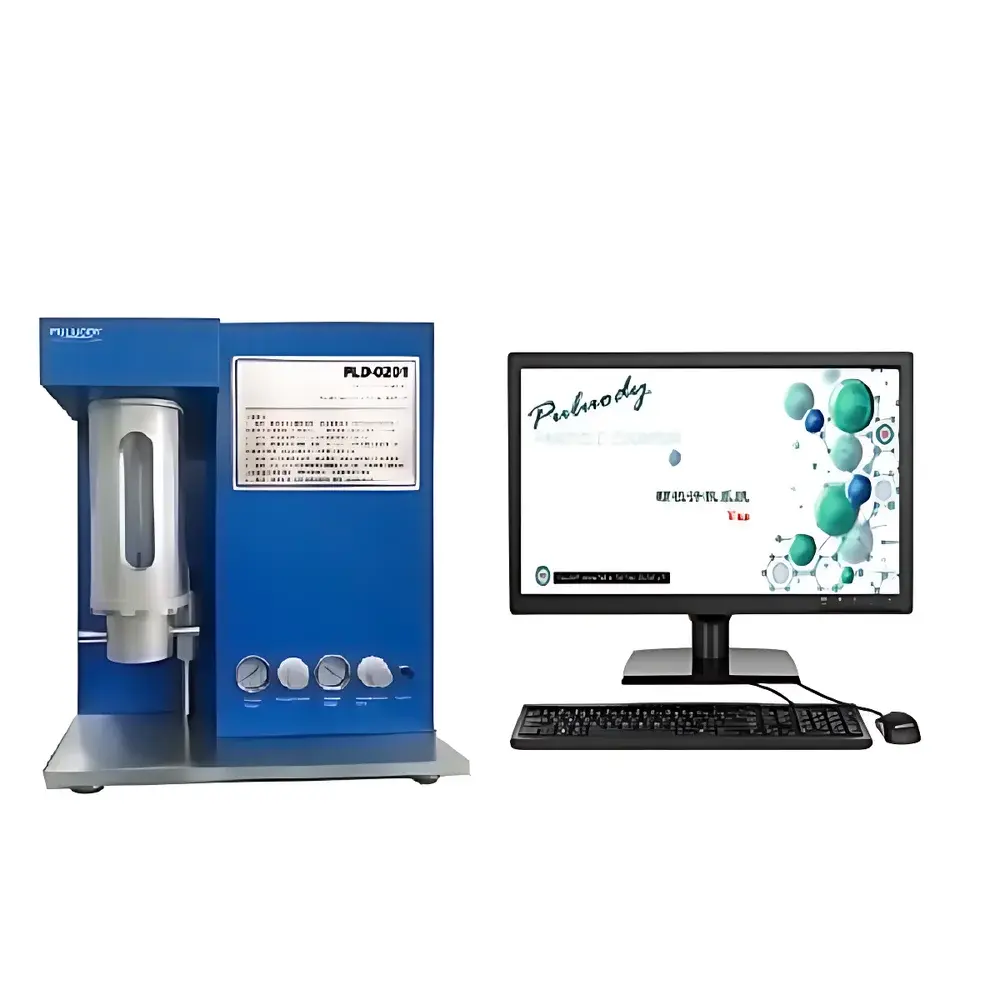
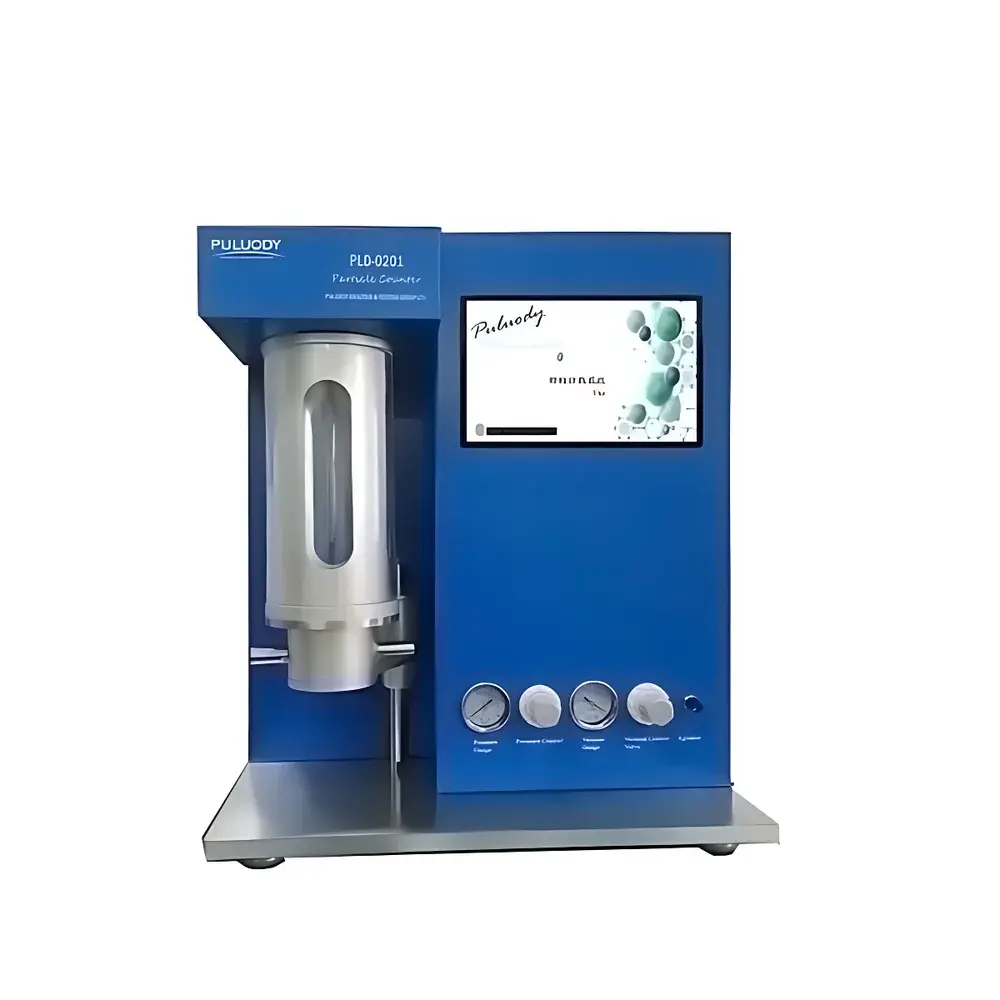
PULUODY PLD-0201-03 Optical Particle Counter for Power Plant Lubricant Cleanliness Testing
| Brand | PULUODY |
|---|---|
| Origin | Shaanxi, China |
| Manufacturer Type | Authorized Distributor |
| Country of Origin | China |
| Model | PLD-0201-03 |
| Instrument Type | Optical Particle Counter |
| Detection Principle | Light Obscuration (LO) |
| Calibration Standards | ISO 11171, ISO 4402, GB/T 18854 |
| Sensitivity | 1 µm (per ISO 4402), 4 µm(c) (per ISO 11171 & GB/T 18854) |
| Measurement Range | 1–1000 µm (sensor-dependent) |
| Channel Resolution | Up to 1000 user-configurable size channels |
| Sample Volume Accuracy | ±1% |
| Flow Control | Precision piston pump + electromagnetic flow regulation (5–60 mL/min) |
| Viscosity Handling | ≤450 mm²/s |
| Pressure Range | –0.08 to 0.8 MPa (dual-polarity pre-treatment system) |
| Operating Temperature | Ambient to 65 °C |
| Storage Capacity | 3000 tests onboard (industrial PC) |
| Compliance | ASTM D6786, ISO 4406:2017, NAS 1638, DL/T 1096, GJB 420B, MOOG, ISO 11218 |
Overview
The PULUODY PLD-0201-03 is a high-precision optical particle counter engineered specifically for cleanliness verification of insulating oils, turbine oils, hydraulic fluids, and lubricants in power generation facilities. It operates on the light obscuration (LO) principle—where particles suspended in oil interrupt a collimated laser beam, generating voltage pulses proportional to their cross-sectional area. This method complies with internationally recognized calibration protocols including ISO 11171 and ISO 4402, ensuring metrological traceability to national standards. Designed for continuous operation in utility laboratory environments, the instrument integrates pressure-assisted sample conditioning, automatic degassing, and viscosity-adaptive flow control—enabling reliable measurement across diverse fluid matrices without manual pre-treatment. Its dual-laser narrow-beam detection architecture (8th-generation) delivers enhanced signal stability and reduced coincidence error at high particle concentrations (≤10,000 particles/mL at <5% error), making it suitable for routine QC and condition-based maintenance programs governed by IEC 60296, IEEE C57.106, and DL/T 1096.
Key Features
- Integrated dual-polarity pressure system (–0.08 to +0.8 MPa) for controlled degassing, homogenization, and high-viscosity sample handling (up to 450 mm²/s)
- Precision piston pump combined with electromagnetic flow regulation ensures volumetric accuracy better than ±1% and programmable flow rates from 5 to 60 mL/min
- 1000-channel configurable size binning with user-defined thresholds (1–100 µm arbitrary resolution; full range up to 1000 µm)
- Onboard industrial PC with color touchscreen interface, embedded OS, and integrated thermal printer—enabling standalone operation without external computing hardware
- Automated post-test self-cleaning cycle using programmable rinse flow (10–100 mL/min)
- Comprehensive standard library: direct compliance with ISO 4406:2017, NAS 1638, GJB 420B (000–12), MOOG Code 00–12, and DL/T 1096
- RS232 serial interface for data export and remote configuration; supports audit-ready CSV and PDF report generation
Sample Compatibility & Compliance
The PLD-0201-03 is validated for use with mineral-based and synthetic transformer oils (IEC 60296), turbine oils (ASTM D4379), hydraulic fluids (ISO 11158), gear oils (ISO 8573-4), and aviation fuels (MIL-PRF-25055). It accommodates both aqueous and organic solvents, polymer solutions, and non-aqueous dielectric liquids per ISO 11500 and GJB 380. All calibration and verification procedures align with GB/T 18854–2022 (equivalent to ISO 11171:2010), JJG/T 066, and JJG 1061. Optional certification reports are available from accredited national metrology institutes—including the Aviation Industry Particle Metrology Center and Northwest National Metrology Center—supporting GLP-compliant documentation and annual recalibration using certified reference materials (GBW series).
Software & Data Management
The instrument runs P6.4 Analysis Software (integrated and PC versions), supporting real-time histogram generation, cumulative distribution curves, and multi-standard comparison overlays. Data files include raw pulse amplitude logs, particle count per channel, calculated contamination grades (e.g., ISO code 18/16/13), and operator metadata. Onboard storage retains 3000 test records with timestamp, sample ID, and environmental parameters (temperature, pressure). External PC integration enables structured database archiving, trend analysis across fleets, and automated reporting compliant with FDA 21 CFR Part 11 requirements—including electronic signatures, audit trails, and role-based access control when deployed in regulated QA/QC workflows.
Applications
This particle counter serves critical monitoring functions across energy infrastructure: transformer oil cleanliness verification prior to commissioning or after maintenance; turbine lube oil trending during outage planning; hydraulic system contamination tracking in hydroelectric governors and nuclear plant control systems; and predictive maintenance of generator bearing oils. It is also employed in R&D labs evaluating filtration efficiency, additive stability, and degradation byproducts in synthetic esters and polyalphaolefins. Secondary applications include particulate assessment in semiconductor process chemicals, pharmaceutical excipient suspensions, and aerospace hydraulic media per MIL-STD-1246C.
FAQ
Does the PLD-0201-03 support ISO 11171-compliant calibration?
Yes—the instrument accepts certified calibration suspensions (e.g., NIST-traceable ISO Medium Test Dust or AC Fine) and performs automated alignment per ISO 11171:2010 Annex B.
Can it measure particles below 4 µm(c)?
It detects down to 1 µm per ISO 4402 methodology; however, quantitative reporting below 4 µm(c) requires validation against primary reference methods and is intended for relative trending—not absolute grade assignment per ISO 4406.
Is external computer connectivity mandatory?
No—full functionality, including grade calculation, histogram display, and thermal printing, is available via the built-in industrial PC and touchscreen interface.
What maintenance intervals are recommended?
Daily rinse cycle; quarterly optical path inspection; annual recalibration with GBW-certified standards and optional third-party verification from national metrology centers.
How does it handle viscous or aerated samples?
The integrated pressure module applies vacuum (-0.08 MPa) for degassing and positive pressure (+0.8 MPa) to drive flow through high-viscosity media, eliminating manual filtration or heating steps.



