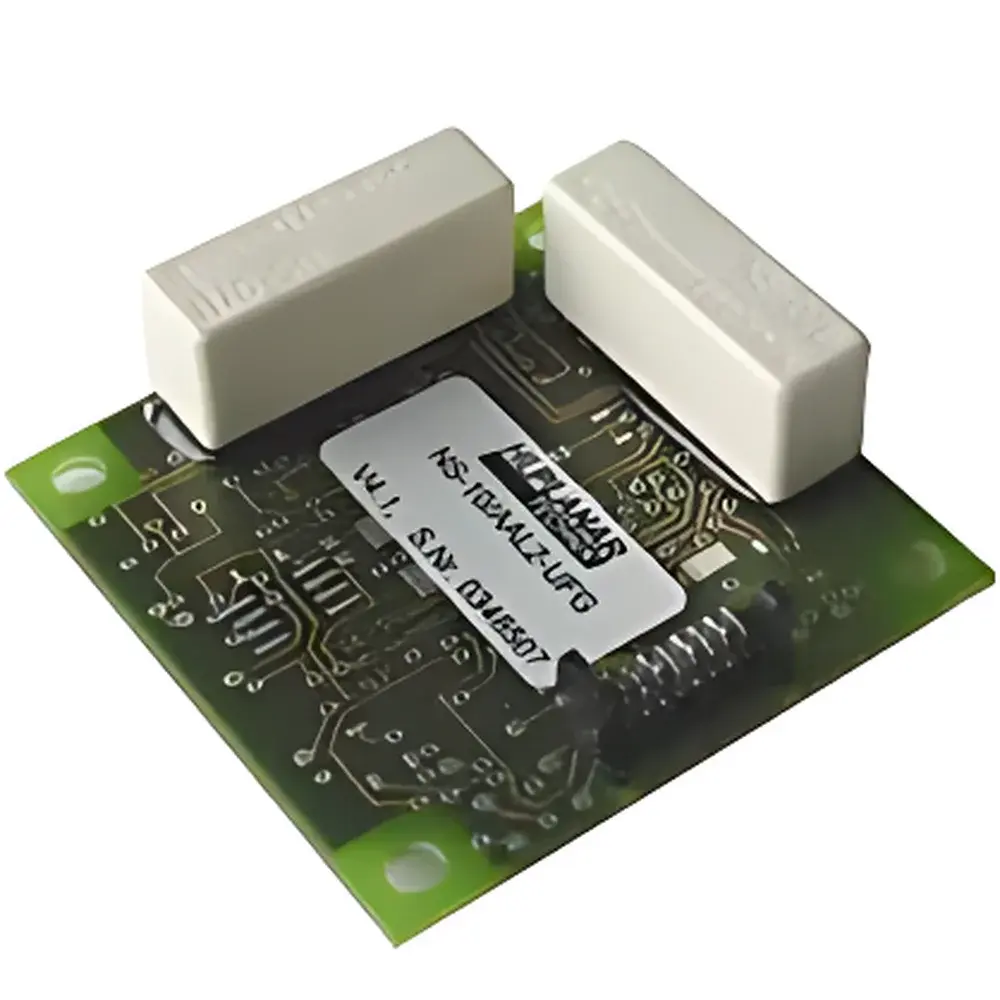
York Instrument NS-10AAL2-UFG Dual-Axis Electrolytic Tilt Sensor
| Brand | York Instrument |
|---|---|
| Origin | USA |
| Manufacturer Type | Original Equipment Manufacturer (OEM) |
| Product Category | Imported |
| Model | NS-10AAL2-UFG |
| Output Type | Analog Voltage (0.15 V/°) & Temperature-Compensated |
| Measurement Principle | Electrolytic Capacitive Sensing |
| Axis Configuration | Dual-Axis (X/Y) |
| Full-Scale Range | ±10° |
| Resolution | 0.001° (typ.), 0.01° (min.) |
| Absolute Accuracy | ±0.08° to ±0.3° (within 0–50°C, temp.-compensated) |
| Nonlinearity | ≤1.5% FS |
| Cross-Axis Sensitivity | ≤0.15% FS |
| Temp. Drift | ≤8 mV/°C |
| Output Voltage Range | 0.3–4.7 V |
| Supply Voltage | 5 VDC ±5% |
| Operating Temp. | −40°C to +85°C |
| Storage Temp. | −40°C to +85°C |
| Weight | 20 g |
| Dimensions (W × D × H) | 45 × 45 × 14 mm (max. 20 mm height with mounting features) |
| Integrated Temperature Sensor | Yes |
| Mounting | PCB-mount (surface-mount compatible) |
| Vibration Resistance | High (designed for industrial mobile platforms) |
Overview
The York Instrument NS-10AAL2-UFG is a dual-axis electrolytic tilt sensor engineered for high-reliability static and quasi-static inclination measurement in demanding industrial, transportation, and infrastructure monitoring applications. Unlike MEMS-based accelerometers or optical inclinometers, this sensor employs a proven electrolytic sensing principle: a sealed, temperature-stabilized cell containing a precisely formulated conductive electrolyte solution and three platinum-coated electrodes. When an AC excitation signal is applied across the outer electrodes, ion mobility within the electrolyte generates a spatially varying electric field—its distribution directly modulated by gravitational orientation relative to the sensor plane. The central electrode detects differential potential shifts induced by asymmetric electrolyte immersion depth during tilt, enabling robust analog voltage output proportional to angular displacement (0.15 V/°) on both X and Y axes. Built-in temperature sensing enables real-time compensation across the full operating range (−40°C to +85°C), ensuring metrological consistency under thermal transients typical in outdoor enclosures, vehicle chassis, or structural health monitoring nodes.
Key Features
- Dual-axis analog output (X/Y) with independent 0.15 V/° sensitivity and monotonic response across ±10° full-scale range
- Integrated digital temperature sensor (±0.5°C accuracy) supporting hardware-level compensation without external calibration routines
- PCB-mountable module design (45 × 45 × 14 mm) optimized for automated SMT assembly and space-constrained OEM integration
- High vibration resilience: no moving mechanical parts; immune to shock up to 50 g (IEC 60068-2-27 compliant)
- Low-power operation: 5 VDC supply, <2 mA quiescent current, suitable for battery-backed remote telemetry systems
- Hermetically sealed electrolyte cell with long-term stability (drift <0.02°/year after 1,000-hour burn-in)
- Compliant with RoHS 3 and REACH Annex XVII; halogen-free PCB substrate and conformal coating options available
Sample Compatibility & Compliance
The NS-10AAL2-UFG is designed for direct integration into embedded control systems, structural monitoring gateways, and mobile platform stabilization subsystems. It requires no sample preparation or consumables—operation is fully self-contained within its hermetic ceramic-polymer housing. The sensor meets IEC 61000-6-2 (immunity) and IEC 61000-6-4 (emission) standards for industrial environments. Its analog output architecture ensures compatibility with legacy PLC analog input modules (e.g., Siemens S7-1200 AI, Allen-Bradley 1769-IF4), as well as modern data acquisition systems supporting 0–5 V or 0.3–4.7 V ratiometric scaling. For regulated industries, traceable calibration certificates (NIST-traceable to ISO/IEC 17025 accredited labs) are available upon request. While not intrinsically safe, it may be deployed in Zone 2 hazardous locations when installed within certified barriers per ATEX/IECEx guidelines.
Software & Data Management
As a purely analog-output device, the NS-10AAL2-UFG does not require proprietary firmware or host software. However, York Instrument provides open-source reference designs—including Arduino-compatible signal conditioning libraries, Python-based DAQ scripts (for NI USB-6009, Raspberry Pi ADC HATs), and LabVIEW FPGA VI templates—for rapid prototyping and system validation. All calibration coefficients (gain, offset, temperature polynomial terms) are provided in CSV format for seamless ingestion into SCADA historian databases (e.g., Ignition, Siemens Desigo CC). Raw voltage outputs support direct mapping to engineering units (degrees) using linear or 2nd-order polynomial models—fully compatible with FDA 21 CFR Part 11 audit trail requirements when logged via validated DAQ software. No driver installation or OS-specific dependencies are required.
Applications
- Structural alignment verification in precast concrete erection and bridge bearing installation
- Inertial reference for autonomous mobile robots (AMRs) and AGVs during low-speed navigation and docking
- Level monitoring in tank farm manifolds and pipeline support piers subject to ground settlement
- Calibration reference for laser alignment tools in semiconductor fab tool leveling
- Vibration-dampened tilt feedback in wind turbine nacelle pitch control (secondary redundancy channel)
- Geotechnical instrumentation for landslide early-warning networks (low-power, long-duration deployments)
FAQ
What is the recommended signal conditioning for optimal resolution?
Use a 16-bit or higher SAR ADC with programmable gain amplifier (PGA), referenced to the same 5 VDC supply as the sensor, to maintain ratiometric integrity. Avoid shared ground paths with switching power supplies.
Can the sensor operate continuously at −40°C?
Yes—the electrolyte formulation remains fully liquid and responsive down to −40°C. Long-term storage at this temperature is also supported without performance degradation.
Is factory recalibration required after solder reflow?
No. The NS-10AAL2-UFG is qualified for lead-free reflow profiles (J-STD-020, peak 260°C). Thermal hysteresis is compensated internally; post-reflow zero offset shift is <±0.03°.
Does the sensor support digital communication protocols (e.g., I²C, SPI)?
No—it is analog-only. For digital interface requirements, consider York Instrument’s NS-10AAL2-DIG variant (I²C output, same form factor).
How is temperature compensation implemented?
On-chip temperature measurement feeds a pre-characterized 2nd-order correction algorithm executed in the host system; coefficients are supplied with each unit’s calibration report.