
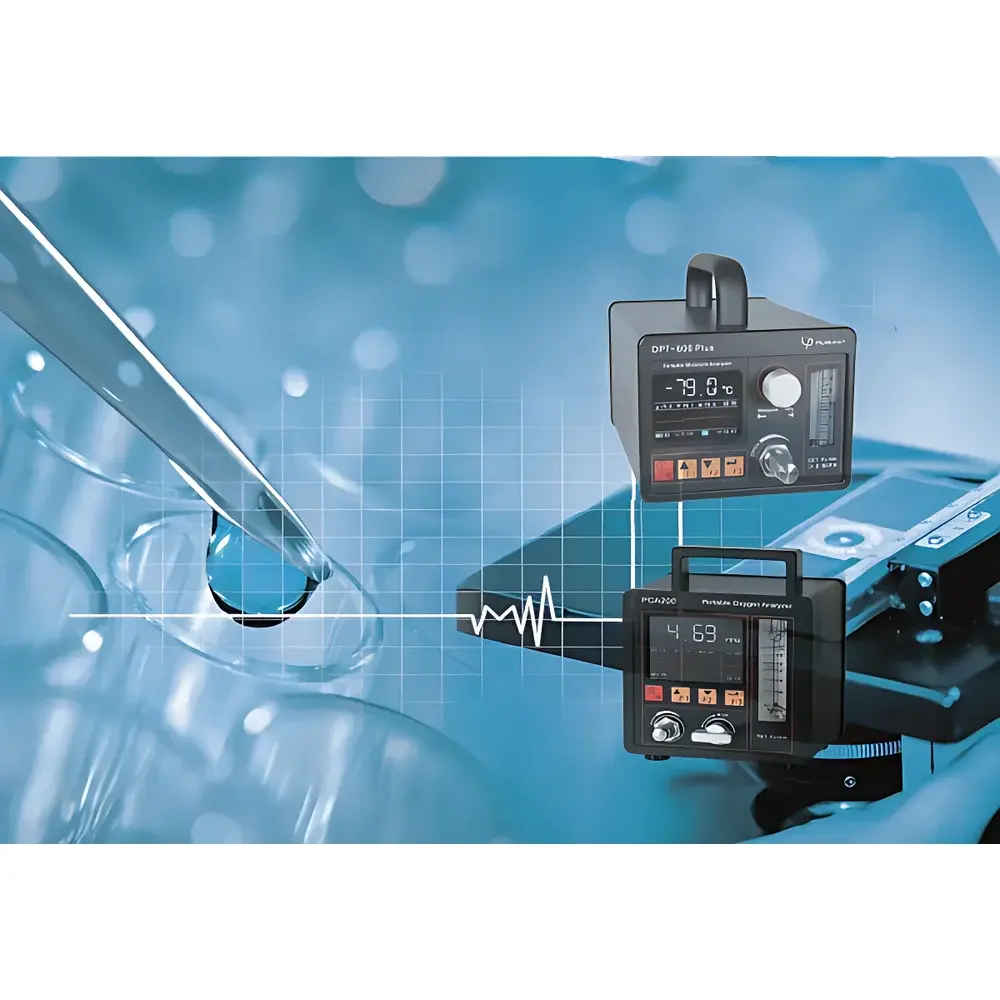
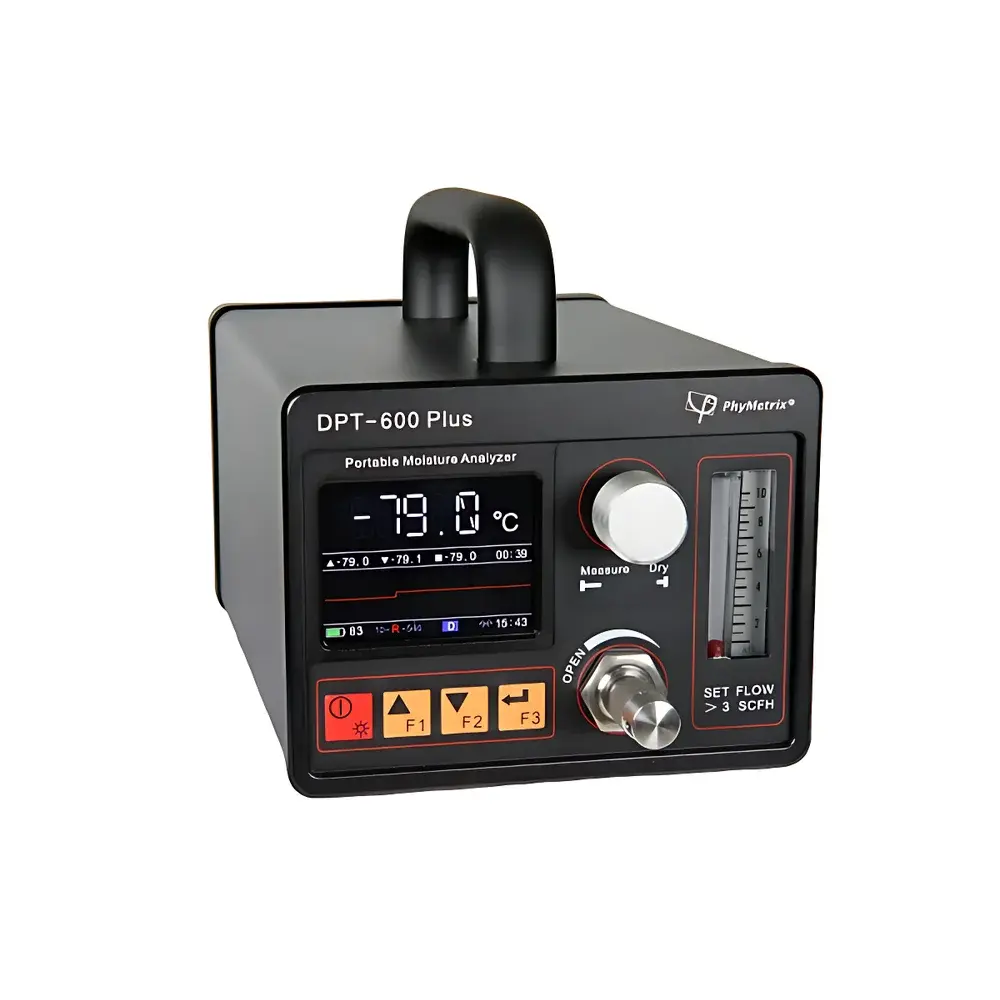
PhyMetrix DPT-600plus Portable and Benchtop Dew Point Meter
| Brand | PhyMetrix |
|---|---|
| Origin | USA |
| Model | DPT-600plus |
| Type | Portable/Benchtop Dew Point Meter |
| Principle | Capacitive Polymer Sensor (Nanoporous Metal Oxide Film) |
| Operating Temperature | -20 °C to +60 °C |
| Accuracy | ±2 °C |
| Repeatability | ±0.5 °C |
| Dew Point Range | -110 °C to +20 °C (standard), optional -60 °C to +20 °C |
| Response Time (T95) | ≤3 min (dry-to-wet) |
| Resolution | 0.1 °C |
| Temperature Compensation Range | -40 °C to +70 °C |
| Flow Rate | 1–5 SCFH (recommended 2–4 SCFH) |
| Pressure Measurement | Built-in absolute pressure sensor with dew point correction |
| Data Storage | >10,000 records (dew point, temperature, pressure) |
| Enclosure Rating | IP67/IP68 |
| Intrinsically Safe | Class I, Div. 1, Groups A, B, C, D |
| Dimensions | 142 × 180 × 146 mm (L×W×H) |
| Weight | 2.6 kg |
Overview
The PhyMetrix DPT-600plus is a high-precision, dual-mode (portable and benchtop) dew point meter engineered for trace moisture analysis in compressed gases, process streams, and calibration gas systems. It employs a proprietary capacitive polymer sensor featuring a nanoporous metal oxide film architecture—designed to maintain electrochemical stability and surface energy control under extreme low-humidity conditions. This sensor technology enables reliable measurement across an extended dew point range of –110 °C to +20 °C, with sub-degree repeatability and minimal hysteresis. Unlike chilled-mirror or aluminum oxide sensors, the DPT-600plus sensor exhibits inherent resistance to condensation-induced drift, hydrocarbon contamination (including alcohols and natural gas liquids), H2S exposure, and particulate fouling—making it suitable for field-deployed monitoring in upstream oil & gas, LNG transfer lines, and high-purity industrial gas distribution networks.
Key Features
- Nanoporous metal oxide film sensor with –110 °C minimum dew point capability, validated per ISO 8503-2 and ASTM D7504 for low-moisture gas analysis
- Integrated absolute pressure transducer enabling real-time conversion between atmospheric and pressure-corrected dew point values (per ISO 8573-3 and ISO 8573-4)
- Auto-calibration routine with internal reference stabilization, reducing need for external span checks during routine operation
- IP67/IP68-rated enclosure with intrinsically safe certification (Class I, Div. 1, Groups A, B, C, D), certified to UL 913 and ATEX Directive 2014/34/EU
- Backlit graphical LCD with user-adjustable brightness, auto-scaling trend plots, and on-screen stability indicators (±0.1 °C over 60 s)
- Full stainless steel (316 SS) and PTFE wetted path; Swagelok® 1/8″ compression fittings; compact 2.6 kg form factor optimized for field portability or lab bench integration
- USB-C interface supporting data export, firmware updates, and power delivery; compatible with USB-powered charging via AC adapter (100–240 VAC) or portable power banks
Sample Compatibility & Compliance
The DPT-600plus is validated for use with non-corrosive, non-condensing gas matrices including nitrogen, air, argon, helium, hydrogen, natural gas, and purified CO2. Its sensor design excludes catalytic interference from common contaminants found in refinery off-gas, biogas, and pharmaceutical purge streams. The instrument complies with key regulatory and quality frameworks: data logging meets FDA 21 CFR Part 11 requirements for audit trail, electronic signature, and record retention; pressure-compensated dew point reporting supports ISO 8573-1:2010 Class 0–4 purity grading; and intrinsic safety certification ensures deployment in hazardous locations per IEC 60079-0 and NEC Article 500.
Software & Data Management
Data acquisition and configuration are managed via the PhyMetrix Connect desktop application (Windows/macOS), which provides secure, timestamped export of .csv files containing dew point, ambient temperature, absolute pressure, flow rate, and sensor capacitance (pF). Each record includes metadata such as operator ID, location tag, and calibration status. The onboard memory stores >10,000 measurement points with automatic time-stamping at user-defined intervals (1 s to 24 h). All stored data retain full traceability—including sensor drift compensation coefficients and pressure correction algorithms—enabling retrospective validation against ISO/IEC 17025-compliant QA procedures.
Applications
- Monitoring moisture in natural gas transmission pipelines and LNG vaporization systems (per GPA 2172 and ISO 12213-2)
- Verification of dryness in semiconductor process gas cabinets (NFPA 55, SEMI F57)
- Validation of compressed air quality per ISO 8573-1 Class 1–4 in pharmaceutical manufacturing (EU GMP Annex 1, USP <1231>)
- Field verification of desiccant dryer performance in petrochemical plants
- Calibration support for primary dew point standards in metrology labs accredited to ISO/IEC 17025
- Moisture surveillance in SF6 switchgear and high-voltage insulation systems (IEC 60480)
FAQ
What is the recommended gas flow rate for optimal accuracy?
The specified operating range is 1–5 SCFH, with 2–4 SCFH providing optimal signal stability and response time. Flow rates below 1 SCFH may increase measurement lag; above 5 SCFH can induce turbulence and pressure drop artifacts.
Does the DPT-600plus require periodic sensor replacement?
The nanoporous sensor has a typical service life of ≥24 months under continuous operation in clean gas streams. Field recalibration every 6 months is recommended for GxP environments; sensor replacement is only required upon diagnostic failure or irreversible contamination.
Can the instrument measure dew point under elevated pressure?
Yes—the integrated pressure sensor enables real-time calculation of both atmospheric-equivalent and pressure-adjusted dew point values using the Magnus-Tetens approximation, compliant with ISO 8573-3 Annex B.
Is the USB-C interface compatible with standard data acquisition software?
The device emulates a CDC ACM serial interface, supporting direct integration with LabVIEW, Python (pySerial), MATLAB, and custom SCADA systems without proprietary drivers.
How does the instrument handle condensation during rapid humidity transitions?
The sensor’s nanostructured surface minimizes water adsorption hysteresis and prevents liquid film formation, enabling stable recovery after T95 ≤3 min during dry-to-wet transitions—verified per IEC 61298-2 test protocol.





