VNIIOFI BB-PyroG2500/3000 High-Temperature Blackbody Radiation Source
| Brand | VNIIOFI |
|---|---|
| Origin | Russia |
| Model | BB-PyroG2500/3000 |
| Temperature Range | 800 °C to 3000 °C |
| Emissivity | 0.9995 ± 0.0005 |
| Cavity Bore Diameter | 10 mm / 15 mm / 25 mm (selectable) |
| Aperture Diameter | 10 mm / 12 mm / 15 mm / 20 mm (selectable) |
| Max. Operating Current | 320 A (at 3000 °C) |
| Max. Operating Voltage | 25 V |
| Radiator Lifetime | >500 h at 2800 K |
| Purge Gas | Argon or vacuum |
| Main Gas Flow Rate | 3 L/min |
| Shield Gas Flow Rate | 0.4 L/min |
| Cooling Medium | Water |
| Mounting Orientation | Vertical or horizontal |
| Dimensions (L × Ø) | 460 mm × 200 mm |
Overview
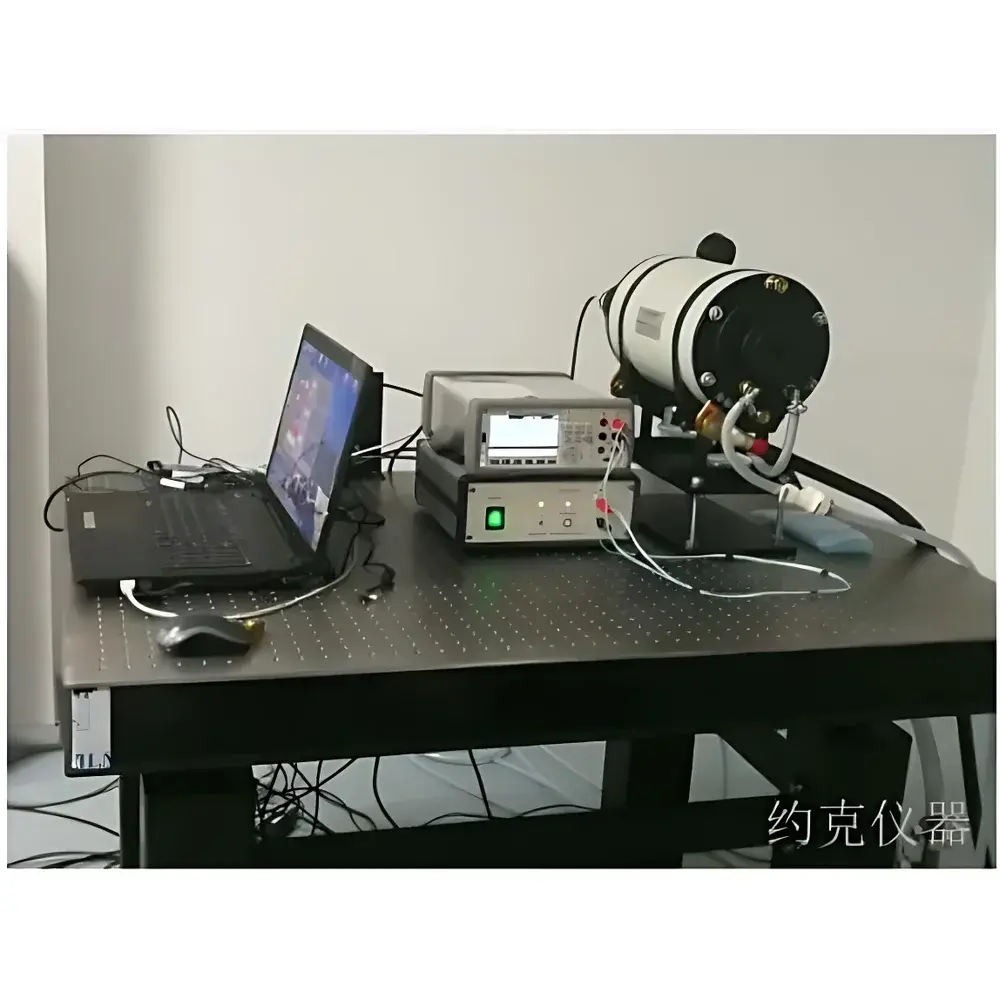
The VNIIOFI BB-PyroG2500/3000 is a high-temperature, cavity-type blackbody radiation source engineered for primary and secondary radiometric calibration in national metrology institutes and accredited calibration laboratories. Designed and validated by the All-Russian Research Institute for Optical and Physical Measurements (VNIIOFI)—a designated institute under the Federal Agency on Technical Regulating and Metrology (Rosstandart)—this source operates on the principle of thermal radiation from a precisely temperature-controlled, high-emissivity graphite cavity. It functions as a spectral radiance standard across the UV-VIS-IR spectrum (approximately 200 nm to 25 µm), delivering traceable, stable, and spatially uniform radiant exitance in accordance with Planck’s law. Its operational range spans 800 °C to 3000 °C (1073 K to 3273 K), enabling calibration of optical pyrometers, spectral radiometers, Fourier-transform infrared (FTIR) spectroradiometers, and imaging radiometric systems used in aerospace thermal testing, semiconductor process monitoring, and high-temperature furnace validation.
Key Features
- Ultra-high cavity emissivity of 0.9995 ± 0.0005, verified via absolute reflectance measurement and cavity geometry modeling per ISO 18434-1 and ASTM E2758 guidelines.
- Pyrolytic graphite radiation cavity with selectable bore diameters (10 mm, 15 mm, or 25 mm) and aperture options (10–20 mm), optimized for collimation efficiency and effective source area definition.
- Robust thermal architecture featuring dual-zone resistive heating, active water cooling, and inert gas purging (argon) to suppress oxidation and maintain spectral stability at temperatures exceeding 2500 °C.
- Integrated thermocouple and multi-point pyrometric monitoring with real-time temperature feedback control, ensuring long-term thermal stability better than ±0.5 K at 2500 °C over 1-hour intervals.
- Modular mechanical design supporting both vertical and horizontal mounting configurations, facilitating integration into custom optical benches, vacuum chambers, or automated calibration stations.
- Compliance-ready interface for external data acquisition: analog voltage outputs for cavity temperature, purge flow, and coolant pressure; digital RS-485 port for remote setpoint programming and diagnostic logging.
Sample Compatibility & Compliance
The BB-PyroG2500/3000 is compatible with all radiation-based measurement instruments requiring a calibrated extended-area source, including filter radiometers, scanning monochromators, integrating sphere-based spectroradiometers, and line-scan infrared cameras. Its cavity geometry and emission profile meet the geometric constraints defined in CIE Publication 55, ISO/IEC 17025:2017 Clause 6.4.10 (reference standard suitability), and EURAMET cg-18 (Guidelines on Calibration of Radiation Thermometers). The system supports full traceability to the International Temperature Scale of 1990 (ITS-90) via dual-mode calibration—using fixed-point cells (e.g., Cu, Ag, Au) at lower ranges and extrapolated ITS-90 interpolation above 1000 °C. All operational documentation—including uncertainty budgets, cavity characterization reports, and lifetime validation data—is provided in English and conforms to GLP and ISO/IEC 17025 audit requirements.
Software & Data Management
The BB-PyroG2500/3000 operates without proprietary software but integrates seamlessly with industry-standard calibration platforms such as LabVIEW™, MATLAB® Instrument Control Toolbox, and Keysight PathWave. Configuration parameters—including ramp rate, dwell time, gas flow setpoints, and safety interlock thresholds—are programmable via ASCII command protocol over RS-485. Full audit trail capability is enabled when connected to a compliant LIMS or calibration management system (e.g., MET/TEAM, Qualer), satisfying FDA 21 CFR Part 11 requirements for electronic records and signatures when paired with appropriate user access controls and electronic signature modules. Calibration certificates include expanded uncertainties (k = 2) derived from Type A and Type B evaluations per GUM (JCGM 100:2008).
Applications
- Primary calibration of radiation thermometers and infrared thermographic systems in NMIs and ISO/IEC 17025-accredited labs.
- Validation of spectral responsivity in hyperspectral imagers and multispectral sensors deployed in Earth observation and planetary science missions.
- Reference source for validating emissivity models of high-temperature materials (e.g., refractory ceramics, turbine blade coatings).
- Traceable irradiance generation for testing solar simulator classification (IEC 60904-9) and concentrator photovoltaic (CPV) receiver calibration.
- High-temperature radiometric intercomparisons within the BIPM-led CCPR key comparison framework (e.g., CCT-K9, CCT-K10).
- Research-grade source for studying non-equilibrium radiation effects in transient plasma diagnostics and laser-induced incandescence (LII) setups.
FAQ
What is the recommended warm-up and stabilization time before calibration use?
Typical stabilization time is 45–60 minutes after reaching target temperature, with thermal gradients monitored to ensure axial and radial uniformity ≤ ±1.5 K across the cavity depth.
Can the BB-PyroG2500/3000 be operated under vacuum?
Yes—the cavity assembly is rated for operation under high vacuum (≤10⁻³ Pa) or argon purge; vacuum compatibility requires optional flange-mounted feedthroughs for electrical and coolant lines.
How is emissivity uncertainty determined for this source?
Emissivity is characterized using absolute reflectance measurements at multiple wavelengths (633 nm, 1064 nm, 3.39 µm) combined with Monte Carlo ray-tracing simulations of cavity geometry and surface roughness, yielding an expanded uncertainty of ±0.0005 (k = 2).
Is routine recalibration required, and what does it entail?
Annual verification against ITS-90 fixed points is recommended; VNIIOFI provides NMI-level recalibration services including cavity emissivity recharacterization, thermocouple drift assessment, and gas-flow system certification.
What safety interlocks are built into the system?
Hardware-enforced interlocks include coolant flow monitor, over-temperature cutoff (>3050 °C), argon pressure loss detection, and emergency power-off triggered by enclosure door opening or ground fault.