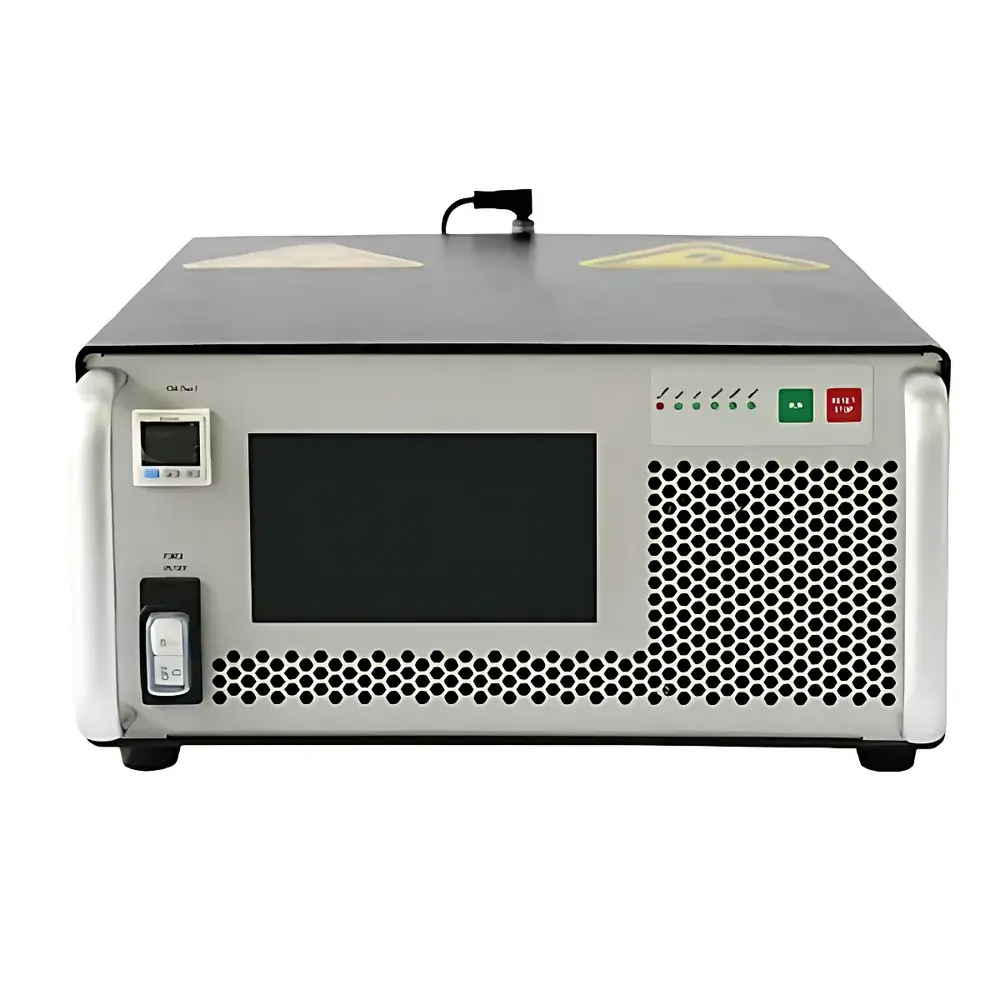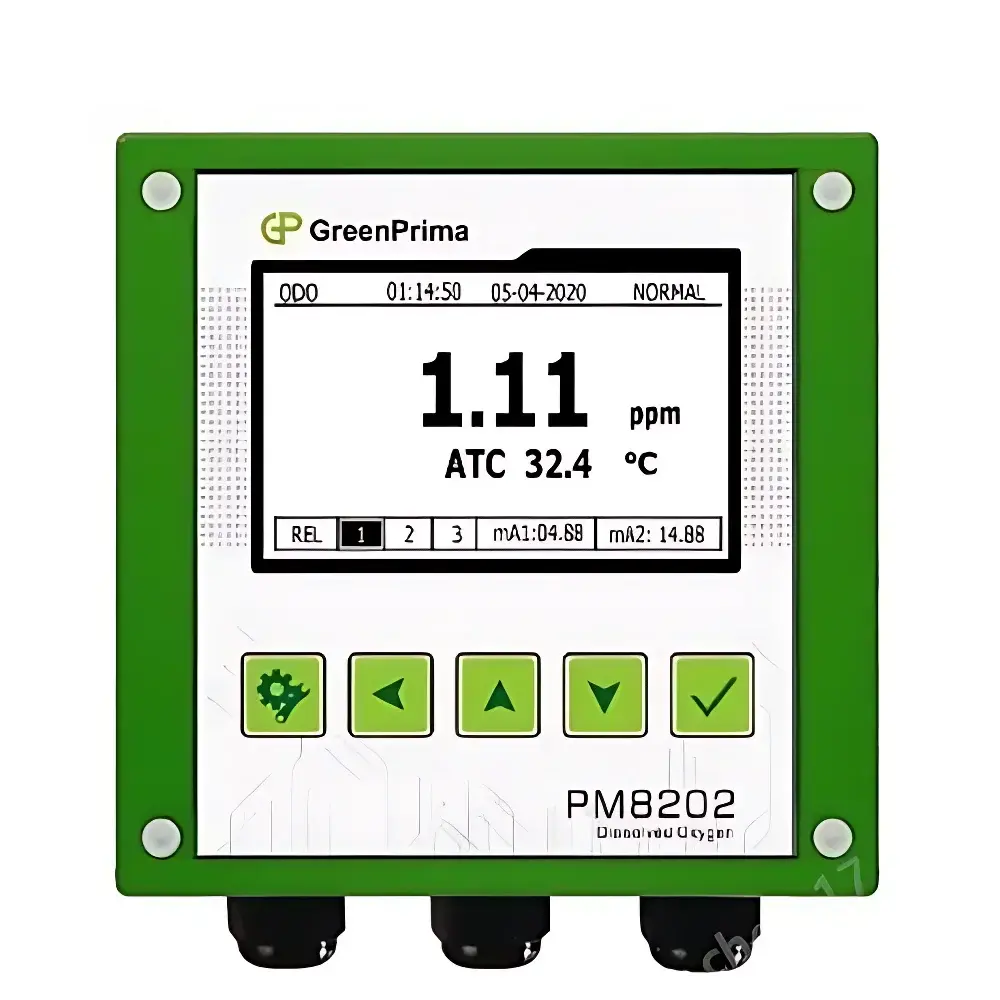
GreenPrima PM8202D Online Polarographic Dissolved Oxygen Analyzer
| Brand | GreenPrima |
|---|---|
| Origin | United Kingdom |
| Manufacturer Type | Original Equipment Manufacturer (OEM) |
| Product Category | Imported Instrument |
| Model | PM8202D |
| Measurement Range | 0.00–20.00 ppm / 0.00–200.00 ppb |
| Resolution | 0.001 ppm / 0.01 ppb |
| Accuracy | ±0.02 ppm / ±0.02 ppb |
| Temperature Compensation | −10 to +130 °C (manual or automatic, NTC10K/PT1000 sensor compatible) |
| Operating Temperature | −10 to +70.0 °C |
| Storage Temperature | −20 to +70.0 °C |
| Display | Backlit graphic LCD with multilingual (English/Chinese) interface |
| Data Storage | 600,000 records |
| Power Supply | 90–260 VAC, 50/60 Hz or optional 24 VDC |
| Analog Outputs | Two isolated 4–20 mA outputs (max. loop resistance 500 Ω, accuracy 0.1% FS, configurable for DO or temperature) |
| Digital Communication | RS485 Modbus RTU |
| Cleaning Cycle Control | Adjustable interval (0.1–1000 h) and duration (1–1000 s) |
| Alarm Outputs | Two independent Hi/Lo relay outputs (5 A / 250 VAC / 30 VDC), with programmable hysteresis |
| Enclosure Rating | IP65 |
| Dimensions | 144 × 144 × 108 mm (panel cutout: 138 × 138 mm) |
| Weight | 0.87 kg |
| Mounting Options | Wall-mount, panel-mount, pipe-mount |
| Electrode Compatibility | Bsens420, Bsens430, Bsens440 polarographic sensors |
| Membrane Type | Clark-type gas-permeable membrane |
| Maintenance Requirement | Periodic electrolyte replenishment |
Overview
The GreenPrima PM8202D Online Polarographic Dissolved Oxygen Analyzer is an industrial-grade process analyzer engineered for continuous, real-time monitoring of dissolved oxygen (DO) concentration in aqueous media. It operates on the classical Clark polarographic principle: molecular oxygen diffuses through a selective gas-permeable membrane into an electrochemical cell containing a cathode (typically gold or platinum) and a silver/silver chloride reference anode, immersed in an aqueous electrolyte. Under a fixed polarizing voltage (typically −0.6 to −0.8 V), oxygen is reduced at the cathode, generating a diffusion-limited current proportional to the partial pressure of dissolved O₂. This current is linearly converted to concentration units (ppm or ppb) after temperature compensation and calibration. Designed for deployment in demanding environments—including wastewater treatment plants, municipal drinking water facilities, aquaculture systems, pharmaceutical bioreactors, fermentation tanks, and chemical process streams—the PM8202D delivers stable, trace-level DO measurement with high reproducibility and long-term baseline stability.
Key Features
- Robust IP65-rated enclosure with full waterproof and gas-tight sealing, suitable for humid, corrosive, or splash-prone industrial settings
- Backlit high-contrast graphic LCD display showing real-time DO value, temperature, system time, relay status, and diagnostic indicators
- Dual isolated 4–20 mA analog outputs configurable for DO concentration, temperature, or derived parameters; compliant with IEC 61000-6-2/4 for electromagnetic immunity
- RS485 Modbus RTU digital interface enabling integration into DCS, SCADA, or PLC-based control architectures without protocol translation
- Programmable cleaning cycle management—interval (0.1–1000 hours) and duration (1–1000 seconds) adjustable via front panel or Modbus register—minimizing fouling-induced drift in suspended-solids-rich applications
- Two independent relay outputs with user-defined high/low setpoints, hysteresis control, and fail-safe logic for process interlocks or alarm annunciation
- Multi-mode mounting flexibility: panel-cut, wall-mounted, or direct pipe-thread installation (with optional flow-through adapter)
- Password-protected configuration menu preventing unauthorized parameter modification—supports audit-ready operational integrity
Sample Compatibility & Compliance
The PM8202D is validated for use across low-conductivity and high-turbidity aqueous matrices, including activated sludge effluent, clarified potable water, seawater-influenced aquaculture recirculation systems, and sterile bioprocess broths. Its Clark-type sensor architecture (compatible with Bsens420/Bsens430/Bsens440 electrodes) ensures reliable performance in applications where membrane fouling is a concern—particularly when paired with scheduled mechanical or air-pulse cleaning. The analyzer complies with key international standards governing environmental and process instrumentation: EN 61326-1 (EMC for industrial environments), EN 61010-1 (safety requirements for electrical equipment), and ISO 5814:2012 (electrochemical determination of dissolved oxygen). While not intrinsically safe, it may be deployed in non-hazardous zones per IEC 60079-0. For regulated industries (e.g., pharmaceutical manufacturing), its data logging capability (600,000 timestamped records) supports GLP-compliant trend analysis and retrospective validation.
Software & Data Management
Data acquisition and configuration are managed locally via the intuitive front-panel interface or remotely via Modbus RTU commands. All measurements—including raw current signal, compensated DO, temperature, and system diagnostics—are timestamped and stored in non-volatile memory. Export is supported via manual USB dump (when equipped with optional USB module) or periodic polling by supervisory software. The embedded firmware implements cyclic redundancy check (CRC) on all stored records and maintains a write-cycle log to verify data integrity over extended deployments. While the base unit does not include FDA 21 CFR Part 11-compliant electronic signature functionality, its deterministic Modbus register map enables third-party SCADA systems to implement audit trails, role-based access control, and electronic record retention in accordance with GMP Annex 11 requirements.
Applications
- Municipal and industrial wastewater treatment: aeration basin DO control, denitrification monitoring, and final effluent compliance verification per EPA Method 360.1 or ISO 5815-1
- Drinking water distribution: residual oxygen tracking post-chlorination to assess pipe corrosion potential and biofilm formation risk
- Aquaculture and hatchery operations: precision DO dosing in recirculating aquaculture systems (RAS) to maintain optimal metabolic conditions for finfish and crustaceans
- Pharmaceutical upstream processing: real-time DO feedback control during mammalian cell culture and microbial fermentation, aligned with USP analytical instrument qualification guidelines
- Power plant condensate monitoring: detection of air ingress into steam cycles via sub-ppb DO levels, supporting ASME PTC 19.11 and EPRI TR-102357 protocols
FAQ
What electrochemical principle does the PM8202D employ?
It uses the Clark polarographic method, relying on oxygen diffusion across a gas-permeable membrane and subsequent electrochemical reduction at a polarized cathode.
Is temperature compensation fully automatic?
Yes—integrated NTC10K or PT1000 sensor inputs enable either manual or automatic temperature compensation across −10 °C to +130 °C.
How frequently must the electrolyte be replaced?
Typical service intervals range from 3 to 6 months depending on operating temperature, flow velocity, and sample particulate load; replacement kits and procedures are documented in the OEM maintenance manual.
Can the device operate on DC power?
Yes—24 VDC is available as an optional power input, enabling deployment in battery-backed or solar-powered remote monitoring stations.
Does the analyzer support HART communication?
No—communication is exclusively via RS485 Modbus RTU; HART compatibility is not implemented in this model variant.