
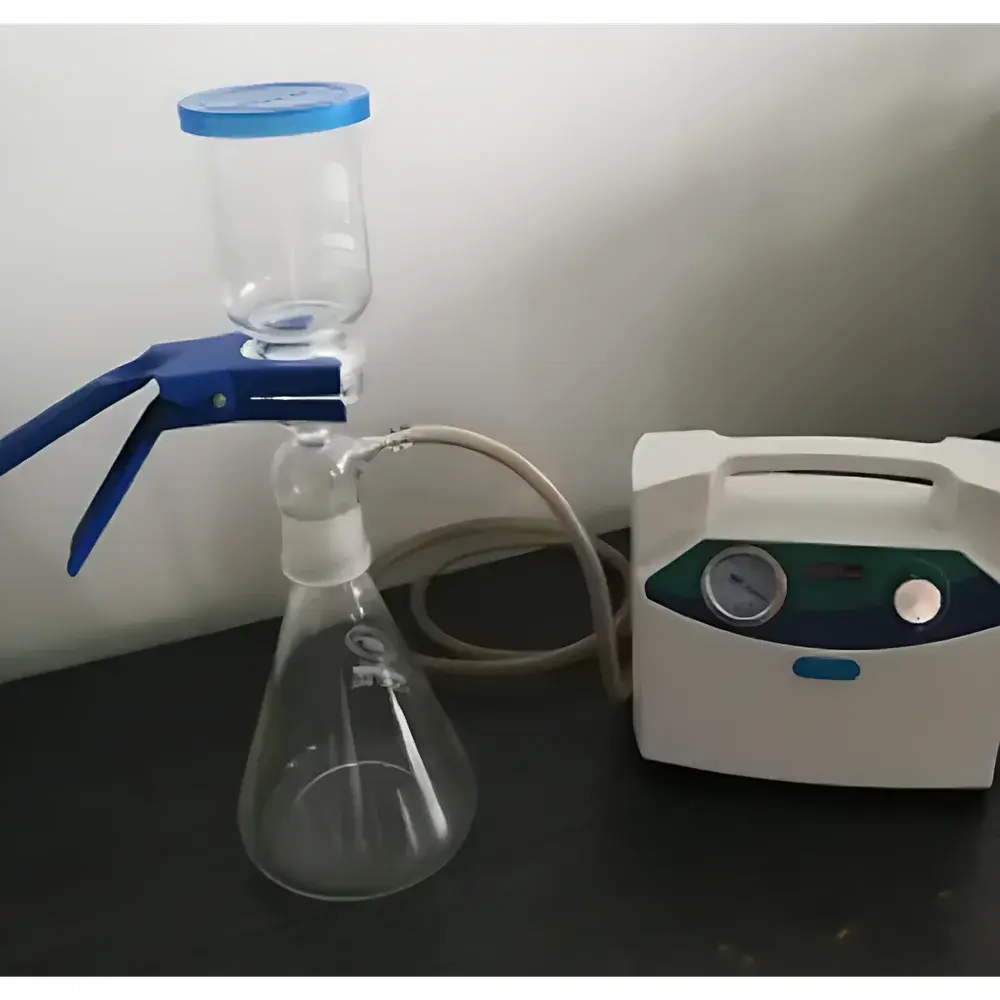
PULUODY PLD-11901 Laboratory Suspended Solids Analyzer
| Brand | PULUODY |
|---|---|
| Origin | Shaanxi, China |
| Manufacturer Type | Authorized Distributor |
| Country of Origin | China |
| Model | PLD-11901 |
| Instrument Type | Benchtop Laboratory Analyzer |
| Filtration Pore Size | 0.45 µm |
| Filter Diameter | φ50 mm or φ60 mm |
| Drying Temperature Control | 104 ± 1 °C |
| Gravimetric Accuracy | ≥0.1 mg |
| Maximum Vacuum Pressure | ≥80 kPa |
| Vacuum Adjustment Range | 20–80 kPa |
| Airflow Rate | ≥20 L/min |
| Acoustic Noise Level | ≤60 dB(A) |
| Power Supply | AC 220 V ±10%, 50 Hz |
| Detection Limit | 2 mg/L |
| Recommended Sample Mass Range | 5–100 mg (corresponding to 100 mL sample volume at typical concentrations) |
Overview
The PULUODY PLD-11901 Laboratory Suspended Solids Analyzer is a gravimetric instrumentation system engineered for the standardized determination of total suspended solids (TSS) in aqueous samples according to established environmental testing protocols—including ISO 11923:1997, EPA Method 160.2, and HJ 91.1–2019 (China’s Standard Methods for Environmental Monitoring). It implements the fundamental principle of quantitative filtration followed by controlled thermal desiccation and high-precision gravimetry. The instrument integrates a vacuum-assisted filtration manifold with an integrated variable-pressure pump, enabling reproducible, operator-independent sample processing across diverse water matrices. Unlike optical or turbidimetric alternatives, this method delivers absolute mass-based quantification—free from interferences caused by particle color, refractive index, or light-scattering heterogeneity—making it the reference technique for regulatory compliance, wastewater discharge reporting, and environmental impact assessment.
Key Features
- Integrated vacuum filtration station with digitally adjustable negative pressure (20–80 kPa), ensuring consistent flow rates across varying sample viscosities and particulate loadings.
- Dual-filter compatibility: supports standard φ50 mm and φ60 mm glass fiber filters (0.45 µm pore size), pre-validated for low blank weight and high retention efficiency per ASTM D5907.
- Thermally stable drying control module calibrated to maintain 104 ± 1 °C—aligned with ISO 5667-12 and US EPA requirements for TSS gravimetric conditioning.
- Low-noise (<60 dB(A)) brushless vacuum pump architecture, minimizing laboratory ambient interference during extended filtration cycles.
- Ergonomic filter holder design with precision-machined sealing gaskets and spring-loaded clamping mechanism, eliminating leakage and ensuring complete sample capture without edge bypass.
- Modular construction allows seamless integration with external analytical balances (≥0.1 mg readability) and standard laboratory ovens/desiccators—no proprietary consumables required.
Sample Compatibility & Compliance
The PLD-11901 is validated for use with surface water, groundwater, domestic wastewater, and industrial effluents—provided samples are homogenized prior to analysis and non-suspended materials (e.g., floating oils, settled sediments, or macro-debris) are removed per ISO 5667-3. It excludes particulates larger than 0.45 µm retained on certified membrane filters meeting ISO 7709 specifications. The methodology conforms to Good Laboratory Practice (GLP) documentation requirements, supporting full traceability when paired with audit-ready balance logs and oven calibration records. While the instrument itself does not embed electronic data integrity controls, its operational workflow is fully compatible with 21 CFR Part 11-compliant laboratory information management systems (LIMS) when manual entry or CSV export is implemented.
Software & Data Management
The PLD-11901 operates as a hardware-only platform with no embedded firmware or proprietary software. All data acquisition and calculation are performed externally using validated spreadsheets or LIMS platforms. Users record initial filter tare weights, post-filtration dry weights, and sample volumes manually or via direct balance interface (RS-232/USB). Final TSS concentration (mg/L) is computed as: (Wfinal – Winitial) × 1000 / Vsample, where weight difference is in grams and volume in liters. This open-data architecture ensures full transparency, facilitates internal method validation, and simplifies third-party audit preparation without software qualification overhead.
Applications
- Regulatory monitoring of municipal wastewater treatment plant influent, effluent, and sludge dewatering streams.
- Baseline characterization of river, lake, and reservoir sediment transport dynamics in hydrological studies.
- Process control in food & beverage, pharmaceutical, and semiconductor manufacturing where rinse water clarity must meet strict particulate thresholds.
- Environmental site assessments requiring quantification of erosion-related particulate loading in stormwater runoff.
- Method comparison and reference measurement in laboratories validating rapid alternatives such as laser diffraction or digital image analysis systems.
FAQ
What filtration membrane specifications are required?
Standard glass fiber filters (0.45 µm nominal pore size, diameter φ50 mm or φ60 mm) compliant with ASTM E1054 and ISO 7709 must be used. Pre-combusted filters are recommended for low-blank applications.
Can the PLD-11901 be used for saline or high-TDS water?
Yes—provided dissolved solids do not precipitate during filtration or drying. For brackish or seawater samples, verify absence of crystalline salt deposition on the filter post-drying; if observed, include a procedural blank correction.
Is calibration required before each analysis?
No instrumental calibration is needed. However, daily verification of vacuum stability (±5 kPa) and periodic validation of oven temperature uniformity (per ISO/IEC 17025 Clause 6.4.3) are mandatory for accredited use.
What is the minimum detectable concentration?
The practical detection limit is 2 mg/L when analyzing 100 mL samples, assuming ≤0.2 mg weighing repeatability and ≤0.4 mg final mass stability per ISO 5725-2.
Does the system support GLP-compliant audit trails?
As a non-electronic, non-data-logging device, the PLD-11901 relies on user-maintained hard-copy or LIMS-integrated records. Its mechanical simplicity inherently supports full procedural transparency and retrospective verification.







