
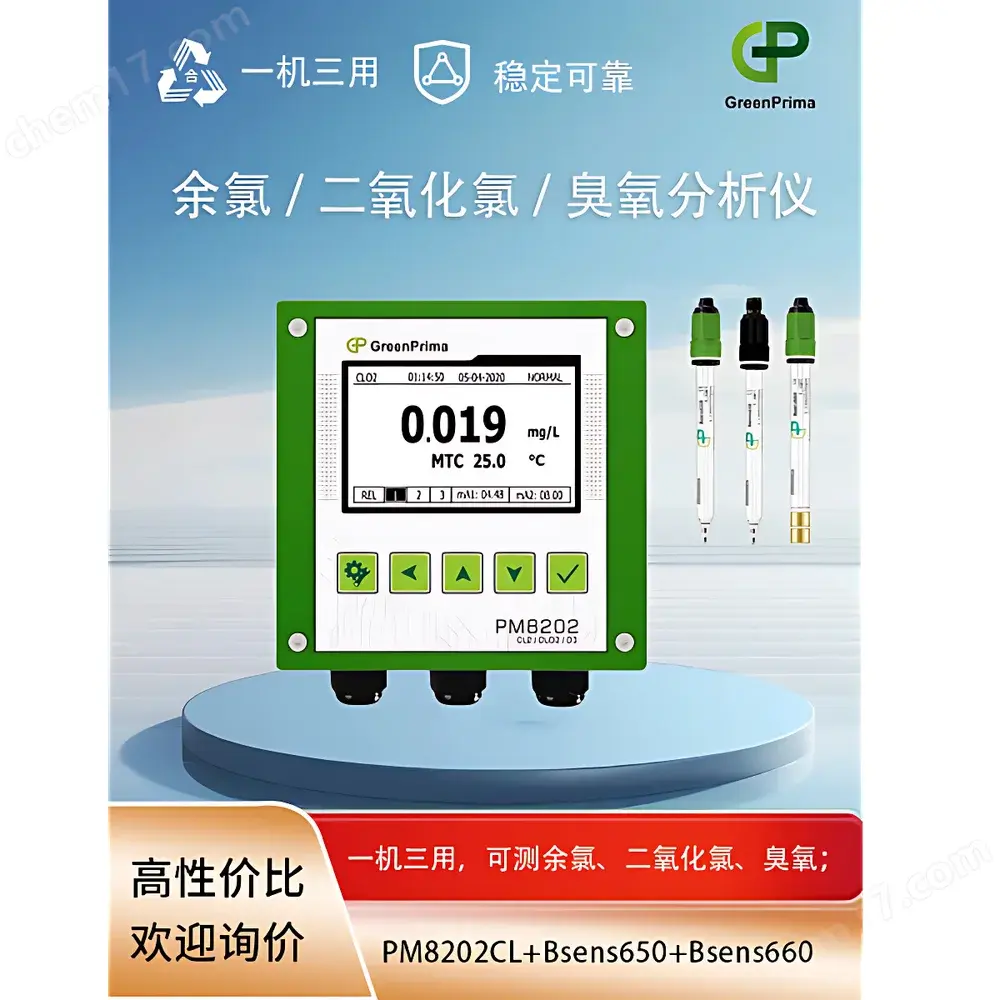
GreenPrima PM8202C-L Residual Chlorine, Chlorine Dioxide and Ozone Analyzer
| Brand | GreenPrima |
|---|---|
| Origin | United Kingdom |
| Manufacturer Type | Original Equipment Manufacturer (OEM) |
| Product Category | Imported Instrument |
| Model | PM8202C-L |
| Instrument Type | Online Analyzer |
| Measurement Principle | Amperometric Constant-Voltage Detection |
| Measured Parameters | Free Chlorine, Total Chlorine, Chlorine Dioxide, Ozone |
| Measurement Range | 0.00–20.00 ppm / 0.00–200.00 ppb |
| Accuracy | ±2% of Full Scale (F.S.) |
| Resolution | 0.001 ppm / 0.01 ppm |
| Temperature Compensation | -10 to 130 °C (NTC10K or PT1000 sensor compatible) |
| Operating Temperature | -10 to 70.0 °C |
| Storage Temperature | -20 to 70.0 °C |
| Display | Backlit Graphic LCD (Chinese/English Switchable) |
| Data Storage | 600,000 records |
| Power Supply | 90–260 VAC, 50/60 Hz or 24 VDC optional |
| Output | Dual isolated 4–20 mA (0.1% F.S., max. loop resistance 500 Ω), RS485 Modbus RTU |
| Relay Outputs | Two programmable Hi/Lo alarms (5 A / 250 VAC / 30 VDC) |
| Cleaning Control | Adjustable interval (0.1–1000 h) and duration (1–1000 s) |
| Enclosure Rating | IP65 |
| Dimensions | 144 × 144 × 108 mm |
| Panel Cutout | 138 × 138 mm |
| Weight | 0.87 kg |
Overview
The GreenPrima PM8202C-L is a high-stability, multi-analyte online amperometric analyzer engineered for continuous monitoring of residual chlorine (free and total), chlorine dioxide, and ozone in aqueous systems. It operates on the constant-voltage amperometric principle—applying a fixed bias potential across a dual-platinum working electrode (Bsens650) or gold electrode (Bsens660), enabling selective electrochemical reduction of oxidants at the electrode surface. The resulting diffusion-limited current is linearly proportional to analyte concentration, providing robust, reagent-free quantification without optical interference or chemical consumption. Integrated with the BAF615 flow-controlled cell, the system maintains laminar, consistent sample throughput—critical for minimizing response lag and drift under variable hydraulic conditions. Designed for deployment in regulated water infrastructure, the analyzer meets foundational requirements for long-term unattended operation in potable water distribution, hospital effluent treatment, secondary water supply networks, and industrial process water loops.
Key Features
- True reagent-free operation: No colorimetric reagents, membranes, or electrolyte replenishment required—reducing consumables cost and maintenance frequency.
- Triple-analyte capability: Single instrument platform supports simultaneous configuration for free chlorine, chlorine dioxide, and ozone—each calibrated independently per ASTM D6503 and ISO 7393-2 protocols.
- Dual-electrode architecture: Platinum-based Bsens650 sensor delivers high selectivity against common interferences (e.g., nitrite, bromide, hydrogen peroxide); gold-based Bsens660 variant offers enhanced stability for ozone measurement in low-conductivity streams.
- Active flow regulation: BAF615 constant-flow cell ensures repeatable hydrodynamic conditions, eliminating flow-rate dependency—a key factor in maintaining ±2% F.S. accuracy across dynamic pressure environments.
- Full environmental resilience: IP65-rated enclosure, wide operating temperature range (-10 to 70 °C), and NTC10K/PT1000-compatible temperature compensation support deployment in outdoor kiosks, pump stations, and mechanical rooms.
- Secure operational interface: Password-protected parameter configuration, programmable alarm hysteresis, and dual relay outputs compliant with IEC 61000-4 EMC standards ensure safe integration into SCADA and PLC-controlled utilities.
Sample Compatibility & Compliance
The PM8202C-L is validated for use in drinking water (per WHO Guidelines and EU Directive 98/83/EC), wastewater disinfection channels, cooling tower circuits, and pharmaceutical purified water (PW) loops. Its amperometric detection method avoids spectral overlap issues inherent in DPD-based photometry, making it suitable for turbid or colored matrices where optical methods fail. All firmware and data logging functions adhere to ALCOA+ principles; audit trail functionality—including operator ID, timestamp, and parameter change history—is configurable to support GLP and GMP-aligned validation (e.g., IQ/OQ/PQ). While not FDA 21 CFR Part 11-certified out-of-the-box, the Modbus RTU protocol enables traceable data export to validated LIMS or MES platforms meeting electronic record requirements.
Software & Data Management
Local configuration and real-time monitoring are performed via the built-in graphic LCD with intuitive Chinese/English toggle. All critical parameters—including calibration coefficients, temperature compensation curves, cleaning schedules, and alarm thresholds—are stored non-volatily. The device logs up to 600,000 timestamped records (measurement value, temperature, status flags) with millisecond-resolution timestamps. Data export is supported via RS485 Modbus RTU (function codes 03h/04h for holding/input registers) to supervisory systems compliant with IEC 62443-3-3. Optional PC utility software provides CSV export, trend visualization, and calibration report generation aligned with ISO/IEC 17025 documentation templates.
Applications
- Drinking water treatment plants: Continuous verification of post-chlorination residual levels at clearwell outlets and distribution system entry points.
- Hospital wastewater disinfection: Monitoring chlorine dioxide dosing efficacy in effluent prior to municipal sewer discharge (per EPA 40 CFR Part 469).
- Food & beverage process water: Ensuring consistent oxidative biocide concentration in CIP rinse cycles without introducing organic contaminants.
- Pharmaceutical water systems: Supporting PW and WFI point-of-use verification where membrane fouling or UV lamp degradation may compromise alternative methods.
- Cooling water management: Detecting residual oxidant carryover from side-stream treatment units to prevent microbiologically influenced corrosion (MIC).
FAQ
What electrochemical principle does the PM8202C-L employ?
It uses constant-voltage amperometry with diffusion-controlled current measurement at a polarized noble-metal electrode surface.
Can the same sensor measure chlorine, chlorine dioxide, and ozone interchangeably?
Yes—via software-selectable calibration curves and electrode-specific bias potentials; however, sensor type (Bsens650 vs. Bsens660) must match target analyte for optimal selectivity.
Is temperature compensation automatic or manual?
Both options are available: automatic compensation using integrated NTC10K or external PT1000 probe, or fixed-offset manual correction.
How often does the system require calibration verification?
Field verification is recommended every 7–14 days using standardized NIST-traceable chlorine standard solutions; full recalibration intervals depend on application severity and regulatory requirements.
Does the analyzer support integration with existing SCADA systems?
Yes—via isolated RS485 Modbus RTU (slave mode), with register mapping documentation provided for seamless HMI tag configuration.







