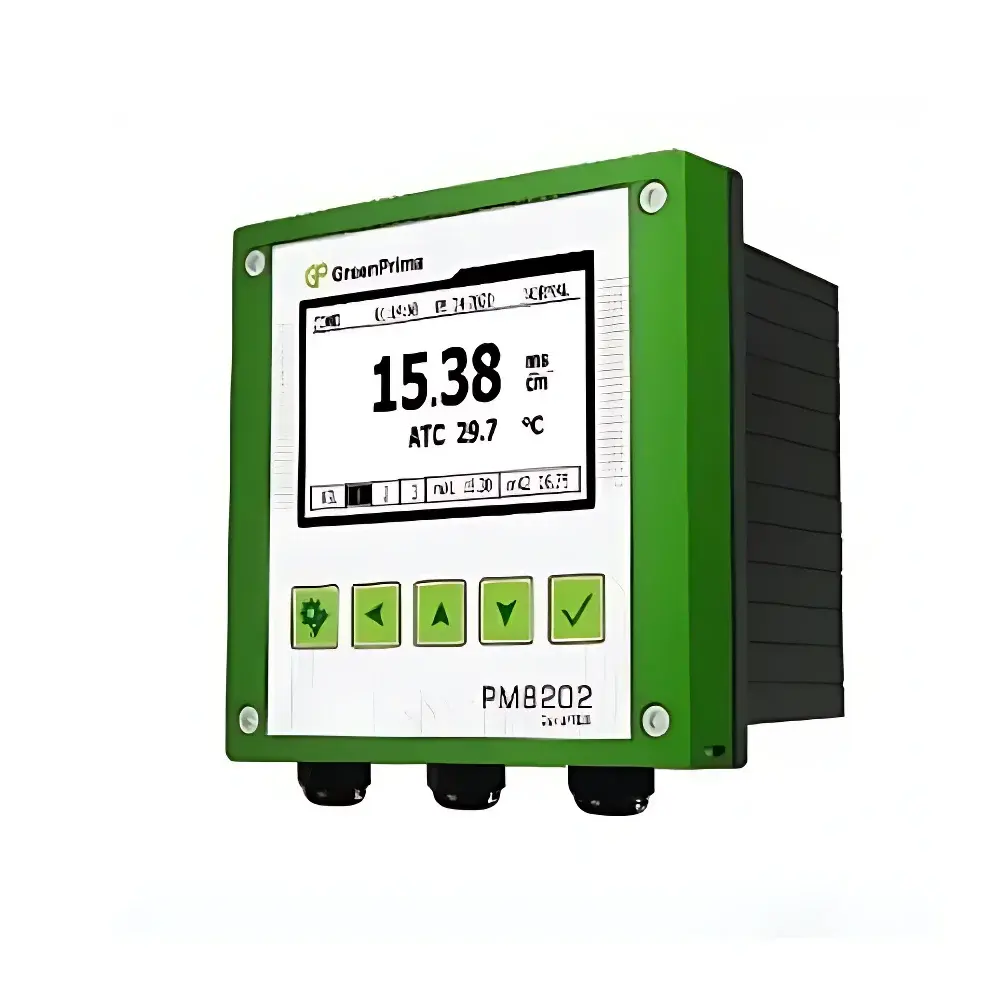
GreenPrima PM8202C Online Conductivity Analyzer for Wastewater and Effluent Monitoring
| Brand | GreenPrima |
|---|---|
| Origin | United Kingdom |
| Manufacturer Type | Original Equipment Manufacturer (OEM) |
| Product Category | Imported Industrial Process Instrument |
| Model | PM8202C |
| Conductivity Range | 0.00–2000 mS/cm |
| Salinity Range | 0.00–78.00 ppt |
| TDS Range | 0–120,000 ppm |
| Temperature Operating Range | −10 to +70.0 °C |
| Storage Temperature Range | −20 to +70.0 °C |
| Conductivity Resolution | 0.01 µS/cm (at low range), 0.1 mS/cm (at high range) |
| Salinity Resolution | 0.01 ppt |
| TDS Resolution | 1 ppm |
| Display | Backlit graphic LCD |
| Temperature Compensation | Automatic/manual (NTC30k or PT1000 sensor input) |
| Accuracy | ±1% of full scale |
| Enclosure Dimensions | 144 × 144 × 108 mm |
| Weight | 0.87 kg |
| Protection Rating | IP65 |
| Power Supply | 90–260 VAC, 50/60 Hz or 24 VDC (optional) |
| Output | Dual isolated 4–20 mA outputs (max. loop resistance 500 Ω, accuracy 0.1% FS) |
| Communication | RS485 Modbus RTU (standard), HART (optional) |
| Relay Outputs | 2 programmable SPDT relays (5 A / 250 VAC / 30 VDC) |
| Data Logging | 600,000 records with timestamp |
| Cleaning Control Output | Adjustable interval (0.1–1000 h) and duration (1–1000 s) |
| Mounting Options | Wall-mount, panel-mount, in-line pipe mount |
| Password Protection | Yes |
| Factory Reset | One-button restore |
Overview
The GreenPrima PM8202C Online Conductivity Analyzer is an industrial-grade, CE-compliant process instrument engineered for continuous, real-time monitoring of electrical conductivity, salinity, and total dissolved solids (TDS) in wastewater, sewage effluent, industrial discharge streams, and municipal water treatment applications. Based on the fundamental principle of conductance measurement—wherein ionic concentration in aqueous solution determines its ability to carry electric current—the PM8202C employs a four-electrode (or toroidal) conductivity cell interface (sensor sold separately) to minimize polarization effects and ensure stable, drift-free performance across wide dynamic ranges. Its dual-range capability—from ultra-low conductivity (µS/cm) in reclaimed water to high-conductivity (mS/cm) in brine or digestate—enables reliable operation without manual range switching. Designed for 24/7 unattended deployment in harsh environments, the analyzer features robust thermal management, wide-temperature operational tolerance, and corrosion-resistant housing compliant with IP65 ingress protection.
Key Features
- True dual-channel analog output: Two fully isolated 4–20 mA current loops configurable independently for conductivity, temperature, salinity, or TDS—each calibrated to 0.1% full-scale accuracy and supporting up to 500 Ω loop resistance.
- Intelligent temperature compensation: Supports both automatic (via integrated NTC30k or external PT1000 probe) and manual compensation across −10 to +130 °C, ensuring measurement fidelity under variable thermal conditions typical of biological treatment basins or heated discharge lines.
- Modular sensor compatibility: Accepts industry-standard conductivity cells—including stainless steel, graphite, and toroidal types—with configurable cell constant (K = 0.01–10.0 cm⁻¹) and automatic recognition via digital handshake (when using smart sensors).
- Industrial-grade human-machine interface: High-contrast backlit graphical LCD with intuitive dual-language (English/Chinese) menu navigation, password-protected configuration access, and one-touch factory reset to prevent unauthorized parameter changes.
- Embedded data integrity architecture: Onboard non-volatile memory stores up to 600,000 timestamped readings (conductivity, temperature, TDS, salinity), supporting trend analysis and regulatory audit trails without external logging hardware.
- Process-integrated control logic: Two programmable SPDT relays support alarm, pump activation, valve control, or cleaning cycle initiation—with adjustable hysteresis, delay timers, and fail-safe state assignment per relay.
Sample Compatibility & Compliance
The PM8202C is validated for use with municipal wastewater, activated sludge effluents, anaerobic digester supernatant, reverse osmosis reject streams, cooling tower blowdown, and industrial rinse waters containing suspended solids up to 5% w/w and oil content <100 mg/L. It complies with IEC 61000-6-2 (immunity) and IEC 61000-6-4 (emissions), meets EN 61326-1 for industrial electromagnetic compatibility, and supports traceability under ISO/IEC 17025 laboratory quality systems when paired with certified reference solutions (e.g., KCl standards traceable to NIST). While not intrinsically safe, optional ATEX-certified barrier kits enable deployment in Zone 2 hazardous areas. The device supports FDA 21 CFR Part 11–compliant data export protocols when integrated with validated SCADA or LIMS platforms.
Software & Data Management
Configuration and diagnostics are performed locally via the front-panel interface or remotely via Modbus RTU over RS485 (up to 1200 m cable length, 32-node network capacity). The embedded Modbus register map includes read/write access to all calibration coefficients, alarm thresholds, relay logic states, and logged data buffers. Optional PC-based GreenPrima ConfigTool software (Windows) enables batch calibration, firmware updates, and CSV export of historical logs with ISO 8601 timestamps. All critical events—including power loss, sensor fault, calibration timeout, and relay actuation—are time-stamped and stored in a dedicated event log. Audit trail functionality records user login/logout, parameter modifications, and calibration actions—supporting GLP/GMP documentation requirements where electronic records are subject to review.
Applications
- Real-time effluent compliance monitoring against local discharge permits (e.g., EPA NPDES, EU Urban Wastewater Treatment Directive limits on conductivity as proxy for chloride/sodium load).
- Control of membrane filtration systems by detecting feedwater salinity shifts that indicate pretreatment failure or seawater intrusion.
- Optimization of electrocoagulation and electrodialysis processes through closed-loop feedback on ionic strength.
- TDS trending in anaerobic digestion sidestreams to infer volatile fatty acid accumulation and microbial health.
- Leak detection in dual-pipe reclaimed water networks by comparing conductivity signatures between potable and non-potable loops.
- Automated chemical dosing control in cooling water systems based on conductivity-driven blowdown scheduling.
FAQ
What conductivity cell types are compatible with the PM8202C?
The analyzer supports analog and digital (RS485) conductivity sensors with standard 4–20 mA, 0–5 V, or Modbus interfaces. Recommended configurations include stainless steel 4-electrode cells (K = 1.0 cm⁻¹) for primary effluent and toroidal cells (K = 10.0 cm⁻¹) for high-solids digestate.
Does the PM8202C support automatic temperature compensation with external probes?
Yes—it accepts both NTC30k thermistors and PT1000 RTDs via dedicated sensor inputs, enabling simultaneous two-point temperature measurement for differential compensation in large-diameter pipes or tanks.
Can the device be integrated into existing DCS or PLC systems?
Absolutely—the dual 4–20 mA outputs and native Modbus RTU protocol ensure seamless integration with Siemens S7, Rockwell ControlLogix, Schneider EcoStruxure, and Honeywell Experion DCS platforms without gateway hardware.
Is calibration traceable to international standards?
Calibration is performed using certified KCl reference solutions (e.g., 1413 µS/cm, 12.88 mS/cm) traceable to NIST SRMs; certificate of calibration (with uncertainty budget) is available upon request for ISO 17025-accredited labs.
How is sensor fouling mitigated during long-term wastewater operation?
The built-in cleaning control output allows precise scheduling of mechanical wipers, ultrasonic transducers, or chemical flush cycles—parameters fully configurable via front panel or Modbus registers to match site-specific fouling rates.