
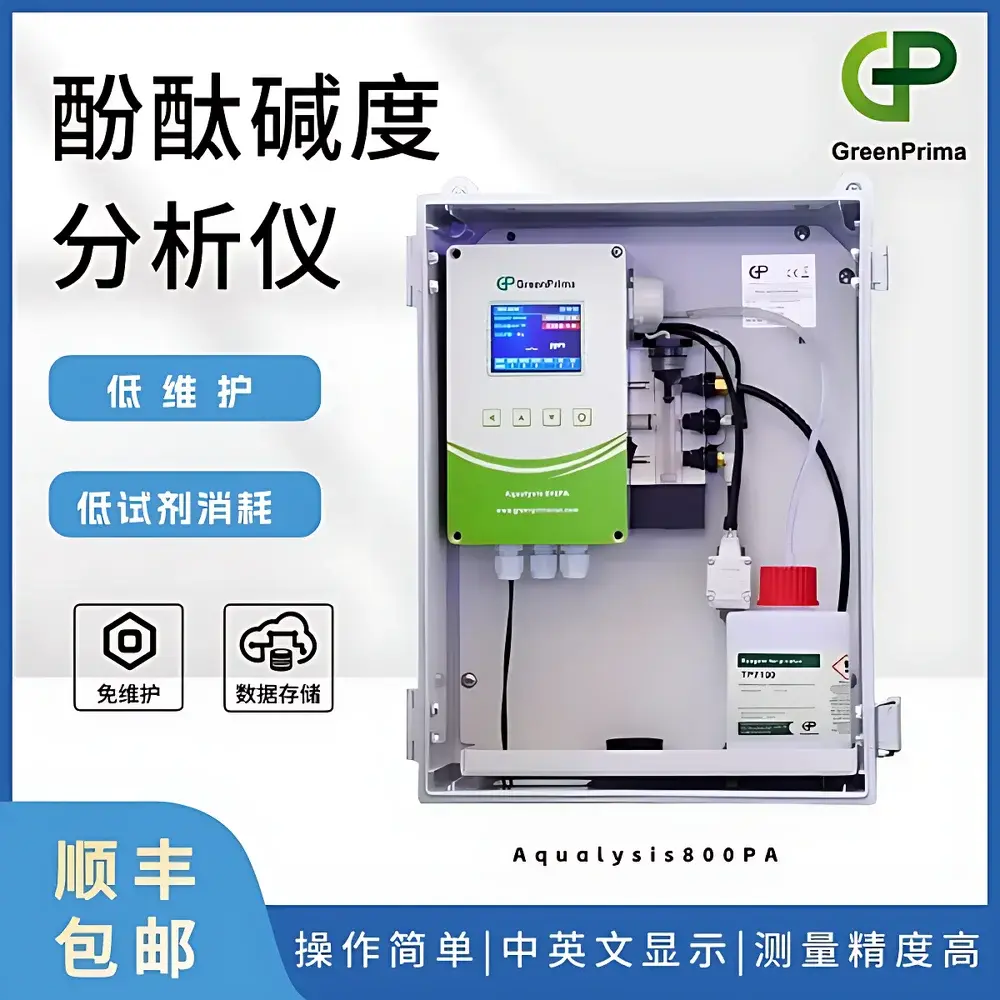
GreenPrima Aqualysis 800PA Phenolphthalein Alkalinity Analyzer
| Brand | GreenPrima |
|---|---|
| Origin | United Kingdom |
| Manufacturer Type | Original Equipment Manufacturer (OEM) |
| Origin Category | Imported |
| Model | Aqualysis 800PA |
| Pricing | Upon Request |
Overview
The GreenPrima Aqualysis 800PA Phenolphthalein Alkalinity Analyzer is a fully automated, benchtop-to-industrial inline analyzer engineered for precise, real-time determination of phenolphthalein alkalinity (P-alkalinity) in industrial water streams. It operates on the principle of potentiometrically guided acid–base titration coupled with photometric endpoint detection: a standardized hydrochloric acid titrant is dosed into the sample until the pH drops below ~8.3, at which point phenolphthalein transitions from pink to colorless; this colorimetric shift is quantified via dual-wavelength spectrophotometry (typically 540 nm and reference wavelength) within a dedicated optical flow cell. The instrument’s embedded microprocessor controls reagent delivery, timing, signal acquisition, and endpoint calculation—ensuring compliance with standard methods including ISO 9963-1, ASTM D1067, and APHA Standard Method 2320 B. Designed for continuous or scheduled operation in harsh industrial environments, the Aqualysis 800PA delivers traceable, GLP-aligned results without operator intervention.
Key Features
- Automated titration–photometry hybrid measurement with ±2% accuracy and ±1% repeatability relative to selected reagent range upper limit
- Integrated touchscreen control unit with full-color LCD display supporting both English and Chinese UI languages
- Compact footprint (400 × 300 × 180 mm; 4 kg) and IP65-rated enclosure for installation in wet or dusty utility areas
- Low-maintenance architecture: minimal moving parts, corrosion-resistant fluidic path (PEEK, PTFE, borosilicate glass), and ≤1.2 mL reagent consumption per analysis
- Flexible operational modes: continuous monitoring or programmable interval analysis (1–360 minutes)
- Comprehensive I/O interface: four programmable relay outputs (250 V AC / 4 A), two digital inputs (start/stop triggers), one isolated 4–20 mA analog output (750 Ω max load), and RS485 Modbus RTU for SCADA integration
- Onboard data logging with timestamped event history, fault diagnostics, and calibration records—retained for ≥12 months
- Configurable rinse cycle (15–1800 s) and adaptive sample conditioning to minimize carryover and fouling
Sample Compatibility & Compliance
The Aqualysis 800PA is validated for use with turbid, high-suspended-solids industrial waters—including basic oxygen furnace (BOF) gas scrubber effluent, blast furnace cooling circuits, recirculating cooling towers, and low-pressure boiler feedwater. Sample acceptance criteria include pH 4–10, temperature 5–40 °C, inlet pressure 0.2–5 bar (optimal: 1–2 bar), and maximum contaminant levels of Fe < 3 ppm, Cu < 0.2 ppm, Al < 0.1 ppm, and Mn < 0.2 ppm. Instrument design conforms to IEC 61326-1 (EMC for industrial environments) and IEC 61010-1 (safety requirements for electrical equipment). Data integrity features—including audit-trail-enabled calibration logs, user-access levels, and non-volatile memory—support alignment with FDA 21 CFR Part 11 expectations where electronic records are subject to regulatory review.
Software & Data Management
The embedded firmware supports zero-point and span calibration using certified standard solutions (e.g., Na₂CO₃ or CaCO₃ reference standards traceable to NIST). All calibrations, alarms, and maintenance events are time-stamped and stored locally with automatic overwrite protection. Optional PC-based configuration software (Aqualysis ConfigTool v3.x) enables remote parameter setup, trend visualization, report export (CSV/PDF), and firmware updates via USB or Ethernet. Data export includes raw absorbance values, titrant volume consumed, calculated alkalinity (in selectable units: °dH, °f, mg/L as CaCO₃, or mmol/L), and diagnostic flags (e.g., “low signal,” “valve timeout,” “reagent depletion”). Integration with LIMS or DCS systems is supported via Modbus RTU over RS485 or 4–20 mA loop.
Applications
This analyzer is routinely deployed in metallurgical plants for closed-loop control of lime dosing in BOF scrubber systems; in power generation facilities for boiler blowdown optimization and scale risk mitigation; and in heavy manufacturing sites managing recirculating cooling water chemistry. Its robustness against particulate interference and tolerance for variable flow rates make it suitable for direct online insertion into bypass lines or side-stream analyzers. Typical applications include:
- Real-time phenolphthalein alkalinity feedback for automated acid dosing in neutralization basins
- Trend-based early warning of carbonate/bicarbonate ratio shifts indicating CO₂ ingress or scaling potential
- Verification of pretreatment efficiency prior to reverse osmosis or ion exchange units
- QA/QC verification during wastewater discharge compliance reporting (e.g., EU Industrial Emissions Directive Annex I)
FAQ
What alkalinity parameters does the Aqualysis 800PA measure?
It measures phenolphthalein alkalinity (P-alkalinity) specifically—the portion of total alkalinity neutralized up to pH ≈ 8.3, expressed as mg/L CaCO₃ or mmol/L.
Can it be integrated with multi-channel sampling systems?
Yes—it is compatible with GreenPrima’s MCS-series multiplexers (2–8 channels), enabling unattended sequential analysis across multiple process points without interrupting measurement cycles.
Is manual intervention required for routine operation?
No. Once calibrated and primed, the system runs autonomously; only periodic reagent replenishment (every 2–6 weeks depending on frequency) and annual sensor verification are recommended.
Does it comply with international water quality standards?
Yes. Its methodology aligns with ISO 9963-1, ASTM D1067, and APHA 2320 B; its hardware and data handling support GLP/GMP-aligned workflows and 21 CFR Part 11 readiness when configured with user authentication and audit trail enabled.
What is the typical analysis time per sample?
2–8 minutes, depending on initial alkalinity concentration and selected titration resolution mode.
Related Products







