
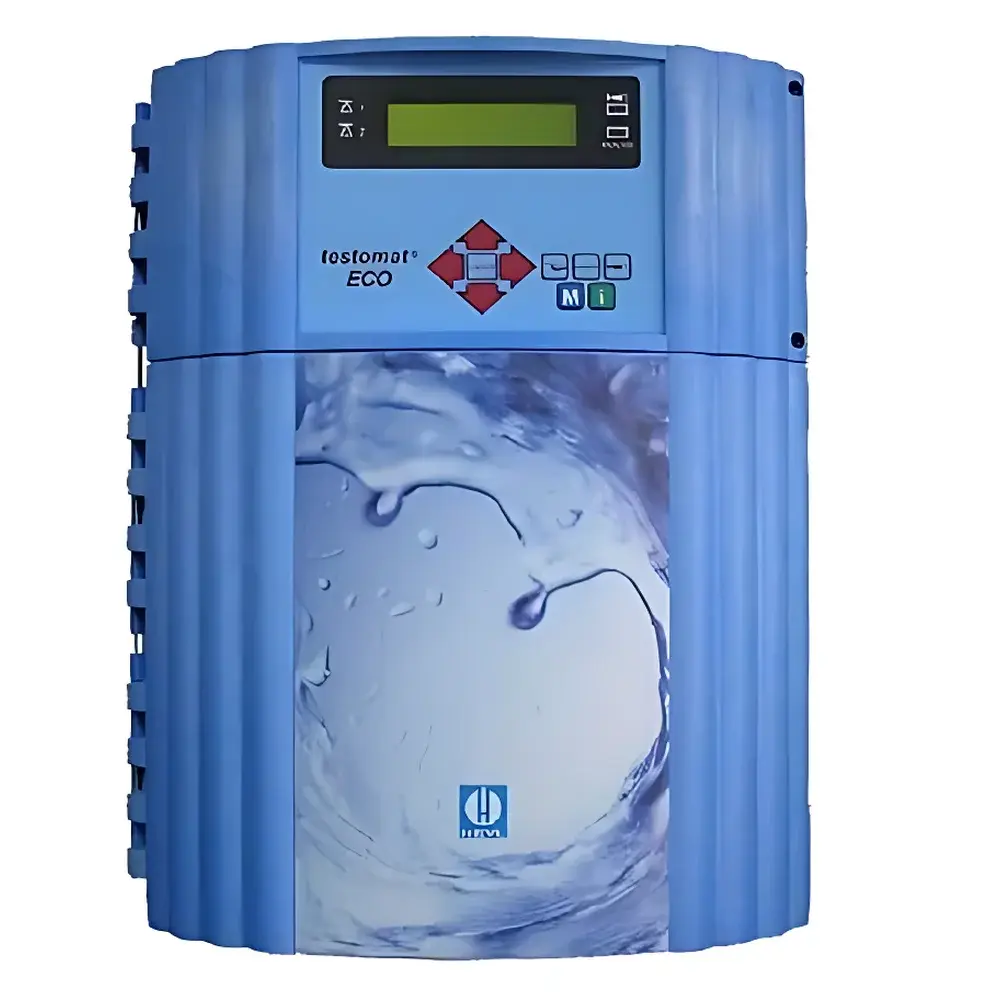
HEYL Testomat ECO / Testomat 2000 Online Water Hardness Analyzer
| Brand | HEYL (Neomeris) |
|---|---|
| Origin | Germany |
| Model | Testomat ECO / Testomat 2000 |
| Measurement Parameter | Total Calcium and Magnesium Hardness (as CaCO₃) |
| Power Supply | 230 V or 24 V ±10 %, 50–60 Hz |
| Power Consumption | ≤30 VA |
| Ingress Protection | IP65 |
| Electrical Safety Class | Class I |
| Compliance | EN 50081-1, EN 50082-2, EN 61010-1 |
| Operating Ambient Temperature | 10–45 °C |
| Sample Inlet Temperature | 10–40 °C |
| Operating Pressure Range | 0.1–3 bar (optional pressure regulator: 1–8 bar) |
| Dimensions (W×H×D) | 380 × 480 × 280 mm |
| Weight | ~9.5 kg |
| Display | Backlit LCD with text-based menu navigation |
| Output Signals | Two programmable relay outputs |
| Maintenance Alert Output | Yes |
| Analog Output | 4–20 mA |
| Mounting | Wall-mounted |
| Units Supported | °dH, °f, ppm CaCO₃, mmol/L |
| Measurement Principle | Colorimetric photometric analysis using EDTA-based titration chemistry |
| Optional Configurations | Dual-channel measurement (Testomat 2000 only) |
| Sampling Frequency Modes | Time-based interval, pulse-triggered (e.g., flow meter signal), volume-proportional, or factory preset cycle |
Overview
The HEYL Testomat ECO and Testomat 2000 are fully automated, continuous online water hardness analyzers engineered for reliable, long-term monitoring of total calcium and magnesium hardness in industrial process water, boiler feedwater, cooling circuits, and potable water distribution systems. Based on standardized colorimetric photometry, the instruments implement a precise endpoint-detection method using ethylenediaminetetraacetic acid (EDTA) reagent chemistry—aligned with ISO 6059 and ASTM D1126 for hardness determination. Unlike grab-sample laboratory methods, these analyzers operate unattended with minimal operator intervention, delivering real-time hardness data at user-defined intervals. The core measurement principle involves controlled dosing of reagents into a reaction chamber, followed by photometric detection of the color change associated with metal-ion complexation. This approach ensures high reproducibility across varying water matrices while maintaining compliance with GLP-aligned operational traceability.
Key Features
- Backlit LCD interface with intuitive text-based menu navigation and on-device programming—no external PC required for basic configuration.
- Simultaneous display and output in four internationally recognized hardness units: German degrees (°dH), French degrees (°f), parts per million as CaCO₃ (ppm), and millimoles per liter (mmol/L).
- Two independently programmable relay outputs for process control—enabling direct integration with softener regeneration valves, alarm panels, or SCADA systems.
- Dual-channel capability (Testomat 2000 model only) allows parallel monitoring of two distinct water streams—for comparative analysis or redundancy-critical applications.
- Flexible sampling frequency selection: time-based cycles (e.g., every 30 min), pulse-triggered acquisition (via flow meter or pump signal), volume-proportional measurement, or fixed factory-set intervals.
- Robust IP65-rated enclosure suitable for installation in humid, non-explosive industrial environments—including utility rooms, pump stations, and mechanical plant areas.
- Low-maintenance architecture featuring self-cleaning measurement cells and modular reagent cartridges (TH2005/TH2025/TH2100/TH2250 series), reducing downtime and service labor requirements.
Sample Compatibility & Compliance
The Testomat ECO/2000 is validated for use with clarified, low-turbidity water samples (turbidity < 5 NTU) having pH between 6.5 and 9.0. It accommodates inlet pressures from 0.1 to 3 bar (extendable to 8 bar with optional pressure regulation), supporting both gravity-fed and pressurized line installations. All electrical design complies with EN 61010-1 (safety requirements for electrical equipment for measurement), EN 50081-1 (EMC emission standard), and EN 50082-2 (EMC immunity standard). While not certified under FDA 21 CFR Part 11, the instrument supports audit-ready operation when deployed within GMP or GLP frameworks—particularly when paired with external data loggers that provide electronic signatures and change-control records.
Software & Data Management
Configuration and calibration are performed locally via the integrated LCD interface; no proprietary software is required for routine operation. Analog 4–20 mA output provides seamless connection to PLCs, DCS systems, or centralized SCADA platforms. Relay outputs support fail-safe logic for critical thresholds—such as initiating softener backwash upon exceeding 100 ppm CaCO₃. Maintenance alerts (e.g., low reagent, dirty cell, or calibration overdue) are communicated via dedicated digital outputs and visual indicators on the display. For extended data retention, users may integrate third-party historians or cloud-based IIoT gateways compliant with MQTT or Modbus TCP protocols.
Applications
- Continuous monitoring of softened water quality prior to boiler feed or reverse osmosis pretreatment.
- Verification of ion exchange resin exhaustion in central water softening plants.
- Regulatory compliance tracking for municipal drinking water hardness reporting (e.g., EU Drinking Water Directive 98/83/EC Annex I parameters).
- Process optimization in food & beverage production where hardness affects cleaning-in-place (CIP) efficiency and scale formation risk.
- Preventive maintenance support in HVAC cooling tower systems to mitigate calcium carbonate precipitation and microbiologically influenced corrosion (MIC).
FAQ
What hardness measurement principle does the Testomat ECO/2000 employ?
It uses photometric endpoint detection based on EDTA chelation chemistry, following the principles defined in ISO 6059.
Can the analyzer be used for wastewater or highly turbid samples?
No—it requires filtered, low-turbidity influent (< 5 NTU); suspended solids may interfere with optical path integrity and reagent dispersion.
Is remote calibration possible without physical access?
Calibration must be performed on-site using certified hardness standards; however, zero and span adjustments can be initiated remotely via relay command if integrated into a supervisory control system.
How often do reagents need replacement?
Typical cartridge lifetime ranges from 30 to 90 days depending on sampling frequency and hardness concentration—TH-series reagent kits are pre-formulated and factory-sealed for consistent stoichiometry.
Does the instrument support digital communication protocols like Modbus?
The base model offers analog 4–20 mA and relay outputs only; Modbus RTU or Ethernet connectivity requires optional interface modules supplied separately by HEYL or authorized system integrators.
Related Products







